Sigrid Jusélius Laboratory, Neuroscience Center, University of Helsinki, Helsinki, Finland.
PLoS One. 2012;7(3):e32869. doi: 10.1371/journal.pone.0032869. Epub 2012 Mar 2.
Previous studies suggest that the responsiveness of TrkB receptor to BDNF is developmentally regulated in rats. Antidepressant drugs (AD) have been shown to increase TrkB signalling in the adult rodent brain, and recent findings implicate a BDNF-independent mechanism behind this phenomenon. When administered during early postnatal life, ADs produce long-lasting biochemical and behavioural alterations that are observed in adult animals.
We have here examined the responsiveness of brain TrkB receptors to BDNF and ADs during early postnatal life of mouse, measured as autophosphorylation of TrkB (pTrkB).
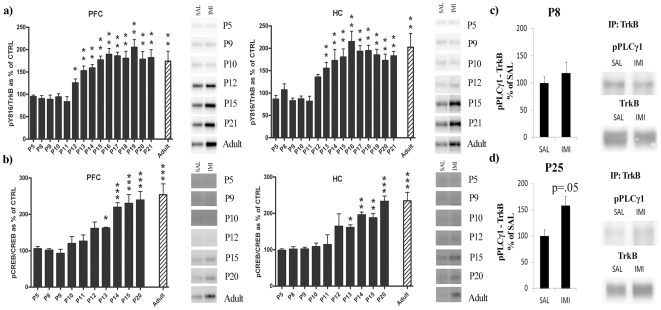
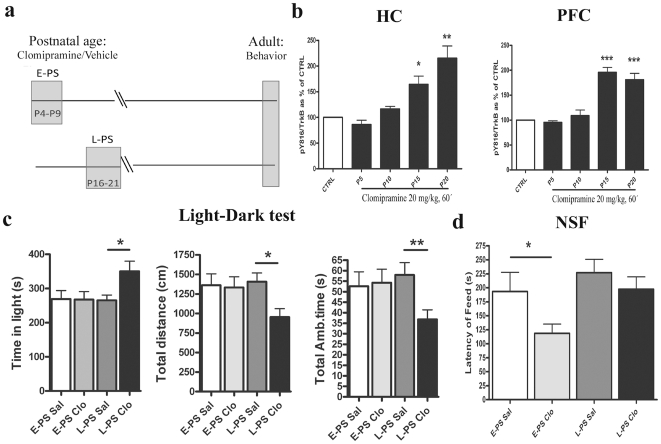
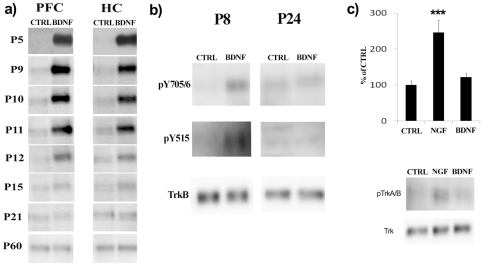
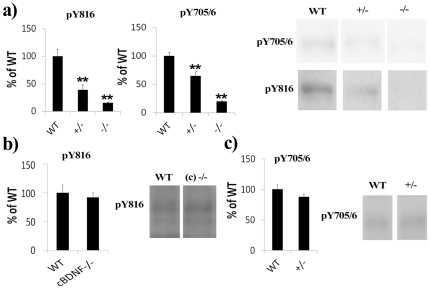
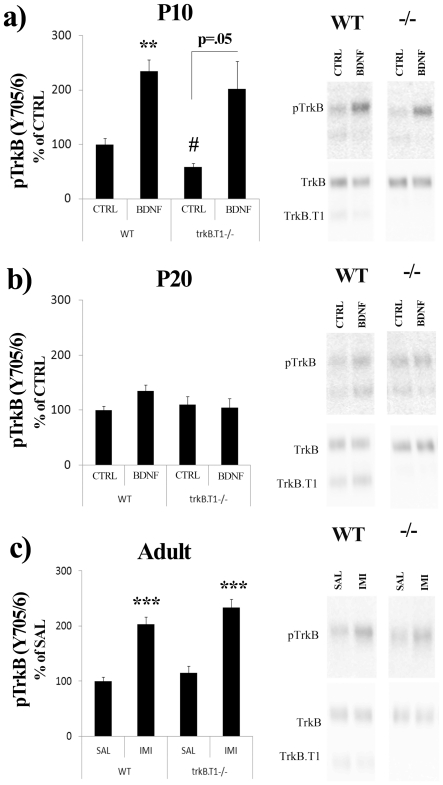
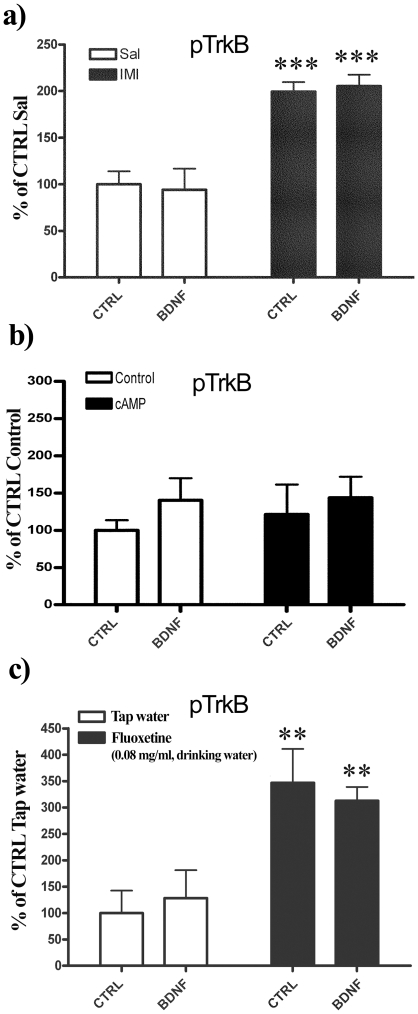
We found that ADs fail to induce TrkB signalling before postnatal day 12 (P12) after which an adult response of TrkB to ADs was observed. Interestingly, there was a temporally inverse correlation between the appearance of the responsiveness of TrkB to systemic ADs and the marked developmental reduction of BDNF-induced TrkB in brain microslices ex vivo. Basal p-TrkB status in the brain of BDNF deficient mice was significantly reduced only during early postnatal period. Enhancing cAMP (cyclic adenosine monophosphate) signalling failed to facilitate TrkB responsiveness to BDNF. Reduced responsiveness of TrkB to BDNF was not produced by the developmental increase in the expression of dominant-negative truncated TrkB.T1 because this reduction was similarly observed in the brain microslices of trkB.T1(-/-) mice. Moreover, postnatal AD administration produced long-lasting behavioural alterations observable in adult mice, but the responses were different when mice were treated during the time when ADs did not (P4-9) or did (P16-21) activate TrkB.
We have found that ADs induce the activation of TrkB only in mice older than 2 weeks and that responsiveness of brain microslices to BDNF is reduced during the same time period. Exposure to ADs before and after the age when ADs activate TrkB produces differential long-term behavioural responses in adult mice.
先前的研究表明,在大鼠中,TrkB 受体对 BDNF 的反应性受到发育的调节。抗抑郁药 (AD) 已被证明可增加成年啮齿动物大脑中的 TrkB 信号,最近的研究结果表明,这种现象背后存在一种 BDNF 非依赖性机制。在生命早期给予 AD 会产生持久的生化和行为改变,这些改变在成年动物中观察到。
我们在这里检查了 AD 在生命早期对小鼠大脑 TrkB 受体的反应性,以 TrkB 的自身磷酸化 (pTrkB) 作为衡量标准。
我们发现 AD 在出生后第 12 天 (P12) 之前不能诱导 TrkB 信号,之后观察到 AD 对 TrkB 的成人反应。有趣的是,AD 对系统的反应性出现的时间与脑切片中体外 BDNF 诱导的 TrkB 的明显发育性减少之间存在时间上的反向相关性。BDNF 缺陷小鼠大脑中的基础 p-TrkB 状态仅在生命早期显著降低。增强 cAMP(环磷酸腺苷)信号未能促进 TrkB 对 BDNF 的反应性。BDNF 诱导的 TrkB 反应性降低不是由表达显性负截断 TrkB.T1 的发育性增加引起的,因为这种降低在 trkB.T1(-/-) 小鼠的脑切片中也观察到。此外,AD 在生命后期的给药会导致成年小鼠出现持久的行为改变,但当小鼠在 AD 不激活 TrkB 的时间(P4-9)或激活 TrkB 的时间(P16-21)接受治疗时,反应是不同的。
我们发现 AD 仅在 2 周以上的小鼠中诱导 TrkB 的激活,并且在此期间大脑切片对 BDNF 的反应性降低。在 AD 激活 TrkB 前后暴露于 AD 会在成年小鼠中产生不同的长期行为反应。