Department of Chemistry and Chemical Biology, Rutgers, The State University of New Jersey, 610 Taylor Road, Piscataway, New Jersey 08854, USA.
J Am Chem Soc. 2012 Apr 4;134(13):6033-44. doi: 10.1021/ja3010896. Epub 2012 Mar 23.
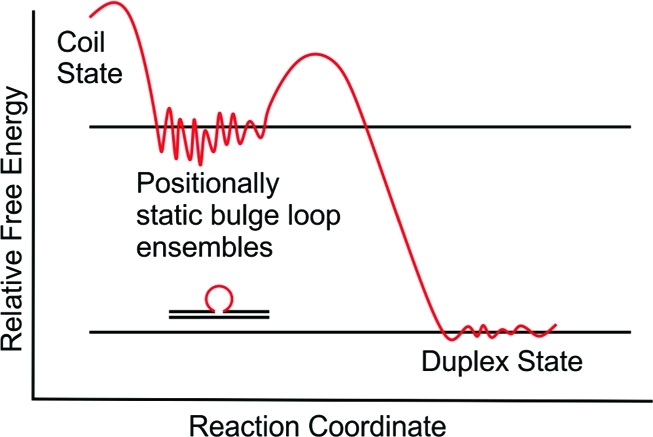
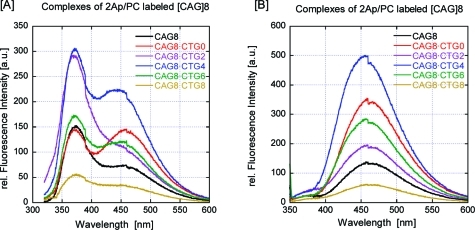
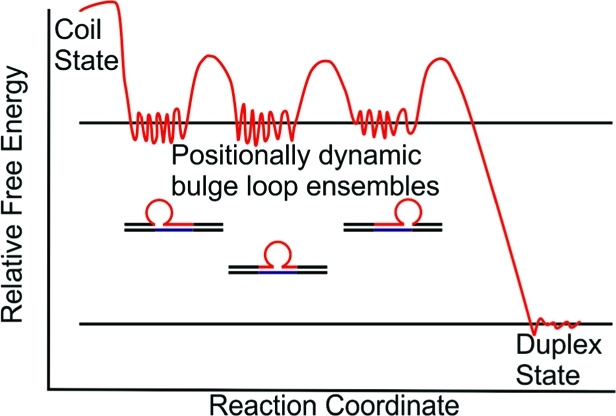
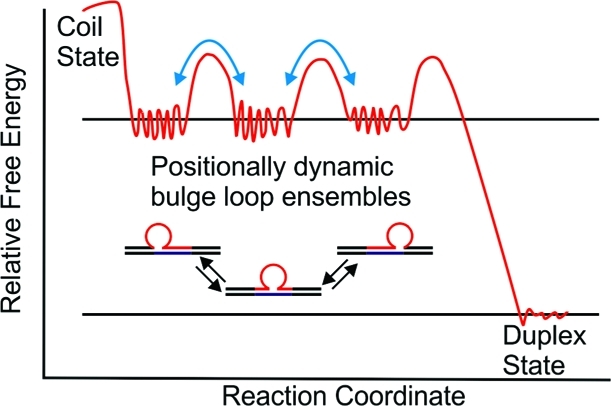
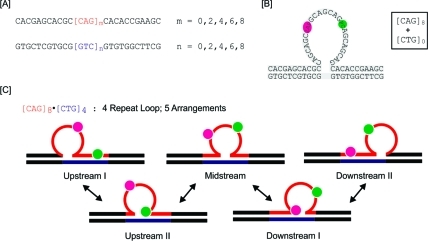
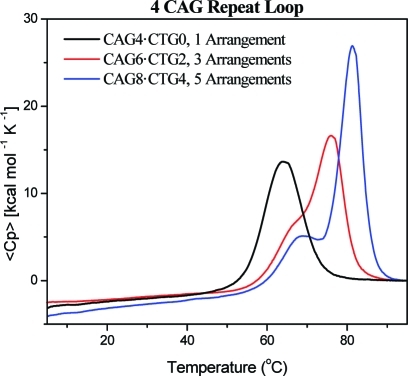
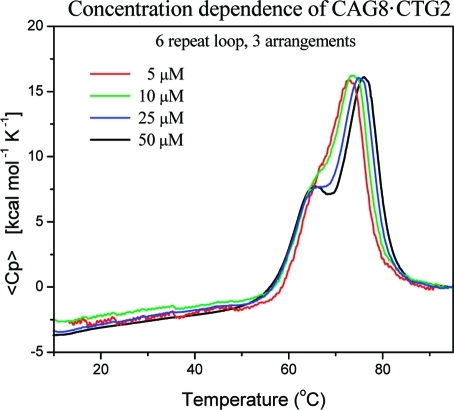
DNA repeat domains can form ensembles of canonical and noncanonical states, including stable and metastable DNA secondary structures. Such sequence-induced structural diversity creates complex conformational landscapes for DNA processing pathways, including those triplet expansion events that accompany replication, recombination, and/or repair. Here we demonstrate further levels of conformational complexity within repeat domains. Specifically, we show that bulge loop structures within an extended repeat domain can form dynamic ensembles containing a distribution of loop positions, thereby yielding families of positional loop isomers, which we designate as "rollamers". Our fluorescence, absorbance, and calorimetric data are consistent with loop migration/translocation between sites within the repeat domain ("rollamerization"). We demonstrate that such "rollameric" migration of bulge loops within repeat sequences can invade and disrupt previously formed base-paired domains via an isoenthalpic, entropy-driven process. We further demonstrate that destabilizing abasic lesions alter the loop distributions so as to favor "rollamers" with the lesion positioned at the duplex/loop junction, sites where the flexibility of the abasic "universal hinge" relaxes unfavorable interactions and/or facilitates topological accommodation. Another strategic siting of an abasic site induces directed loop migration toward denaturing domains, a phenomenon that merges destabilizing domains. In the aggregate, our data reveal that dynamic ensembles within repeat domains profoundly impact the overall energetics of such DNA constructs as well as the distribution of states by which they denature/renature. These static and dynamic influences within triplet repeat domains expand the conformational space available for selection and targeting by the DNA processing machinery. We propose that such dynamic ensembles and their associated impact on DNA properties influence pathways that lead to DNA expansion.
DNA 重复结构域可以形成包括稳定和亚稳定 DNA 二级结构在内的规范和非规范状态的集合。这种序列诱导的结构多样性为 DNA 加工途径创建了复杂的构象景观,包括伴随复制、重组和/或修复的三核苷酸扩展事件。在这里,我们展示了重复结构域内进一步的构象复杂性。具体来说,我们表明,扩展重复结构域中的凸起环结构可以形成包含环位置分布的动态集合,从而产生位置环异构体的家族,我们将其命名为“rollamers”。我们的荧光、吸收和量热数据与重复结构域内环位置的迁移/易位一致(“rollamerization”)。我们证明,重复序列中凸起环的这种“rollameric”迁移可以通过等焓、熵驱动的过程侵入和破坏先前形成的碱基配对结构域。我们进一步证明,不稳定的脱碱基损伤改变了环分布,从而有利于在双链体/环接头处具有损伤的“rollamers”,脱碱基的“通用铰链”的灵活性放松了不利相互作用并/或促进拓扑适应。碱基缺失损伤的另一个策略性定位会诱导凸起环向变性结构域的定向迁移,这一现象融合了不稳定的结构域。总的来说,我们的数据揭示了重复结构域内的动态集合对这些 DNA 结构的整体能量以及它们变性/复性的状态分布产生深远影响。这些三核苷酸重复结构域内的静态和动态影响扩展了可供 DNA 处理机制选择和靶向的构象空间。我们提出,这种动态集合及其对 DNA 性质的影响会影响导致 DNA 扩展的途径。