• 文献检索
  • 文档翻译
  • 深度研究
  • 学术资讯
  • Suppr Zotero 插件Zotero 插件
  • 邀请有礼
  • 套餐&价格
  • 历史记录
应用&插件
Suppr Zotero 插件Zotero 插件浏览器插件Mac 客户端Windows 客户端微信小程序
定价
高级版会员购买积分包购买API积分包
服务
文献检索文档翻译深度研究API 文档MCP 服务
关于我们
关于 Suppr公司介绍联系我们用户协议隐私条款
关注我们

Suppr 超能文献

核心技术专利:CN118964589B侵权必究
粤ICP备2023148730 号-1Suppr @ 2026

文献检索

告别复杂PubMed语法,用中文像聊天一样搜索,搜遍4000万医学文献。AI智能推荐,让科研检索更轻松。

立即免费搜索

文件翻译

保留排版,准确专业,支持PDF/Word/PPT等文件格式,支持 12+语言互译。

免费翻译文档

深度研究

AI帮你快速写综述,25分钟生成高质量综述,智能提取关键信息,辅助科研写作。

立即免费体验

基于 CMAC 神经网络的危险气味识别。

Hazardous Odor Recognition by CMAC Based Neural Networks.

机构信息

Computer Engineering Department, Engineering Faculty, Fatih University, 34500, Istanbul, Turkey.

出版信息

Sensors (Basel). 2009;9(9):7308-19. doi: 10.3390/s90907308. Epub 2009 Sep 11.

DOI:10.3390/s90907308
PMID:22399997
原文链接:https://pmc.ncbi.nlm.nih.gov/articles/PMC3290512/
Abstract

Electronic noses are being developed as systems for the automated detection and classification of odors, vapors, and gases. Artificial neural networks (ANNs) have been used to analyze complex data and to recognize patterns, and have shown promising results in recognition of volatile compounds and odors in electronic nose applications. When an ANN is combined with a sensor array, the number of detectable chemicals is generally greater than the number of unique sensor types. The odor sensing system should be extended to new areas since its standard style where the output pattern from multiple sensors with partially overlapped specificity is recognized by a neural network or multivariate analysis. This paper describes the design, implementation and performance evaluations of the application developed for hazardous odor recognition using Cerebellar Model Articulation Controller (CMAC) based neural networks.

摘要

电子鼻被开发为用于自动检测和分类气味、蒸气和气体的系统。人工神经网络 (ANN) 已被用于分析复杂数据和识别模式,并在电子鼻应用中识别挥发性化合物和气味方面显示出有前途的结果。当 ANN 与传感器阵列结合使用时,可检测到的化学物质的数量通常大于独特传感器类型的数量。由于其标准样式,即通过神经网络或多元分析识别具有部分重叠特异性的多个传感器的输出模式,因此应该将气味感测系统扩展到新的领域。本文描述了使用基于小脑模型关节控制器 (CMAC) 的神经网络开发的危险气味识别应用程序的设计、实现和性能评估。
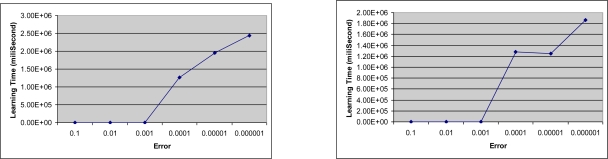
https://cdn.ncbi.nlm.nih.gov/pmc/blobs/b338/3290512/bc13b807809a/sensors-09-07308f8.jpg
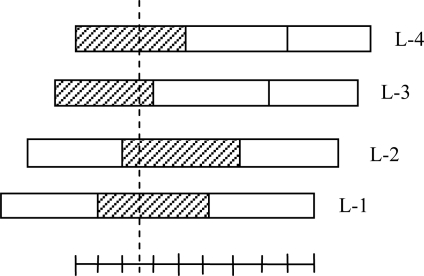
https://cdn.ncbi.nlm.nih.gov/pmc/blobs/b338/3290512/9651d8a22c3e/sensors-09-07308f1.jpg
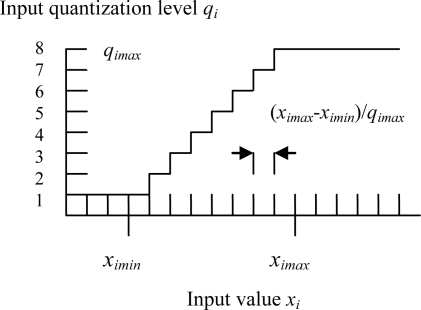
https://cdn.ncbi.nlm.nih.gov/pmc/blobs/b338/3290512/b12bc29678b6/sensors-09-07308f2.jpg
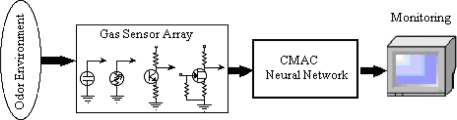
https://cdn.ncbi.nlm.nih.gov/pmc/blobs/b338/3290512/aaca241ab5cf/sensors-09-07308f3.jpg
https://cdn.ncbi.nlm.nih.gov/pmc/blobs/b338/3290512/204d005c394c/sensors-09-07308f4.jpg
https://cdn.ncbi.nlm.nih.gov/pmc/blobs/b338/3290512/b6ab106b816f/sensors-09-07308f5.jpg
https://cdn.ncbi.nlm.nih.gov/pmc/blobs/b338/3290512/9324bda80d08/sensors-09-07308f6.jpg
https://cdn.ncbi.nlm.nih.gov/pmc/blobs/b338/3290512/2ebccf295356/sensors-09-07308f7.jpg
https://cdn.ncbi.nlm.nih.gov/pmc/blobs/b338/3290512/bc13b807809a/sensors-09-07308f8.jpg
https://cdn.ncbi.nlm.nih.gov/pmc/blobs/b338/3290512/9651d8a22c3e/sensors-09-07308f1.jpg
https://cdn.ncbi.nlm.nih.gov/pmc/blobs/b338/3290512/b12bc29678b6/sensors-09-07308f2.jpg
https://cdn.ncbi.nlm.nih.gov/pmc/blobs/b338/3290512/aaca241ab5cf/sensors-09-07308f3.jpg
https://cdn.ncbi.nlm.nih.gov/pmc/blobs/b338/3290512/204d005c394c/sensors-09-07308f4.jpg
https://cdn.ncbi.nlm.nih.gov/pmc/blobs/b338/3290512/b6ab106b816f/sensors-09-07308f5.jpg
https://cdn.ncbi.nlm.nih.gov/pmc/blobs/b338/3290512/9324bda80d08/sensors-09-07308f6.jpg
https://cdn.ncbi.nlm.nih.gov/pmc/blobs/b338/3290512/2ebccf295356/sensors-09-07308f7.jpg
https://cdn.ncbi.nlm.nih.gov/pmc/blobs/b338/3290512/bc13b807809a/sensors-09-07308f8.jpg

相似文献

1
Hazardous Odor Recognition by CMAC Based Neural Networks.基于 CMAC 神经网络的危险气味识别。
Sensors (Basel). 2009;9(9):7308-19. doi: 10.3390/s90907308. Epub 2009 Sep 11.
2
Engineering Aspects of Olfaction嗅觉的工程学方面
3
The Synthetic Moth: A Neuromorphic Approach toward Artificial Olfaction in Robots合成蛾:一种用于机器人人工嗅觉的神经形态方法
4
Odor Recognition with a Spiking Neural Network for Bioelectronic Nose.基于尖峰神经网络的生物电子鼻气味识别
Sensors (Basel). 2019 Feb 26;19(5):993. doi: 10.3390/s19050993.
5
Hierarchically clustered adaptive quantization CMAC and its learning convergence.分层聚类自适应量化小脑模型关节控制器及其学习收敛性
IEEE Trans Neural Netw. 2007 Nov;18(6):1658-82. doi: 10.1109/TNN.2007.900810.
6
Meat quality assessment by electronic nose (machine olfaction technology).电子鼻(机器嗅觉技术)进行的肉品质评估。
Sensors (Basel). 2009;9(8):6058-83. doi: 10.3390/s90806058. Epub 2009 Jul 30.
7
Gas Recognition in E-Nose System: A Review.电子鼻系统中的气体识别:综述。
IEEE Trans Biomed Circuits Syst. 2022 Apr;16(2):169-184. doi: 10.1109/TBCAS.2022.3166530. Epub 2022 May 19.
8
Chlorophenols identification in water using an electronic nose and ANNs (artificial neural networks) classification.利用电子鼻和人工神经网络分类法识别水中的氯酚
Water Sci Technol. 2004;49(9):99-105.
9
Detection and classification of human body odor using an electronic nose.使用电子鼻检测和分类人体气味。
Sensors (Basel). 2009;9(9):7234-49. doi: 10.3390/s90907234. Epub 2009 Sep 9.
10
FCMAC-Yager: a novel Yager-inference-scheme-based fuzzy CMAC.FCMAC-Yager:一种基于Yager推理方案的新型模糊小脑模型关节控制器
IEEE Trans Neural Netw. 2006 Nov;17(6):1394-410. doi: 10.1109/TNN.2006.880362.

引用本文的文献

1
Pattern classification using an olfactory model with PCA feature selection in electronic noses: study and application.基于 PCA 特征选择的电子鼻嗅觉模型的模式分类:研究与应用。
Sensors (Basel). 2012;12(3):2818-30. doi: 10.3390/s120302818. Epub 2012 Mar 1.
2
Electronic nose based on an optimized competition neural network.基于优化竞争神经网络的电子鼻。
Sensors (Basel). 2011;11(5):5005-19. doi: 10.3390/s110505005. Epub 2011 May 4.

本文引用的文献

1
Fuzzy clustering neural networks for real-time odor recognition system.用于实时气味识别系统的模糊聚类神经网络。
J Autom Methods Manag Chem. 2007;2007:38405. doi: 10.1155/2007/38405.
2
Learning convergence of CMAC technique.小脑模型关节控制器(CMAC)技术的学习收敛性
IEEE Trans Neural Netw. 1997;8(6):1281-92. doi: 10.1109/72.641451.