Department of Radiation Physics and The University of Texas Graduate School of Biomedical Sciences at Houston, The University of Texas MD Anderson Cancer Center, 1515 Holcombe Blvd, Houston, TX 77030, USA.
J Appl Clin Med Phys. 2012 Mar 8;13(2):3707. doi: 10.1120/jacmp.v13i2.3707.
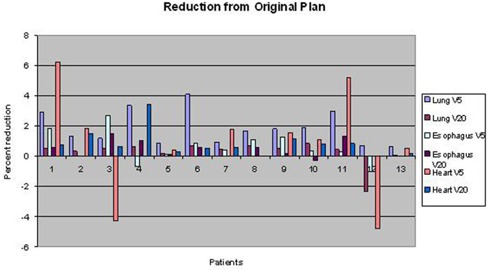
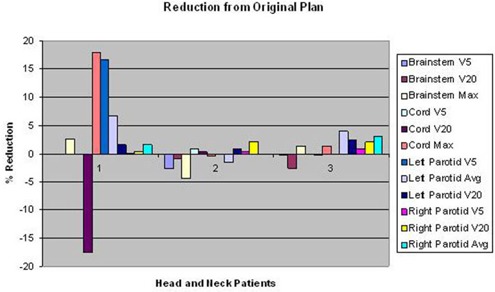
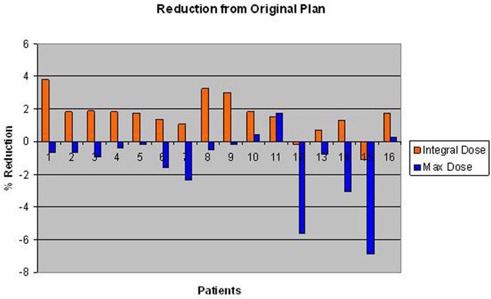
The purpose of this work was to determine the dosimetric benefit to normal tissues by tracking the multi-leaf collimator (MLC) apertures with the photon jaws in step-and-shoot intensity-modulated radiation therapy (IMRT) on the Varian 2100 platform. Radiation treatment plans for ten thoracic, three pediatric, and three head and neck cancer patients were converted to plans with the jaws tracking each segment's MLC apertures, and compared to the original plans in a commercial radiation treatment planning system (TPS). The change in normal tissue dose was evaluated in the new plan by using the parameters V5, V10, and V20 (volumes receiving 5, 10 and 20 Gy, respectively) in the cumulative dose-volume histogram for the following structures: total lung minus gross target volume, heart, esophagus, spinal cord, liver, parotids, and brainstem. To validate the accuracy of our beam model, MLC transmission was measured and compared to that predicted by the TPS. The greatest changes between the original and new plans occurred at lower dose levels. In all patients, the reduction in V20 was never more than 6.3% and was typically less than 1%; the maximum reduction in V5 was 16.7% and was typically less than 3%. The variation in normal tissue dose reduction was not predictable, and we found no clear parameters that indicated which patients would benefit most from jaw tracking. Our TPS model of MLC transmission agreed with measurements with absolute transmission differences of less than 0.1% and, thus, uncertainties in the model did not contribute significantly to the uncertainty in the dose determination. We conclude that the amount of dose reduction achieved by collimating the jaws around each MLC aperture in step-and-shoot IMRT is probably not clinically significant.
本研究旨在通过在瓦里安 2100 平台上使用光子机架跟踪多叶准直器(MLC)射野的步进式调强放疗(step-and-shoot IMRT),确定跟踪多叶准直器(MLC)射野对正常组织的剂量学益处。将 10 例胸部、3 例儿科和 3 例头颈部癌症患者的放疗计划转换为用机架跟踪每个射野的 MLC 射野的计划,并在商业放疗计划系统(TPS)中与原始计划进行比较。通过在累积剂量-体积直方图中使用 V5、V10 和 V20(分别表示接收 5、10 和 20Gy 的体积)参数,评估新计划中正常组织剂量的变化,这些参数来自以下结构:全肺减去大体肿瘤靶区、心脏、食管、脊髓、肝脏、腮腺和脑干。为了验证我们束流模型的准确性,测量了 MLC 透射并与 TPS 预测值进行了比较。原始计划和新计划之间的最大变化发生在较低的剂量水平。在所有患者中,V20 的减少从未超过 6.3%,通常小于 1%;V5 的最大减少为 16.7%,通常小于 3%。正常组织剂量减少的变化不可预测,我们没有发现明确的参数表明哪些患者将从机架跟踪中获益最大。我们的 MLC 透射 TPS 模型与测量值一致,绝对透射差异小于 0.1%,因此,模型中的不确定性不会对剂量确定的不确定性产生显著影响。我们的结论是,在步进式调强放疗中,用机架围绕每个 MLC 射野准直可能不会显著减少剂量。