El Rawas Rana, Klement Sabine, Salti Ahmad, Fritz Michael, Dechant Georg, Saria Alois, Zernig Gerald
Experimental Psychiatry Unit, Center for Psychiatry and Psychotherapy, Medical University Innsbruck Innsbruck, Austria.
Front Behav Neurosci. 2012 Mar 2;6:8. doi: 10.3389/fnbeh.2012.00008. eCollection 2012.
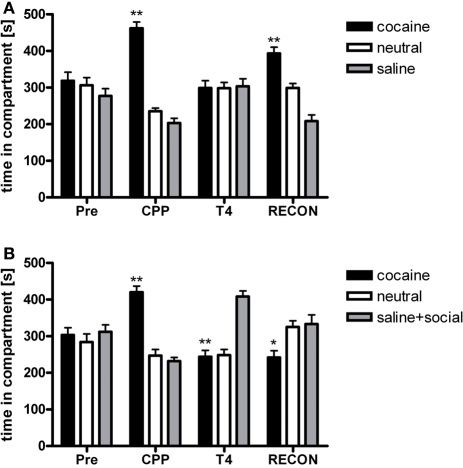
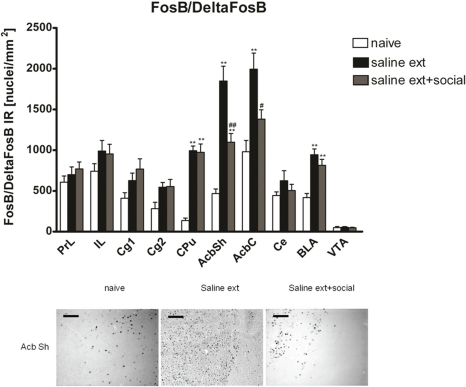
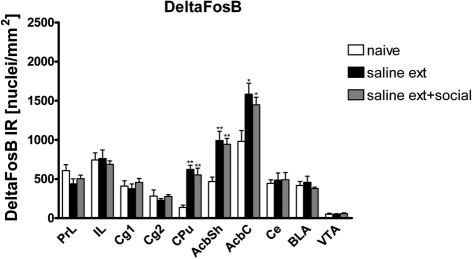
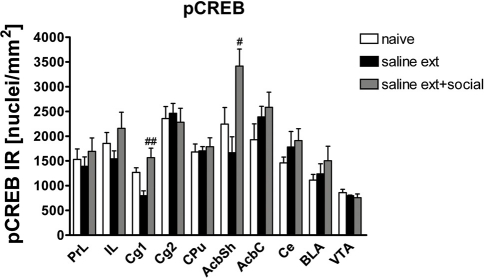
The worsening of drug abuse by drug-associated social interaction is a well-studied phenomenon. In contrast, the molecular mechanisms of the beneficial effect of social interaction, if offered as a mutually exclusive choice to drugs of abuse, are under-investigated. In a rat place preference conditioning (CPP) paradigm, four 15 min episodes of social interaction with a gender- and weight-matched male early-adult conspecific inhibited cocaine-induced reinstatement of cocaine CPP, a model of relapse. These protective effects of social interaction were paralleled by a reduced activation, as assessed by Zif268 expression, in brain areas known to play pivotal roles in drug-seeking behavior. Here we show that social interaction during extinction of cocaine CPP also reduced cocaine-CPP-stimulated FosB expression in the nucleus accumbens shell and core. In addition, social interaction during cocaine CPP extinction increased pCREB (cAMP response element binding protein) expression in the nucleus accumbens shell and the cingulate cortex area 1 (Cg1). Our results show that FosB and pCREB may be implicated in the protective effect of social interaction against cocaine-induced reinstatement of CPP. Thus, social interaction, if offered in a context that is clearly distinct from the previously drug-associated one, may profoundly inhibit relapse to cocaine addiction.
药物相关社交互动导致药物滥用情况恶化是一个已得到充分研究的现象。相比之下,若将社交互动作为滥用药物的一种相互排斥的选择,其有益作用的分子机制却研究不足。在大鼠位置偏爱条件反射(CPP)范式中,与性别和体重匹配的成年早期同种雄性大鼠进行4次每次15分钟的社交互动,可抑制可卡因诱导的可卡因CPP恢复,这是一种复发模型。社交互动的这些保护作用与通过Zif268表达评估的、在寻求药物行为中起关键作用的脑区激活减少相平行。在此我们表明,可卡因CPP消退期间的社交互动也降低了伏隔核壳部和核心中可卡因-CPP刺激的FosB表达。此外,可卡因CPP消退期间的社交互动增加了伏隔核壳部和扣带皮层1区(Cg1)中pCREB(环磷酸腺苷反应元件结合蛋白)的表达。我们的结果表明,FosB和pCREB可能与社交互动对可卡因诱导的CPP恢复的保护作用有关。因此,如果在与先前药物相关情境明显不同的背景下提供社交互动,可能会显著抑制可卡因成瘾的复发。