Kool Mirjam, Hammad Hamida, Lambrecht Bart N
F1000 Biol Rep. 2012;4:6. doi: 10.3410/B4-6. Epub 2012 Mar 1.
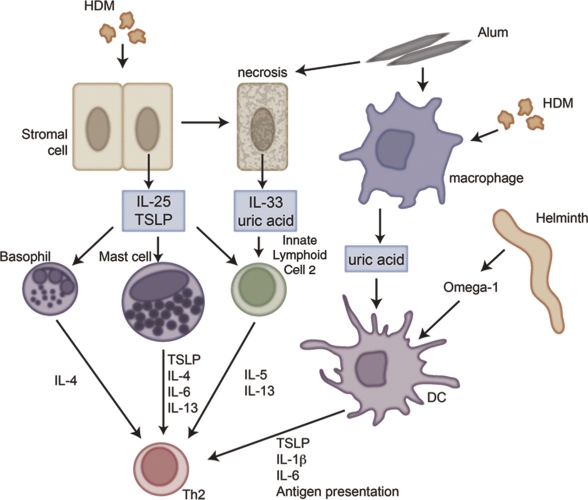
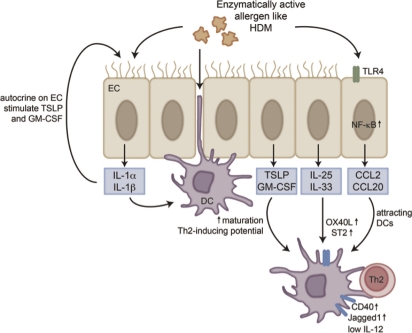
In contrast to the development of Th1 (type 1 T helper cells), Th17 and Treg (regulatory T cells), little is known of the mechanisms governing Th2 development, which is important for immunity to helminths and for us to understand the pathogenesis of allergy. A picture is emerging in which mucosal epithelial cells instruct dendritic cells to promote Th2 responses in the absence of IL-12 (interleukin 12) production and provide instruction through thymic stromal lymphopoieitin (TSLP) or granulocyte-macrophage colony stimulating factor (GM-CSF). At the same time, allergens, helminths and chemical adjuvants elicit the response of innate immune cells like basophils, which provide more polarizing cytokines and IL-4 and reinforce Th2 immunity. This unique communication between cells will only be fully appreciated if we study Th2 immunity in vivo and in a tissue-specific context, and can only be fully understood if we compare several models of Th2 immune response induction.
与Th1(1型辅助性T细胞)、Th17和Treg(调节性T细胞)的发育情况相比,目前对于调控Th2发育的机制了解甚少,而Th2发育对于抵抗蠕虫免疫以及我们理解过敏发病机制都很重要。一幅图景正在浮现,即黏膜上皮细胞在不产生白细胞介素12(IL-12)的情况下指导树突状细胞促进Th2反应,并通过胸腺基质淋巴细胞生成素(TSLP)或粒细胞-巨噬细胞集落刺激因子(GM-CSF)提供指导。同时,过敏原、蠕虫和化学佐剂引发嗜碱性粒细胞等天然免疫细胞的反应,这些细胞会提供更多极化细胞因子和IL-4并增强Th2免疫。只有当我们在体内和组织特异性背景下研究Th2免疫时,这种细胞间独特的交流才能得到充分认识,并且只有当我们比较几种Th2免疫反应诱导模型时,才能完全理解它。