Division of Molecular Pathology, Institute of Cancer Research, Sutton, UK.
Nat Med. 2012 Mar 11;18(4):605-11. doi: 10.1038/nm.2661.
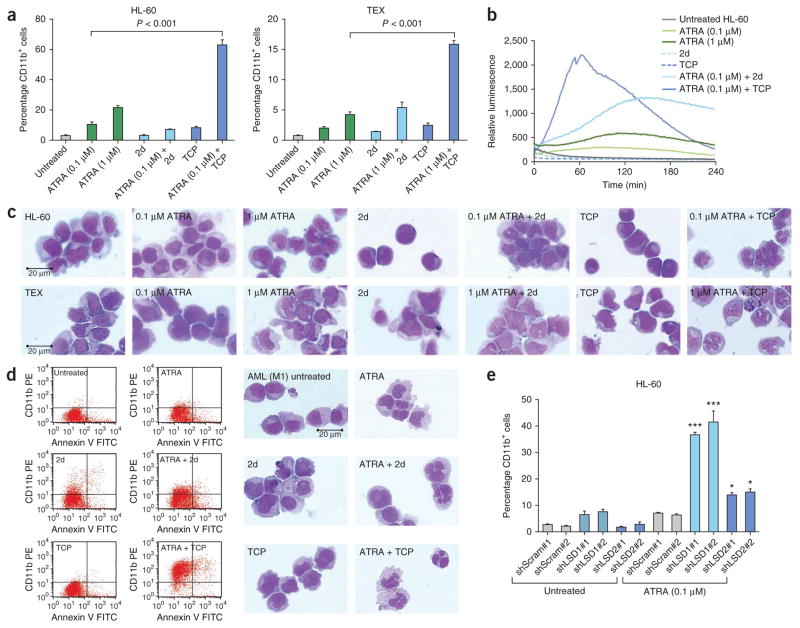
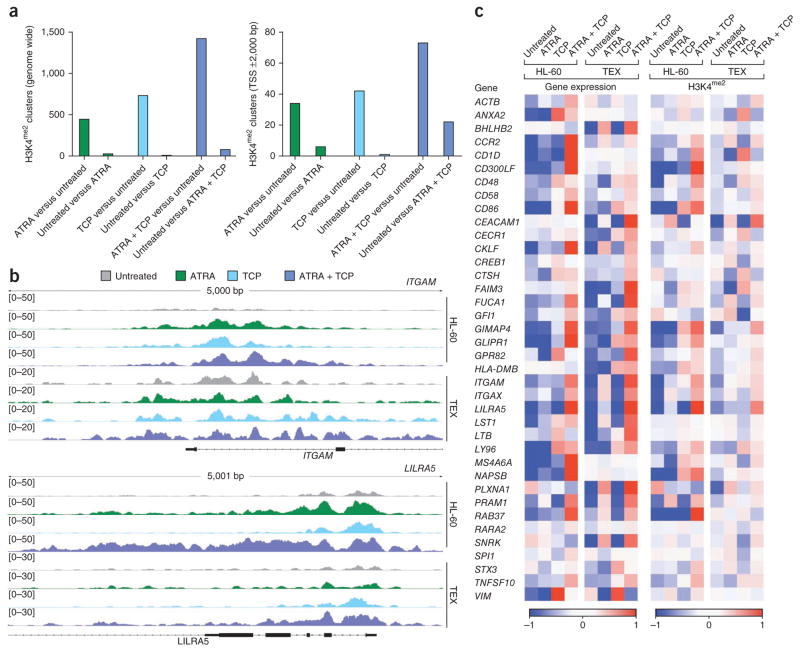
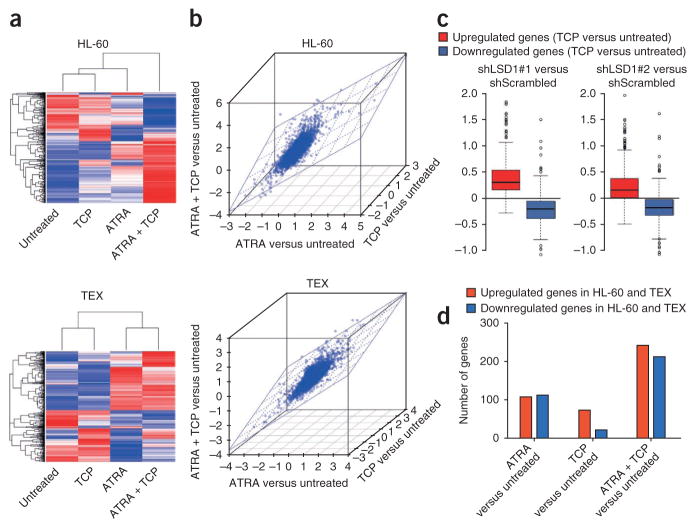
Acute promyelocytic leukemia (APL), a cytogenetically distinct subtype of acute myeloid leukemia (AML), characterized by the t(15;17)-associated PML-RARA fusion, has been successfully treated with therapy utilizing all-trans-retinoic acid (ATRA) to differentiate leukemic blasts. However, among patients with non-APL AML, ATRA-based treatment has not been effective. Here we show that, through epigenetic reprogramming, inhibitors of lysine-specific demethylase 1 (LSD1, also called KDM1A), including tranylcypromine (TCP), unlocked the ATRA-driven therapeutic response in non-APL AML. LSD1 inhibition did not lead to a large-scale increase in histone 3 Lys4 dimethylation (H3K4(me2)) across the genome, but it did increase H3K4(me2) and expression of myeloid-differentiation-associated genes. Notably, treatment with ATRA plus TCP markedly diminished the engraftment of primary human AML cells in vivo in nonobese diabetic (NOD)-severe combined immunodeficient (SCID) mice, suggesting that ATRA in combination with TCP may target leukemia-initiating cells. Furthermore, initiation of ATRA plus TCP treatment 15 d after engraftment of human AML cells in NOD-SCID γ (with interleukin-2 (IL-2) receptor γ chain deficiency) mice also revealed the ATRA plus TCP drug combination to have a potent anti-leukemic effect that was superior to treatment with either drug alone. These data identify LSD1 as a therapeutic target and strongly suggest that it may contribute to AML pathogenesis by inhibiting the normal pro-differentiative function of ATRA, paving the way for new combinatorial therapies for AML.
急性早幼粒细胞白血病(APL)是一种具有独特细胞遗传学特征的急性髓细胞白血病(AML)亚型,其特征是存在 t(15;17)相关的 PML-RARA 融合,已成功采用全反式维甲酸(ATRA)治疗来分化白血病细胞。然而,在非 APL AML 患者中,基于 ATRA 的治疗并未有效。在这里,我们表明,通过表观遗传重编程,组蛋白赖氨酸特异性去甲基化酶 1(LSD1,也称为 KDM1A)抑制剂,包括曲马司汀(TCP),可以解锁非 APL AML 中 ATRA 驱动的治疗反应。LSD1 抑制不会导致基因组范围内组蛋白 3 赖氨酸 4 二甲基化(H3K4(me2))的大规模增加,但它确实增加了 H3K4(me2)和髓系分化相关基因的表达。值得注意的是,ATRA 加 TCP 治疗明显减少了非肥胖型糖尿病(NOD)-严重联合免疫缺陷(SCID)小鼠体内原发性人 AML 细胞的植入,表明 ATRA 联合 TCP 可能靶向白血病起始细胞。此外,在 NOD-SCID γ(IL-2 受体 γ 链缺陷)小鼠中植入人 AML 细胞后 15 天开始 ATRA 加 TCP 治疗也显示出 ATRA 加 TCP 药物联合具有强大的抗白血病作用,优于单独使用任何一种药物的治疗效果。这些数据将 LSD1 鉴定为治疗靶点,并强烈表明它可能通过抑制 ATRA 的正常促分化功能来促进 AML 的发病机制,为 AML 的新组合疗法铺平了道路。