Department of Psychology, Vanderbilt University, Nashville, TN 37240-7817, USA.
Eur J Phys Rehabil Med. 2012 Jun;48(2):299-306. Epub 2012 Mar 12.
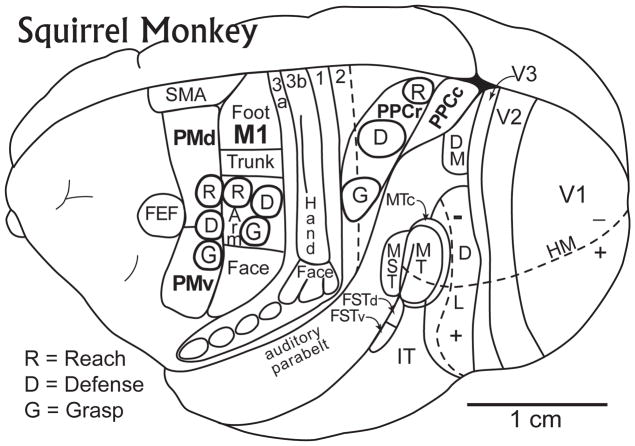
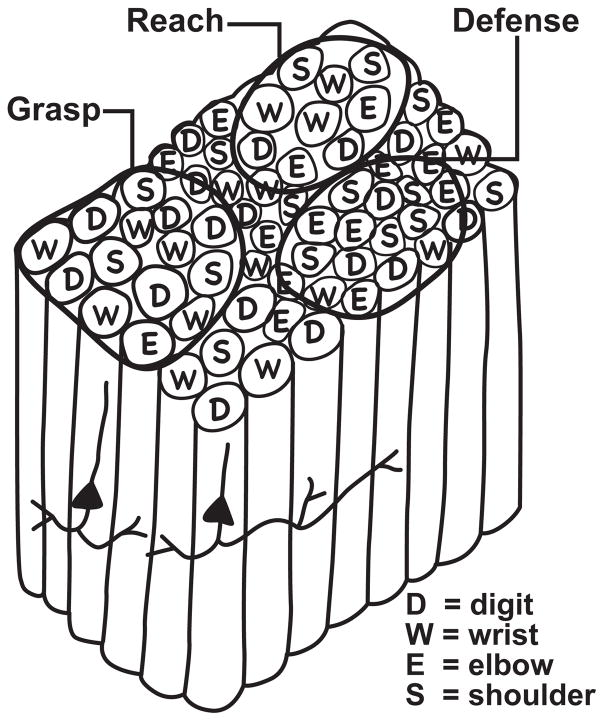
In all primates, the cortical control of hand and arm movements is initiated and controlled by a network of cortical regions including primary motor cortex (M1), premotor cortex (PMC), and posterior parietal cortex (PPC). These interconnected regions are influenced by inputs from especially visual and somatosensory cortical areas, and prefrontal cortex. Here we discuss recent evidence showing M1, PMC, and PPC can be subdivided into a number of functional zones or domains, including several that participate in guiding and controlling hand and arm movements. Functional zones can be defined by the movement sequences evoked by microstimulation within them, and functional zones related to the same type of movement in all three cortical regions are interconnected. The inactivation of a functional zone in each of the regions has a different impact on motor behavior. Finally, there is considerable plasticity within the networks so that behavioral recoveries can occur after damage to functional zones within a network.
在所有灵长类动物中,手部和手臂运动的皮质控制是由包括初级运动皮层(M1)、运动前皮层(PMC)和顶后皮层(PPC)在内的皮质区域网络发起和控制的。这些相互连接的区域受到来自视觉和躯体感觉皮质区域以及前额叶皮层的输入的影响。在这里,我们讨论了最近的证据表明,M1、PMC 和 PPC 可以细分为许多功能区或域,包括几个参与指导和控制手部和手臂运动的功能区。功能区可以通过在其中进行微刺激引起的运动序列来定义,并且与三个皮质区域中相同类型运动相关的功能区是相互连接的。每个区域中的一个功能区的失活对运动行为有不同的影响。最后,网络内有相当大的可塑性,因此在网络内的功能区受损后可以进行行为恢复。