Department of Nutritional Sciences, Room 350, University of Toronto, 150 College St, Toronto, ON, M5S 3E2, Canada.
Genes Nutr. 2012 Oct;7(4):559-66. doi: 10.1007/s12263-012-0290-x. Epub 2012 Mar 11.
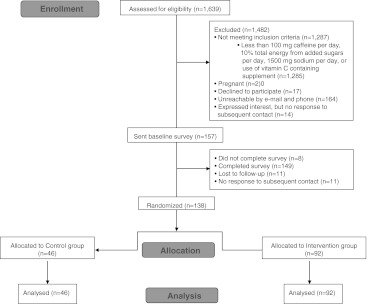
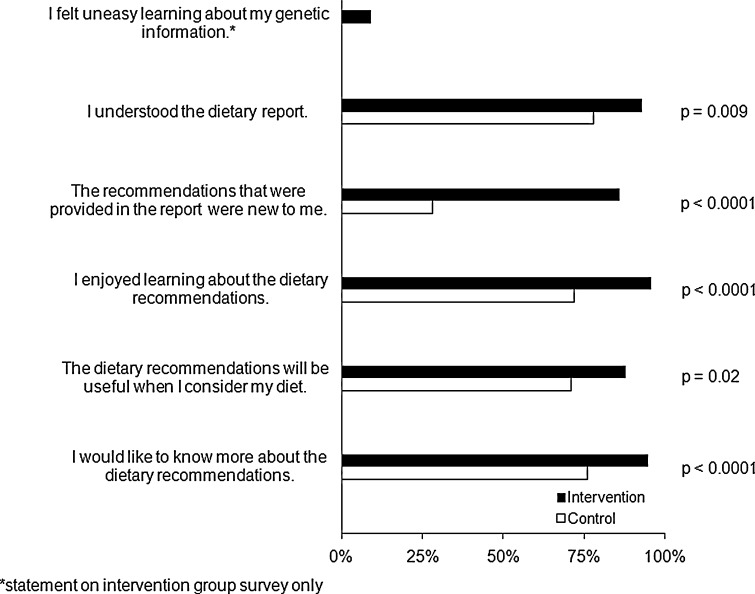
Personal genetic information has become increasingly accessible to the public as a result of direct-to-consumer (DTC) genetic tests; however, concerns have been raised over their value and potential risks. We compared the effects of providing genotype-based dietary advice with general recommendations on behavioral outcomes using a randomized controlled study. Participants were men and women from the Toronto Nutrigenomics and Health Study between the ages of 20-35 years (n = 149) who completed a survey to assess their awareness of DTC genetic tests and nutrigenomics, as well as potential motivations for undergoing genetic testing. Participants were then randomized into an intervention (I) or control (C) group and were given either genotype-based personalized dietary advice or general dietary advice, respectively. A second survey was administered to assess the participants' opinions of the dietary reports they received. A greater proportion of participants in the intervention group agreed that they understood the dietary advice they were given (93% (I) vs. 78% (C); p = 0.009). Participants in the intervention group were more likely to agree that the dietary recommendations they received would be useful when considering their diet (88% (I) vs. 72% (C); p = 0.02) and wanted to know more about the recommendations (95% (I) vs. 76% (C); p < 0.0001). Only 9% of participants in the intervention group reported feeling uneasy about learning their genetic information. These findings suggest that individuals find dietary recommendations based on genetics more understandable and more useful than general dietary advice. Very few feel uneasy about receiving their genetic information that relates to personalized nutrition.
由于直接面向消费者(DTC)的基因检测,个人遗传信息越来越容易被公众获取;然而,人们对其价值和潜在风险表示担忧。我们通过一项随机对照研究比较了基于基因型的饮食建议与一般行为建议对行为结果的影响。参与者为年龄在 20-35 岁之间的多伦多营养基因组学与健康研究中的男性和女性(n=149),他们完成了一项调查,以评估他们对 DTC 基因检测和营养基因组学的认识,以及进行基因检测的潜在动机。然后,参与者被随机分为干预(I)组或对照组(C),分别给予基于基因型的个性化饮食建议或一般饮食建议。第二次调查用于评估参与者对他们收到的饮食报告的看法。干预组中有更大比例的参与者同意他们理解所提供的饮食建议(93%(I)与 78%(C);p=0.009)。干预组的参与者更有可能同意他们收到的饮食建议在考虑他们的饮食时会很有用(88%(I)与 72%(C);p=0.02),并且希望了解更多关于这些建议的信息(95%(I)与 76%(C);p<0.0001)。干预组中只有 9%的参与者表示对了解自己的遗传信息感到不安。这些发现表明,个人认为基于遗传学的饮食建议比一般饮食建议更容易理解和更有用。很少有人对收到与个性化营养相关的遗传信息感到不安。