Ikemoto M, Tabata M, Miyake T, Kono T, Mori M, Totani M, Murachi T
College of Medical Technology, Kyoto University, Japan.
Biochem J. 1990 Sep 15;270(3):697-703. doi: 10.1042/bj2700697.
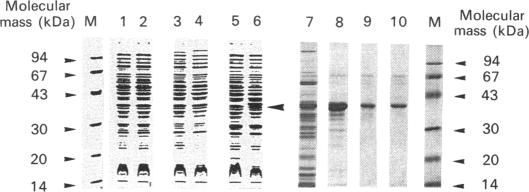
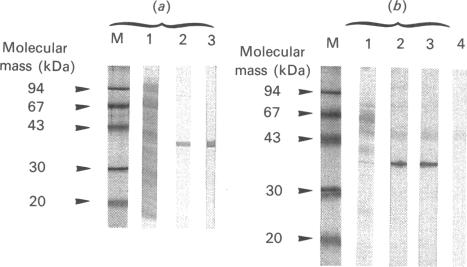
Arginase is an enzyme that catalyses the hydrolysis of arginine to urea and ornithine. It is abundantly present in the liver of ureotelic animals (i.e. those whose excretion is characterized by the excretion of uric acid as the chief end-product of nitrogen metabolism), but its purification has hitherto not been simple, and the yield not high. Starting with a partially truncated cDNA for human liver arginase recently made available, we constructed an expression plasmid that had tandemly linked tac promotors placed upstream of a full-length cDNA. By selecting Escherichia coli strain KY1436 as the host micro-organism, we established an efficient system for the production of human liver arginase protein. Chromatographies on CM-Sephadex G-150, DEAE-cellulose and Sephadex G-150, followed by preparative agar-gel electrophoresis, yielded 10 mg of apparently homogeneous enzyme protein from 1 g (wet wt.) of E. coli cells. E. coli-expressed human liver arginase had chemical, immunological and most catalytic properties indistinguishable from those of purified human erythrocyte arginase. However, E. coli-expressed arginase was a monomer of Mr 35,000, whereas the purified erythrocyte arginase was trimer of Mr 105,000. They differed also in pH- and temperature-stabilities. Gel-filtration experiments with these two purified arginases under various conditions, as well as with unfractionated human liver and erythrocyte cytosol preparations, indicated that the native form of human arginase should be of Mr 35,000, and that the trimeric appearance of human erythrocyte arginase after purification was an artifact of the purification procedures. It was thus concluded that, in Nature, the liver and erythrocyte arginases are identical proteins.
精氨酸酶是一种催化精氨酸水解生成尿素和鸟氨酸的酶。它大量存在于排尿素动物的肝脏中(即那些以尿酸作为氮代谢主要终产物进行排泄的动物),但其纯化过程迄今并不简单,产量也不高。从最近获得的人肝脏精氨酸酶的部分截短cDNA开始,我们构建了一个表达质粒,该质粒在全长cDNA的上游串联连接了tac启动子。通过选择大肠杆菌菌株KY1436作为宿主微生物,我们建立了一个高效生产人肝脏精氨酸酶蛋白的系统。在CM - Sephadex G - 150、DEAE - 纤维素和Sephadex G - 150上进行层析,随后进行制备性琼脂凝胶电泳,从1克(湿重)大肠杆菌细胞中获得了10毫克明显均一的酶蛋白。大肠杆菌表达的人肝脏精氨酸酶在化学、免疫和大多数催化特性上与纯化的人红细胞精氨酸酶无法区分。然而,大肠杆菌表达的精氨酸酶是分子量为35,000的单体,而纯化的红细胞精氨酸酶是分子量为105,000的三聚体。它们在pH稳定性和温度稳定性方面也有所不同。在各种条件下对这两种纯化的精氨酸酶以及未分级的人肝脏和红细胞胞质溶胶制剂进行凝胶过滤实验表明,人精氨酸酶的天然形式应为分子量35,000,纯化后人红细胞精氨酸酶的三聚体形态是纯化过程造成的假象。因此得出结论,在自然界中,肝脏和红细胞精氨酸酶是相同的蛋白质。