Université de Montréal, CP 6128, Succ. Centre-ville, Montreal, Quebec H3C 3J7, Canada.
BMC Public Health. 2012 Mar 15;12:192. doi: 10.1186/1471-2458-12-192.
An increased interest is observed in broadening community pharmacists' role in public health. To date, little information has been gathered in Canada on community pharmacists' perceptions of their role in health promotion and prevention; however, such data are essential to the development of public-health programs in community pharmacy. A cross-sectional study was therefore conducted to explore the perceptions of community pharmacists in urban and semi-urban areas regarding their ideal and actual levels of involvement in providing health-promotion and prevention services and the barriers to such involvement.
Using a five-step modified Dillman's tailored design method, a questionnaire with 28 multiple-choice or open-ended questions (11 pages plus a cover letter) was mailed to a random sample of 1,250 pharmacists out of 1,887 community pharmacists practicing in Montreal (Quebec, Canada) and surrounding areas. It included questions on pharmacists' ideal level of involvement in providing health-promotion and preventive services; which services were actually offered in their pharmacy, the employees involved, the frequency, and duration of the services; the barriers to the provision of these services in community pharmacy; their opinion regarding the most appropriate health professionals to provide them; and the characteristics of pharmacists, pharmacies and their clientele.
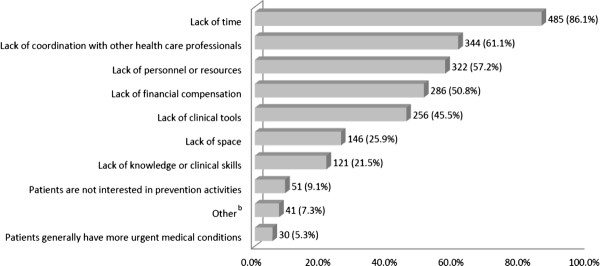
In all, 571 out of 1,234 (46.3%) eligible community pharmacists completed and returned the questionnaire. Most believed they should be very involved in health promotion and prevention, particularly in smoking cessation (84.3%); screening for hypertension (81.8%), diabetes (76.0%) and dyslipidemia (56.9%); and sexual health (61.7% to 89.1%); however, fewer respondents reported actually being very involved in providing such services (5.7% [lifestyle, including smoking cessation], 44.5%, 34.8%, 6.5% and 19.3%, respectively). The main barriers to the provision of these services in current practice were lack of: time (86.1%), coordination with other health care professionals (61.1%), staff or resources (57.2%), financial compensation (50.8%), and clinical tools (45.5%).
Although community pharmacists think they should play a significant role in health promotion and prevention, they recognize a wide gap between their ideal and actual levels of involvement. The efficient integration of primary-care pharmacists and pharmacies into public health cannot be envisioned without addressing important organizational barriers.
人们对扩大社区药剂师在公共卫生领域的作用越来越感兴趣。迄今为止,加拿大社区药剂师对其在促进健康和预防方面的作用的看法很少被收集,但这些数据对于在社区药剂学中开展公共卫生项目至关重要。因此,进行了一项横断面研究,以探讨城市和半城市地区社区药剂师对其提供健康促进和预防服务的理想和实际参与水平的看法,以及阻碍其参与的障碍。
使用五步改进的 Dillman 定制设计方法,向在蒙特利尔(加拿大魁北克省)及其周边地区的 1887 名社区药剂师中随机抽取的 1250 名药剂师邮寄了一份包含 28 个多项选择或开放式问题的问卷(11 页加一封求职信)。问卷包括药剂师在提供健康促进和预防服务方面的理想参与水平;他们的药店实际提供了哪些服务,参与的员工,服务的频率和持续时间;在社区药房提供这些服务的障碍;他们对最适合提供这些服务的卫生专业人员的看法;以及药剂师、药店及其客户的特征。
共有 1234 名符合条件的社区药剂师中的 571 人完成并返回了问卷。大多数人认为他们应该非常参与健康促进和预防,特别是在戒烟(84.3%);筛查高血压(81.8%)、糖尿病(76.0%)和血脂异常(56.9%);和性健康(61.7%至 89.1%);然而,较少的受访者报告说他们实际上非常参与提供此类服务(5.7%[生活方式,包括戒烟]、44.5%、34.8%、6.5%和 19.3%)。目前实践中提供这些服务的主要障碍是缺乏:时间(86.1%)、与其他卫生保健专业人员的协调(61.1%)、员工或资源(57.2%)、经济补偿(50.8%)和临床工具(45.5%)。
尽管社区药剂师认为他们应该在促进健康和预防方面发挥重要作用,但他们认识到他们的理想和实际参与水平之间存在很大差距。如果不解决重要的组织障碍,就无法想象将初级保健药剂师和药店有效地纳入公共卫生。