Department of Pharmacology and Physiology, Georgetown University Medical Center, Washington, DC, USA.
Nat Med. 2012 Mar 18;18(4):564-71. doi: 10.1038/nm.2687.
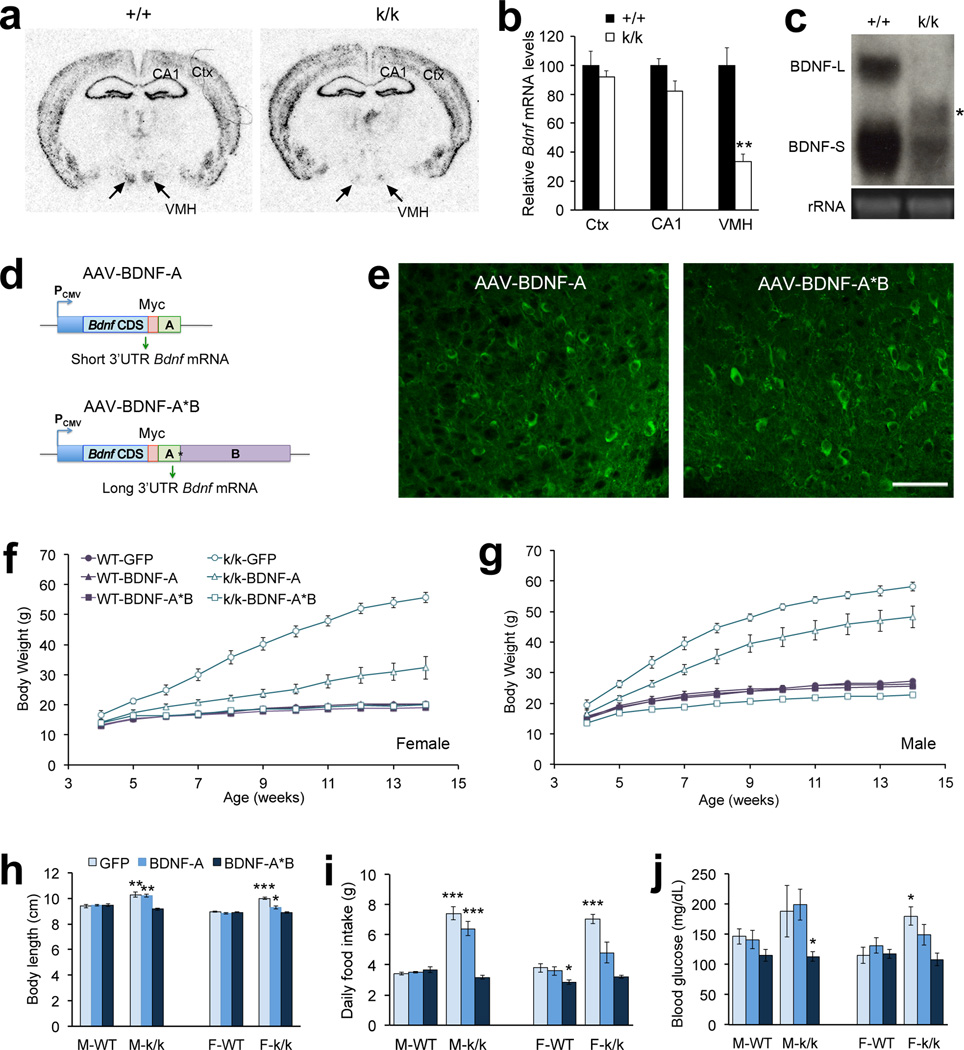
Mutations in the Bdnf gene, which produces transcripts with either short or long 3' untranslated regions (3' UTRs), cause human obesity; however, the precise role of brain-derived neurotrophic factor (BDNF) in the regulation of energy balance is unknown. Here we show the relationship between Bdnf mRNA with a long 3' UTR (long 3' UTR Bdnf mRNA), leptin, neuronal activation and body weight. We found that long 3' UTR Bdnf mRNA was enriched in the dendrites of hypothalamic neurons and that insulin and leptin could stimulate its translation in dendrites. Furthermore, mice harboring a truncated long Bdnf 3' UTR developed severe hyperphagic obesity, which was completely reversed by viral expression of long 3' UTR Bdnf mRNA in the hypothalamus. In these mice, the ability of leptin to activate hypothalamic neurons and inhibit food intake was compromised despite normal activation of leptin receptors. These results reveal a novel mechanism linking leptin action to BDNF expression during hypothalamic-mediated regulation of body weight, while also implicating dendritic protein synthesis in this process.
Bdnf 基因的突变会导致人类肥胖,该基因产生的转录本具有短或长的 3' 非翻译区(3'UTR);然而,脑源性神经营养因子(BDNF)在调节能量平衡中的精确作用尚不清楚。在这里,我们展示了长 3'UTR(长 3'UTR Bdnf mRNA)的 Bdnf mRNA 与瘦素、神经元激活和体重之间的关系。我们发现长 3'UTR Bdnf mRNA 富集在下丘脑神经元的树突中,胰岛素和瘦素可以刺激其在树突中的翻译。此外,携带截断的长 Bdnf 3'UTR 的小鼠表现出严重的多食性肥胖,而通过病毒在下丘脑表达长 3'UTR Bdnf mRNA 则完全逆转了这种肥胖。在这些小鼠中,尽管瘦素受体的正常激活,瘦素激活下丘脑神经元和抑制摄食的能力受到了损害。这些结果揭示了一种新的机制,将瘦素作用与下丘脑介导的体重调节过程中的 BDNF 表达联系起来,同时也暗示了树突状蛋白合成在这个过程中的作用。