Key Laboratory of Cardiovascular Remodeling and Function Research, Chinese Ministry of Education and Chinese Ministry of Health, Qilu Hospital, Shandong University, Jinan, Shandong, China.
PLoS One. 2012;7(3):e33497. doi: 10.1371/journal.pone.0033497. Epub 2012 Mar 12.
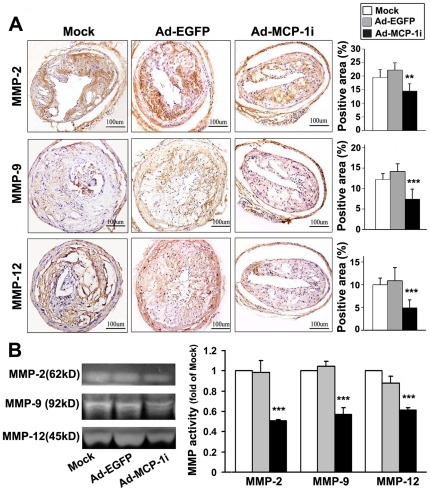
Monocyte chemoattractant protein-1 (MCP-1), a CC chemokine (CCL2), has been demonstrated to play important roles in atherosclerosis and becoming an important therapeutic target for atherosclerosis. The present study was undertaken to test the hypothesis that local RNAi of MCP-1 by site-specific delivery of adenovirus-mediated small hairpin RNA (shRNA) may enhance plaque stability and prevent plaque disruption in ApoE-/- mice. We designed an adenovirus-mediated shRNA against mouse MCP-1 (rAd5-MCP-1-shRNA). Male apolipoprotein E-knockout (ApoE-/-) mice (n = 120) were fed a high-fat diet and vulnerable plaques were induced by perivascular placement of constrictive collars around the carotid artery, intraperitoneal injection of lipopolysaccharide and stress stimulation. Mice were randomly divided into RNA interference (Ad-MCP-1i) group receiving local treatment of rAd5-MCP-1-shRNA suspension, Ad-EGFP group receiving treatment of rAd5-mediated negative shRNA and mock group receiving treatment of saline. Two weeks after treatment, plaque disruption rates were significantly lower in the Ad-MCP-1i group than in the Ad-EGFP group (13.3% vs. 60.0%, P = 0.01), and local MCP-1 expression was significantly inhibited in the Ad-MCP-1i group confirmed by immunostaining, qRT-PCR and western blot (P<0.001). Compared with the Ad-EGFP group, carotid plaques in the Ad-MCP-1i group showed increased levels of collagen and smooth muscle cells, and decreased levels of lipid and macrophages. The expression of inflammatory cytokines and activities of matrix metalloproteinases (MMPs) were lower in the Ad-MCP-1i group than in the Ad-EGFP group. In conclusion, site-specific delivery of adenoviral-mediated shRNA targeting mouse MCP-1 downregulated MCP-1 expression, turned a vulnerable plaque into a more stable plaque phenotype and prevented plaque disruption. A marked suppression of the local inflammatory cytokine expression may be the central mechanism involved.
单核细胞趋化蛋白-1(MCP-1),一种 CC 趋化因子(CCL2),已被证明在动脉粥样硬化中发挥重要作用,并成为动脉粥样硬化的重要治疗靶点。本研究旨在验证以下假设:通过局部递送达腺病毒介导的小发夹 RNA(shRNA)对 MCP-1 的 RNAi 可能增强载脂蛋白 E 基因敲除(ApoE-/-)小鼠斑块的稳定性并防止斑块破裂。我们设计了一种针对小鼠 MCP-1 的腺病毒介导的 shRNA(rAd5-MCP-1-shRNA)。雄性载脂蛋白 E 基因敲除(ApoE-/-)小鼠(n = 120)给予高脂饮食,通过颈动脉周围放置缩窄环、腹腔内注射脂多糖和应激刺激诱导易损斑块。小鼠随机分为 RNA 干扰(Ad-MCP-1i)组,接受 rAd5-MCP-1-shRNA 混悬液局部治疗;Ad-EGFP 组,接受 rAd5 介导的阴性 shRNA 治疗;模拟组,接受生理盐水治疗。治疗 2 周后,Ad-MCP-1i 组斑块破裂率明显低于 Ad-EGFP 组(13.3%比 60.0%,P = 0.01),免疫组化、qRT-PCR 和 Western blot 证实 Ad-MCP-1i 组局部 MCP-1 表达明显抑制(P<0.001)。与 Ad-EGFP 组相比,Ad-MCP-1i 组颈动脉斑块胶原和平滑肌细胞水平升高,脂质和巨噬细胞水平降低。Ad-MCP-1i 组炎症细胞因子表达和基质金属蛋白酶(MMPs)活性低于 Ad-EGFP 组。总之,靶向小鼠 MCP-1 的腺病毒介导的 shRNA 的局部递送达下调 MCP-1 表达,将易损斑块转化为更稳定的斑块表型并防止斑块破裂。局部炎症细胞因子表达的显著抑制可能是其中心机制。