Department of Epidemiology, University of North Carolina at Chapel Hill, Campus Box 7435, Chapel Hill, NC 27599, USA.
Breast Cancer Res. 2012 Mar 19;14(2):R51. doi: 10.1186/bcr3152.
A gene expression signature indicative of activated wound responses is common to more than 90% of non-neoplastic tissues adjacent to breast cancer, but these tissues also exhibit substantial heterogeneity. We hypothesized that gene expression subtypes of breast cancer microenvironment can be defined and that these microenvironment subtypes have clinical relevance.
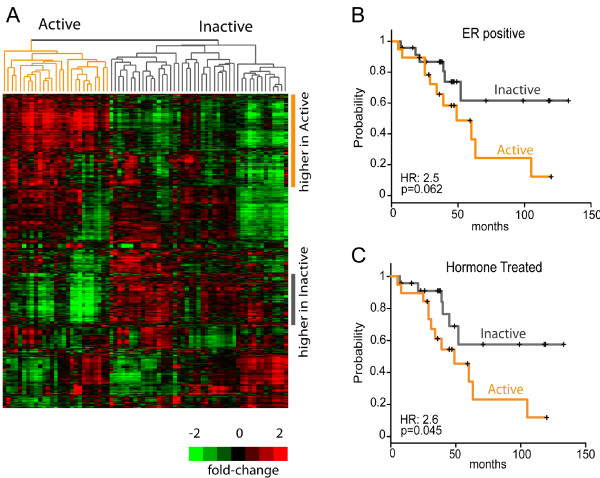
Gene expression was evaluated in 72 patient-derived breast tissue samples adjacent to invasive breast cancer or ductal carcinoma in situ. Unsupervised clustering identified two distinct gene expression subgroups that differed in expression of genes involved in activation of fibrosis, cellular movement, cell adhesion and cell-cell contact. We evaluated the prognostic relevance of extratumoral subtype (comparing the Active group, defined by high expression of fibrosis and cellular movement genes, to the Inactive group, defined by high expression of claudins and other cellular adhesion and cell-cell contact genes) using clinical data. To establish the biological characteristics of these subtypes, gene expression profiles were compared against published and novel tumor and tumor stroma-derived signatures (Twist-related protein 1 (TWIST1) overexpression, transforming growth factor beta (TGF-β)-induced fibroblast activation, breast fibrosis, claudin-low tumor subtype and estrogen response). Histological and immunohistochemical analyses of tissues representing each microenvironment subtype were performed to evaluate protein expression and compositional differences between microenvironment subtypes.
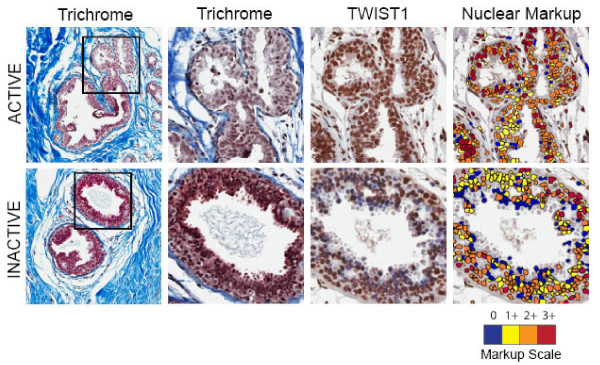
Extratumoral Active versus Inactive subtypes were not significantly associated with overall survival among all patients (hazard ratio (HR) = 1.4, 95% CI 0.6 to 2.8, P = 0.337), but there was a strong association with overall survival among estrogen receptor (ER) positive patients (HR = 2.5, 95% CI 0.9 to 6.7, P = 0.062) and hormone-treated patients (HR = 2.6, 95% CI 1.0 to 7.0, P = 0.045). The Active subtype of breast microenvironment is correlated with TWIST-overexpression signatures and shares features of claudin-low breast cancers. The Active subtype was also associated with expression of TGF-β induced fibroblast activation signatures, but there was no significant association between Active/Inactive microenvironment and desmoid type fibrosis or estrogen response gene expression signatures. Consistent with the RNA expression profiles, Active cancer-adjacent tissues exhibited higher density of TWIST nuclear staining, predominantly in epithelium, and no evidence of increased fibrosis.
These results document the presence of two distinct subtypes of microenvironment, with Active versus Inactive cancer-adjacent extratumoral microenvironment influencing the aggressiveness and outcome of ER-positive human breast cancers.
在超过 90%的乳腺癌旁非肿瘤组织中,存在一种能指示激活的伤口反应的基因表达特征,但这些组织也表现出明显的异质性。我们假设可以定义乳腺癌微环境的基因表达亚型,并且这些微环境亚型具有临床相关性。
对 72 例来自浸润性乳腺癌或导管原位癌患者的乳腺组织样本进行基因表达评估。无监督聚类确定了两个不同的基因表达亚组,这些亚组在参与纤维化、细胞运动、细胞黏附和细胞-细胞接触激活的基因表达上存在差异。我们使用临床数据评估了肿瘤外亚型(将高表达纤维化和细胞运动基因的“活跃”组与高表达紧密连接和其他细胞黏附和细胞-细胞接触基因的“不活跃”组进行比较)的预后相关性。为了确定这些亚型的生物学特征,我们将基因表达谱与已发表和新的肿瘤和肿瘤基质衍生的特征(TWIST 相关蛋白 1(TWIST1)过表达、转化生长因子β(TGF-β)诱导的成纤维细胞激活、乳腺纤维化、claudin-low 肿瘤亚型和雌激素反应)进行了比较。对代表每种微环境亚型的组织进行了组织学和免疫组织化学分析,以评估微环境亚型之间的蛋白表达和组成差异。
在所有患者中,肿瘤旁活跃与不活跃亚组与总生存无显著相关性(危险比(HR)=1.4,95%CI 0.6 至 2.8,P=0.337),但在雌激素受体(ER)阳性患者(HR=2.5,95%CI 0.9 至 6.7,P=0.062)和激素治疗患者(HR=2.6,95%CI 1.0 至 7.0,P=0.045)中与总生存有很强的相关性。乳腺癌微环境的活跃亚型与 TWIST 过表达特征相关,并具有 claudin-low 乳腺癌的特征。活跃亚型也与 TGF-β 诱导的成纤维细胞激活特征表达相关,但活跃/不活跃微环境与纤维瘤样纤维化或雌激素反应基因表达特征之间无显著相关性。与 RNA 表达谱一致,活跃的癌旁组织显示 TWIST 核染色密度较高,主要位于上皮细胞,且无纤维化增加的证据。
这些结果证明存在两种不同的微环境亚型,活跃与不活跃的肿瘤旁肿瘤外微环境影响 ER 阳性人乳腺癌的侵袭性和结局。