Department of Biology, University of York, PO Box 373, York YO10 5YW, UK.
BMC Evol Biol. 2012 Mar 19;12:35. doi: 10.1186/1471-2148-12-35.
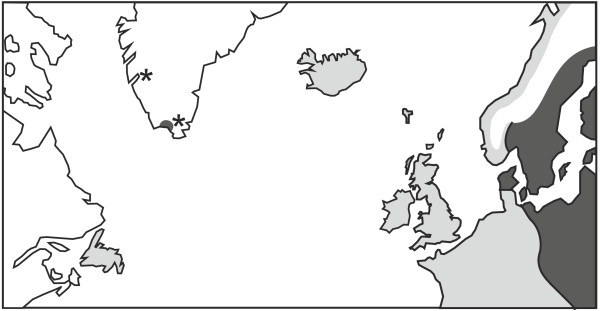
House mice (Mus musculus) are commensals of humans and therefore their phylogeography can reflect human colonization and settlement patterns. Previous studies have linked the distribution of house mouse mitochondrial (mt) DNA clades to areas formerly occupied by the Norwegian Vikings in Norway and the British Isles. Norwegian Viking activity also extended further westwards in the North Atlantic with the settlement of Iceland, short-lived colonies in Greenland and a fleeting colony in Newfoundland in 1000 AD. Here we investigate whether house mouse mtDNA sequences reflect human history in these other regions as well.
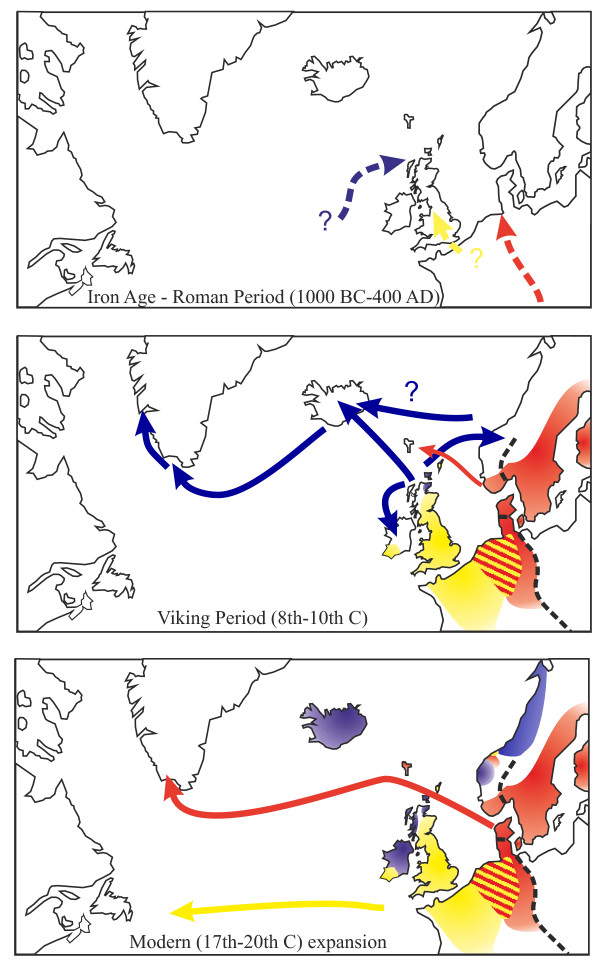
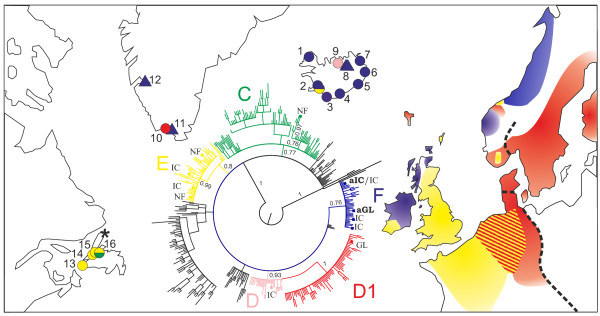
House mice samples from Iceland, whether from archaeological Viking Age material or from modern-day specimens, had an identical mtDNA haplotype to the clade previously linked with Norwegian Vikings. From mtDNA and microsatellite data, the modern-day Icelandic mice also share the low genetic diversity shown by their human hosts on Iceland. Viking Age mice from Greenland had an mtDNA haplotype deriving from the Icelandic haplotype, but the modern-day Greenlandic mice belong to an entirely different mtDNA clade. We found no genetic association between modern Newfoundland mice and the Icelandic/ancient Greenlandic mice (no ancient Newfoundland mice were available). The modern day Icelandic and Newfoundland mice belong to the subspecies M. m. domesticus, the Greenlandic mice to M. m. musculus.
In the North Atlantic region, human settlement history over a thousand years is reflected remarkably by the mtDNA phylogeny of house mice. In Iceland, the mtDNA data show the arrival and continuity of the house mouse population to the present day, while in Greenland the data suggest the arrival, subsequent extinction and recolonization of house mice--in both places mirroring the history of the European human host populations. If house mice arrived in Newfoundland with the Viking settlers at all, then, like the humans, their presence was also fleeting and left no genetic trace. The continuity of mtDNA haplotype in Iceland over 1000 years illustrates that mtDNA can retain the signature of the ancestral house mouse founders. We also show that, in terms of genetic variability, house mouse populations may also track their host human populations.
家鼠(Mus musculus)是人类的共生生物,因此它们的系统地理学可以反映人类的殖民和定居模式。先前的研究将家鼠线粒体(mt)DNA 谱系的分布与挪威维京人在挪威和不列颠群岛曾经居住过的地区联系起来。挪威维京人的活动还进一步向西扩展到北大西洋,在那里建立了冰岛、格陵兰的短命殖民地以及公元 1000 年在纽芬兰短暂建立的殖民地。在这里,我们研究家鼠 mtDNA 序列是否也反映了这些其他地区的人类历史。
无论是来自考古时代的维京时代材料还是来自现代样本,冰岛的家鼠样本都具有与先前与挪威维京人相关联的支系相同的 mtDNA 单倍型。从 mtDNA 和微卫星数据来看,现代冰岛老鼠与它们在冰岛的人类宿主一样,具有低遗传多样性。来自格陵兰的维京时代老鼠具有源自冰岛单倍型的 mtDNA 单倍型,但现代格陵兰老鼠属于完全不同的 mtDNA 支系。我们没有发现现代纽芬兰老鼠与冰岛/古代格陵兰老鼠之间的遗传关联(没有古代纽芬兰老鼠的样本)。现代冰岛和纽芬兰老鼠属于亚种 M. m. domesticus,而格陵兰老鼠属于 M. m. musculus。
在北大西洋地区,家鼠的 mtDNA 系统发育令人惊讶地反映了人类在一千多年的定居历史。在冰岛,mtDNA 数据显示家鼠种群的到达和延续至今,而在格陵兰,数据表明家鼠的到达、随后灭绝和再殖民——在这两个地方都反映了欧洲人类宿主种群的历史。如果家鼠确实是随维京人一起到达纽芬兰的,那么就像人类一样,它们的存在也是短暂的,没有留下遗传痕迹。1000 多年来,冰岛 mtDNA 单倍型的连续性表明 mtDNA 可以保留祖先家鼠创始者的特征。我们还表明,就遗传可变性而言,家鼠种群也可能跟踪其宿主人类种群。