Brown T Michelle, Horblyuk Ruslan V, Grotzinger Kelly M, Matzdorff Axel C, Pashos Chris L
RTI Health Solutions, Research Triangle Park, NC, USA.
GlaxoSmithKline, Collegeville, PA, USA.
BMC Blood Disord. 2012 Mar 22;12:2. doi: 10.1186/1471-2326-12-2.
Chronic immune thrombocytopenia (ITP) is a debilitating autoimmune disorder that causes a reduction in blood platelets and increased risk of bleeding. ITP is currently managed with various pharmacologic therapies and splenectomy.This study was conducted to assess patient perceived and reported treatment side effects, as well as the perceived burden or bother, and need to reduce or stop treatment, associated with these side effects among adult patients with chronic ITP.
A Web-enabled survey was administered to members of a US-based ITP patient support group. Patients reported demographic and clinical characteristics, ITP treatments' side effects for treatments received since diagnosed, level of bother (or distress), and need to reduce or stop treatment, associated with side effects. Current and past exposure was assessed for five specific treatment types: corticosteroids (CS), intravenous immunoglobulin (IVIg), anti-D immunoglobulin (anti-D), rituximab (RT), and splenectomy (SPL), as well as for other patient-referenced therapies (captured as "other").
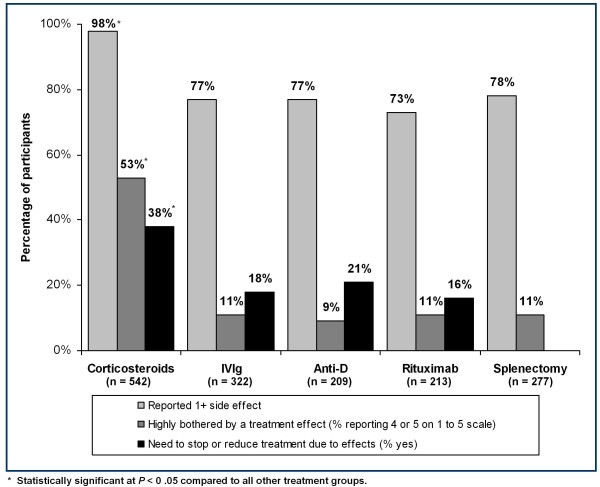
The survey was completed by 589 patients; 78% female, 89% white, mean age 48 years (SD = 14.71), and 68% reported a typical low platelet count of < 50,000/μL. Current or past treatment with CS was reported by 92% (n = 542) of patients, 56% (n = 322) for IVIg, 36% (n = 209) for anti-D, 36% (n = 213) for RT, and 39% (n = 227) for SPL. A substantial proportion of CS-treated patients reported side effects (98%, P < 0.05), were highly bothered by their side effects (53.1%, P < 0.05), and reported the need to stop or reduce treatment due to side effects (37.8%, P < 0.05). Among patients reporting side effects of treatment, significant associations were noted for the number of side effects, aggregate bother of reported side effects, and the need to stop or reduce treatment (all P < 0.05).
Current ITP treatments, particularly corticosteroids, are associated with multiple bothersome side effects that may lead to patients stopping or reducing therapy. Open, informed and complete communication between clinician and patient regarding both the benefits and the side effects of ITP treatment may better prepare patients for their prescribed regimens.
慢性免疫性血小板减少症(ITP)是一种使人衰弱的自身免疫性疾病,会导致血小板减少并增加出血风险。目前,ITP通过各种药物治疗和脾切除术进行管理。本研究旨在评估成年慢性ITP患者感知到并报告的治疗副作用,以及与这些副作用相关的感知负担或困扰,以及减少或停止治疗的需求。
对美国一个ITP患者支持小组的成员进行了一项基于网络的调查。患者报告了人口统计学和临床特征、自确诊以来接受的ITP治疗的副作用、困扰程度(或痛苦程度)以及与副作用相关的减少或停止治疗的需求。评估了五种特定治疗类型的当前和过去暴露情况:皮质类固醇(CS)、静脉注射免疫球蛋白(IVIg)、抗D免疫球蛋白(抗D)、利妥昔单抗(RT)和脾切除术(SPL),以及其他患者提及的疗法(记录为“其他”)。
589名患者完成了调查;78%为女性,89%为白人,平均年龄48岁(标准差=14.71),68%的患者报告典型的低血小板计数<50,000/μL。92%(n=542)的患者报告目前或过去接受过CS治疗,IVIg治疗的患者为56%(n=322),抗D治疗的患者为36%(n=209),RT治疗的患者为36%(n=213),SPL治疗的患者为39%(n=227)。接受CS治疗的患者中有很大一部分报告了副作用(98%,P<0.05),对其副作用深感困扰(53.1%,P<0.05),并报告因副作用需要停止或减少治疗(37.8%,P<0.05)。在报告治疗副作用的患者中,副作用数量、报告的副作用总困扰程度以及停止或减少治疗的需求之间存在显著关联(均P<0.05)。
目前的ITP治疗,尤其是皮质类固醇,与多种令人困扰的副作用相关,这些副作用可能导致患者停止或减少治疗。临床医生与患者之间就ITP治疗的益处和副作用进行开放、知情且完整的沟通,可能会让患者更好地为其规定的治疗方案做好准备。