CNRS-Commissariat à l'Energie Atomique-Université Joseph Fourier, Grenoble 1, Institut de Biologie Structurale Jean-Pierre Ebel, Grenoble, France.
J Biol Chem. 2012 May 25;287(22):18005-17. doi: 10.1074/jbc.M111.337089. Epub 2012 Mar 22.
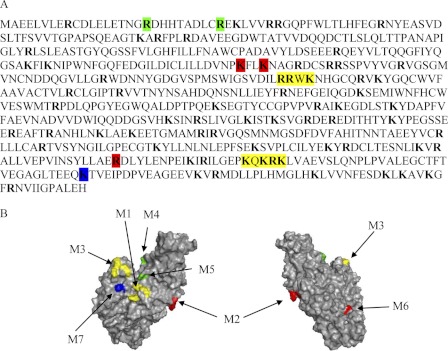
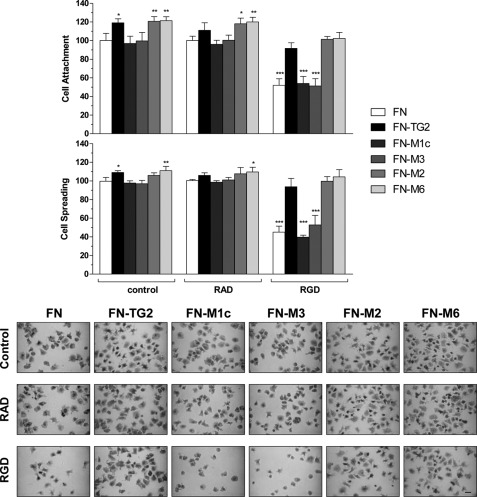
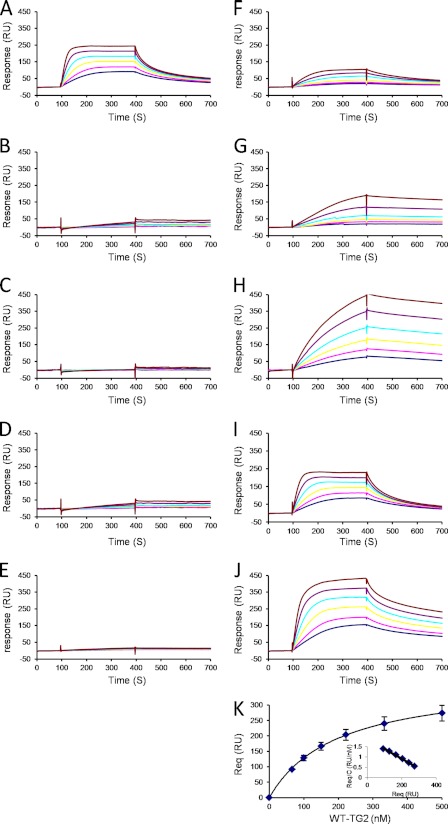
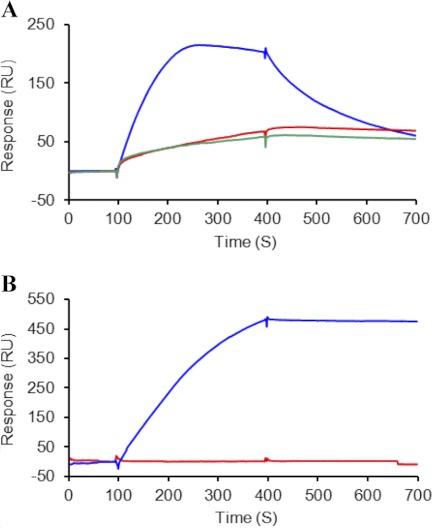
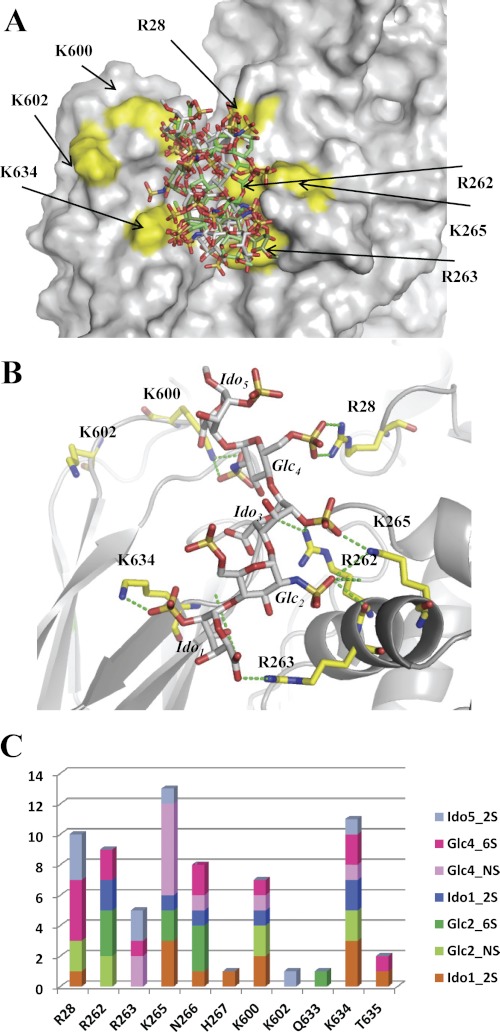
Heparan sulfate proteoglycans are critical binding partners for extracellular tranglutaminase-2 (TG2), a multifunctional protein involved in tissue remodeling events related to organ fibrosis and cancer progression. We previously showed that TG2 has a strong affinity for heparan sulfate (HS)/heparin and reported that the heparan sulfate proteoglycan syndecan-4 acts as a receptor for TG2 via its HS chains in two ways: by increasing TG2-cell surface trafficking/externalization and by mediating RGD-independent cell adhesion to fibronectin-TG2 matrix during wound healing. Here we have investigated the molecular basis of this interaction. Site-directed mutagenesis revealed that either mutation of basic RRWK (262-265) or KQKRK (598-602) clusters, forming accessible heparin binding sequences on the TG2 three-dimensional structure, led to an almost complete reduction of heparin binding, indicating that both clusters contribute to form a single binding surface. Mutation of residues Arg(19) and Arg(28) also led to a significant reduction in heparin binding, suggesting their involvement. Our findings indicate that the heparin binding sites on TG2 mainly comprise two clusters of basic amino acids, which are distant in the linear sequence but brought into spatial proximity in the folded "closed" protein, forming a high affinity heparin binding site. Molecular modeling showed that the identified site can make contact with a single heparin-derived pentasaccharide. The TG2-heparin binding mutants supported only weak RGD-independent cell adhesion compared with wild type TG2 or mutants with retained heparin binding, and both heparin binding clusters were critical for TG2-mediated cell adhesion. These findings significantly advance our knowledge of how HS/heparin influences the adhesive function of TG2.
硫酸乙酰肝素蛋白聚糖是细胞外转谷氨酰胺酶-2(TG2)的关键结合伴侣,TG2 是一种多功能蛋白,参与与器官纤维化和癌症进展相关的组织重塑事件。我们之前表明,TG2 与硫酸乙酰肝素(HS)/肝素具有很强的亲和力,并报告硫酸乙酰肝素蛋白聚糖 syndecan-4 通过其 HS 链以两种方式作为 TG2 的受体:通过增加 TG2-细胞表面运输/外化,以及通过介导 RG D 非依赖性细胞黏附到纤维连接蛋白-TG2 基质在伤口愈合过程中。在这里,我们研究了这种相互作用的分子基础。定点突变显示,碱性 RRWK(262-265)或 KQKRK(598-602)簇的突变,形成 TG2 三维结构上可及的肝素结合序列,导致肝素结合几乎完全减少,表明两个簇都有助于形成单一结合表面。残基 Arg(19)和 Arg(28)的突变也导致肝素结合显著减少,表明它们参与其中。我们的发现表明,TG2 上的肝素结合位点主要由两个碱性氨基酸簇组成,它们在线性序列中相距很远,但在折叠的“封闭”蛋白中空间上接近,形成高亲和力的肝素结合位点。分子建模表明,所鉴定的位点可以与单个肝素衍生的五糖接触。与野生型 TG2 或保留肝素结合的突变体相比,TG2-肝素结合突变体仅支持较弱的 RG D 非依赖性细胞黏附,并且两个肝素结合簇对于 TG2 介导的细胞黏附都至关重要。这些发现显著提高了我们对 HS/肝素如何影响 TG2 黏附功能的认识。