University of Hamburg, Biocenter Klein Flottbek, Applied Botany/Biology of Useful Plants, Ohnhorststraße 18, Hamburg, Germany.
Ann Bot. 2012 Jun;109(7):1253-62. doi: 10.1093/aob/mcs057. Epub 2012 Mar 25.
The release of hydrogen cyanide (HCN) from injured plant tissue affects multiple ecological interactions. Plant-derived HCN can act as a defence against herbivores and also plays an important role in plant-pathogen interactions. Crucial for activity as a feeding deterrent is the amount of HCN generated per unit time, referred to as cyanogenic capacity (HCNc). Strong intraspecific variation in HCNc has been observed among cyanogenic plants. This variation, in addition to genotypic variability (e.g. in Trifolium repens), can result from modifications in the expression level of the enzymes involved in either cyanogenic precursor formation or HCN release (as seen in Sorghum bicolor and Phaseolus lunatus). Thus, a modification or modulation of HCNc in reaction to the environment can only be achieved from one to the next generation when under genetic control and within days or hours when transcriptional regulations are involved. In the present study, it is shown that in rubber tree (Hevea brasiliensis) HCNc is modulated by post-translational activity regulation of the key enzymes for cyanide release.
Linamarase (LIN) and hydroxynitrile lyase (HNL) activity was determined by colorimetric assays utilizing dissociation of the substrates p-nitrophenyl-β-d-glucopyranoside and acetone cyanohydrin, respectively.
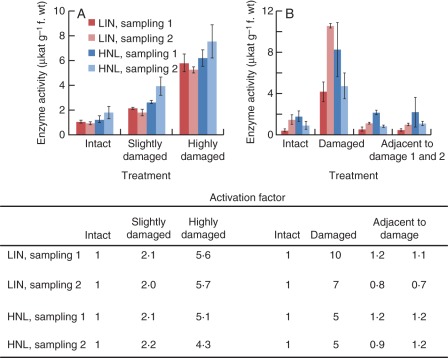
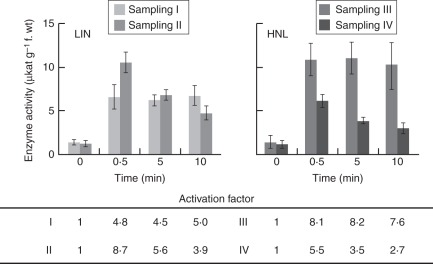
In rubber tree leaves, LIN and HNL show up to ten-fold increased activity in response to tissue damage. This enzyme activation occurs within seconds and results in accelerated HCN formation. It is restricted to the damaged leaf area and depends on the severity of tissue damage.
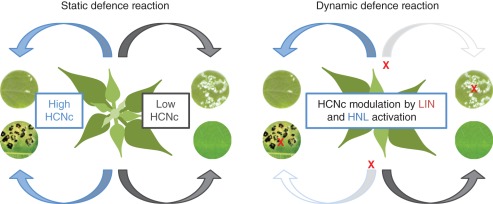
LIN and HNL activation (in contrast to genetic and transcriptional regulations) allows an immediate, local and damage type-dependent modulation of the cyanogenic response. Accordingly, this post-translational activation plays a decisive role in the defence of H. brasiliensis against herbivores as well as pathogens and may allow more flexible reactions in response to these different antagonists.
受伤植物组织释放的氢氰酸(HCN)会影响多种生态相互作用。植物源性 HCN 可以作为一种防御机制来抵御草食动物,同时在植物-病原体相互作用中也起着重要作用。作为一种摄食威慑物,关键在于单位时间内产生的 HCN 量,即氰苷原生成能力(HCNc)。含氰植物中存在强烈的种内 HCNc 变异。这种变异除了与基因型变异(例如三叶草)有关外,还可能是由于参与氰苷原形成或 HCN 释放的酶的表达水平发生变化(如高粱和菜豆)。因此,只有在遗传控制下,经过一代或下一代,或在涉及转录调控的数天或数小时内,才能对环境做出 HCNc 的修饰或调节。本研究表明,在橡胶树(Hevea brasiliensis)中,HCNc 通过释放氰化物的关键酶的翻译后活性调节来进行调节。
利用底物对硝基苯-β-d-吡喃葡萄糖苷和丙酮氰醇的分解,通过比色法测定 linamarase(LIN)和羟腈裂解酶(HNL)的活性。
在橡胶树叶片中,LIN 和 HNL 的活性在受到组织损伤后增加了十倍。这种酶的激活发生在几秒钟内,导致 HCN 的形成加速。它仅限于受损的叶片区域,并取决于组织损伤的严重程度。
LIN 和 HNL 的激活(与遗传和转录调控相反)允许对氰苷原反应进行即时、局部和损伤类型依赖的调节。因此,这种翻译后激活在橡胶树抵御草食动物和病原体的防御中起着决定性作用,并且可能允许对这些不同的拮抗剂做出更灵活的反应。