Department of Mechanical Engineering, National Chung Cheng University, 168, University Rd., Min-Hsiung, Chia Yi, 62102, Taiwan; E-Mails:
Sensors (Basel). 2009;9(8):6456-70. doi: 10.3390/s90806456. Epub 2009 Aug 20.
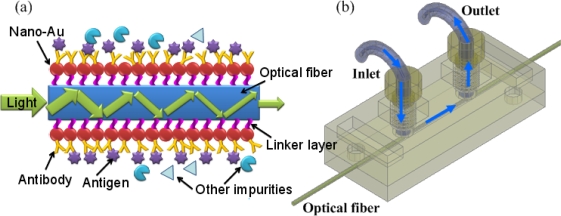
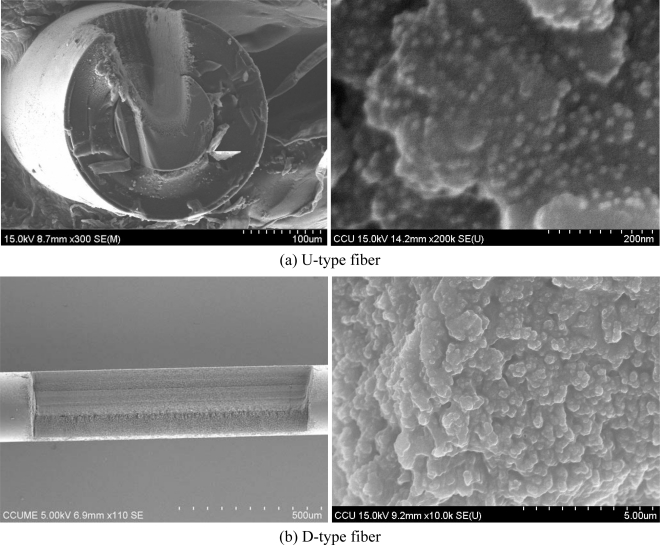
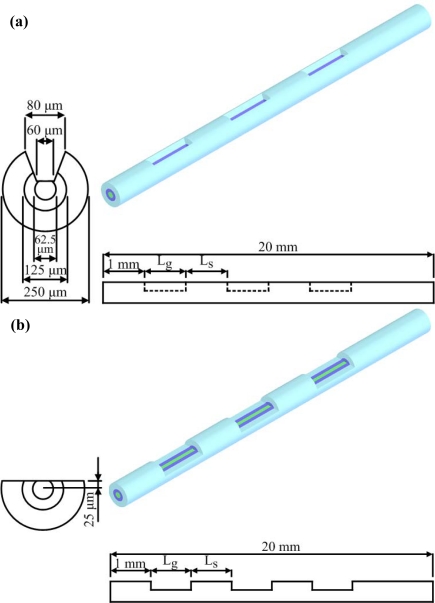
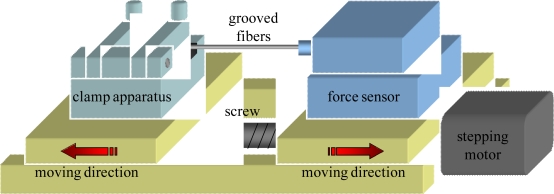
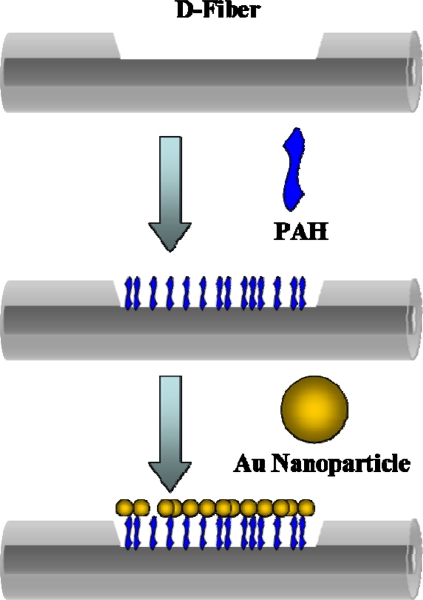
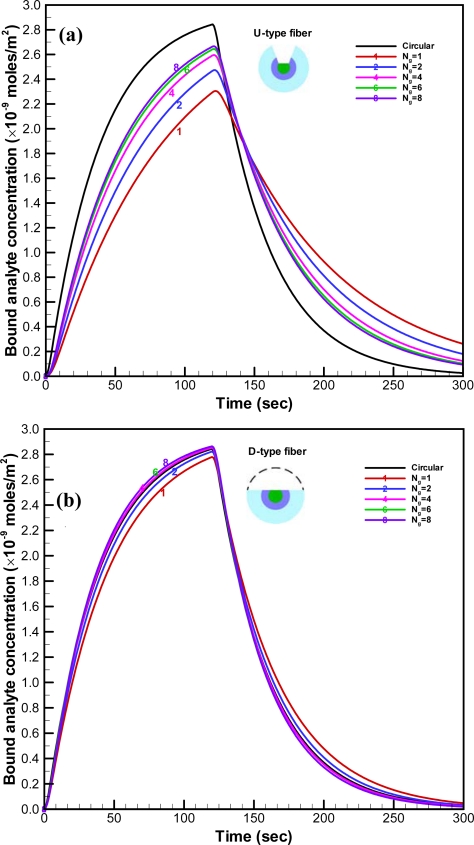
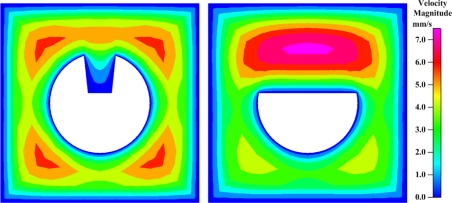
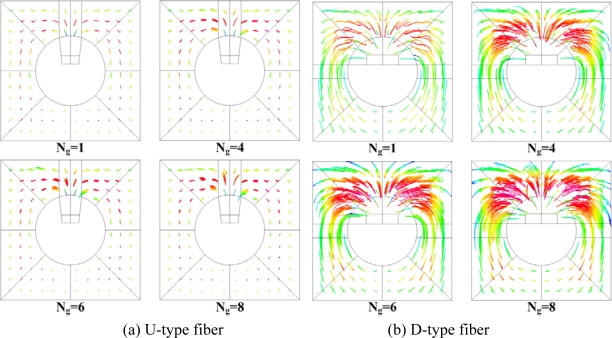
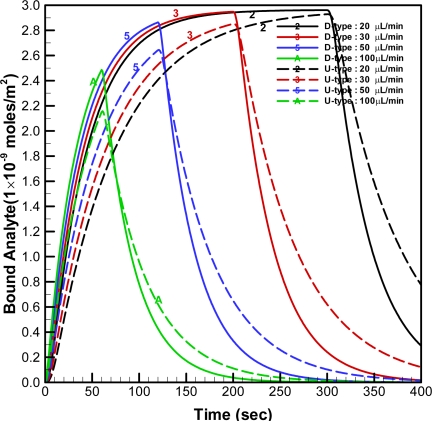
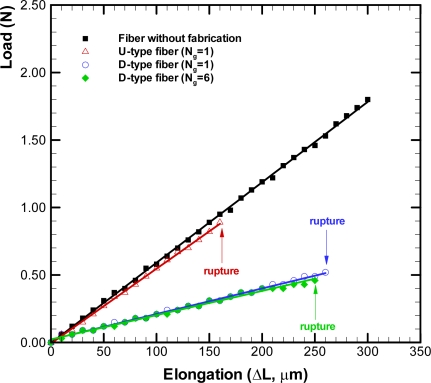
Bio-molecular recognition is detected by the unique optical properties of self-assembled gold nanoparticles on the unclad portions of an optical fiber whose surfaces have been modified with a receptor. To enhance the performance of the sensing platform, the sensing element is integrated with a microfluidic chip to reduce sample and reagent volume, to shorten response time and analysis time, as well as to increase sensitivity. The main purpose of the present study is to design grooves on the optical fiber for the FO-LPR microfluidic chip and investigate the effect of the groove geometry on the biochemical binding kinetics through simulations. The optical fiber is designed and termed as U-type or D-type based on the shape of the grooves. The numerical results indicate that the design of the D-type fiber exhibits efficient performance on biochemical binding. The grooves designed on the optical fiber also induce chaotic advection to enhance the mixing in the microchannel. The mixing patterns indicate that D-type grooves enhance the mixing more effectively than U-type grooves. D-type fiber with six grooves is the optimum design according to the numerical results. The experimental results show that the D-type fiber could sustain larger elongation than the U-type fiber. Furthermore, this study successfully demonstrates the feasibility of fabricating the grooved optical fibers by the femtosecond laser, and making a transmission-based FO-LPR probe for chemical sensing. The sensor resolution of the sensor implementing the D-type fiber modified by gold nanoparticles was 4.1 × 10(-7) RIU, which is much more sensitive than that of U-type optical fiber (1.8 × 10(-3) RIU).
生物分子识别是通过光纤未覆盖部分上自组装金纳米粒子的独特光学特性来检测的,光纤表面已经用受体进行了修饰。为了提高传感平台的性能,将传感元件与微流控芯片集成,以减少样品和试剂的体积,缩短响应时间和分析时间,并提高灵敏度。本研究的主要目的是在光纤上设计用于 FO-LPR 微流控芯片的凹槽,并通过模拟研究凹槽几何形状对生化结合动力学的影响。根据凹槽的形状,光纤被设计并命名为 U 型或 D 型。数值结果表明,D 型光纤的设计在生化结合方面表现出高效的性能。光纤上设计的凹槽还会引起混沌对流,从而增强微通道中的混合。混合模式表明,D 型凹槽比 U 型凹槽更有效地增强混合。根据数值结果,带有六个凹槽的 D 型光纤是最佳设计。实验结果表明,D 型光纤比 U 型光纤能够承受更大的伸长率。此外,本研究成功地演示了通过飞秒激光制造带有凹槽的光纤的可行性,并制作了基于传输的 FO-LPR 探针用于化学传感。用金纳米粒子修饰的 D 型光纤实现的传感器分辨率为 4.1×10(-7) RIU,比 U 型光纤(1.8×10(-3) RIU)的灵敏度高得多。