Department of Pediatrics, Division of Neurology, Children's Hospital of Philadelphia Research Institute, Philadelphia, Pennsylvania, United States of America.
PLoS One. 2012;7(3):e33494. doi: 10.1371/journal.pone.0033494. Epub 2012 Mar 20.
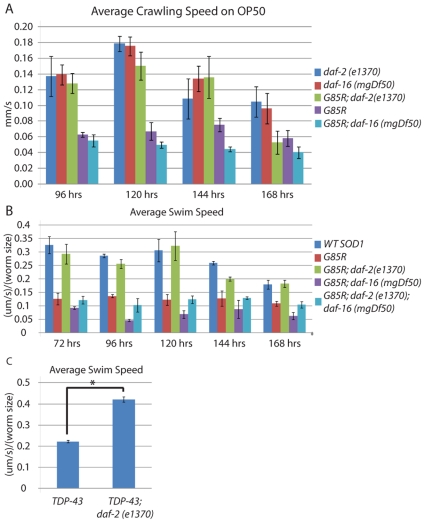
The DAF-2 Insulin/IGF-1 signaling (IIS) pathway is a strong modifier of Caenorhabditis elegans longevity and healthspan. As aging is the greatest risk factor for developing neurodegenerative diseases such as Amyotrophic Lateral Sclerosis (ALS), we were interested in determining if DAF-2 signaling modifies disease pathology in mutant superoxide dismutase 1 (SOD1) expressing C. elegans. Worms with pan-neuronal G85R SOD1 expression demonstrate significantly impaired locomotion as compared to WT SOD1 expressing controls and they develop insoluble SOD1 aggregates. Reductions in DAF-2 signaling, either through a hypomorphic allele or neuronally targeted RNAi, decreases the abundance of aggregated SOD1 and results in improved locomotion in a DAF-16 dependant manner. These results suggest that manipulation of the DAF-2 Insulin/IGF-1 signaling pathway may have therapeutic potential for the treatment of ALS.
DAF-2 胰岛素/IGF-1 信号通路(IIS)是调节秀丽隐杆线虫寿命和健康跨度的重要因素。由于衰老是导致神经退行性疾病(如肌萎缩侧索硬化症,ALS)的最大风险因素,我们有兴趣确定 DAF-2 信号是否会改变表达突变超氧化物歧化酶 1(SOD1)的线虫的疾病病理学。与表达 WT SOD1 的对照相比,具有全神经元 G85R SOD1 表达的线虫表现出明显的运动障碍,并且它们会形成不溶性 SOD1 聚集体。通过减弱等位基因或神经元靶向 RNAi 降低 DAF-2 信号,会减少聚集 SOD1 的丰度,并以 DAF-16 依赖的方式改善运动能力。这些结果表明,操纵 DAF-2 胰岛素/IGF-1 信号通路可能具有治疗 ALS 的治疗潜力。