Wuhan Institute for Neuroscience and Neuroengineering, South-Central University for Nationalities, Wuhan, China.
PLoS One. 2012;7(3):e33722. doi: 10.1371/journal.pone.0033722. Epub 2012 Mar 23.
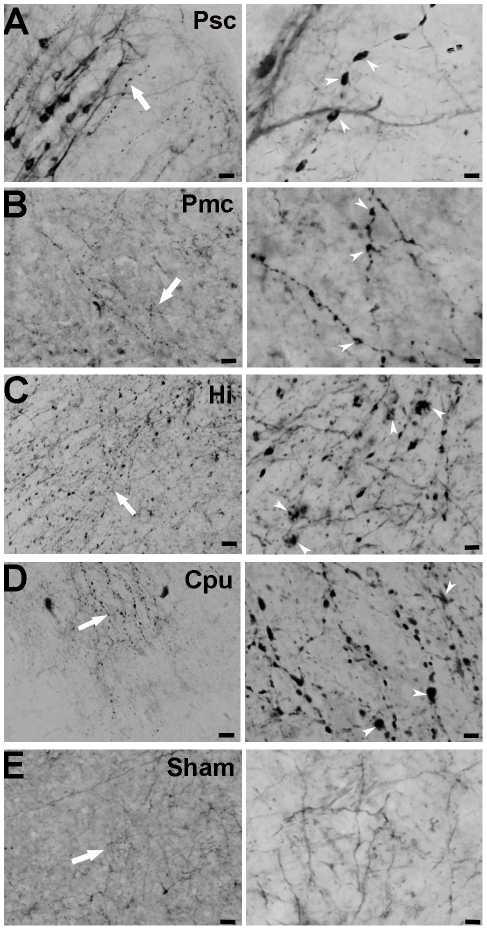
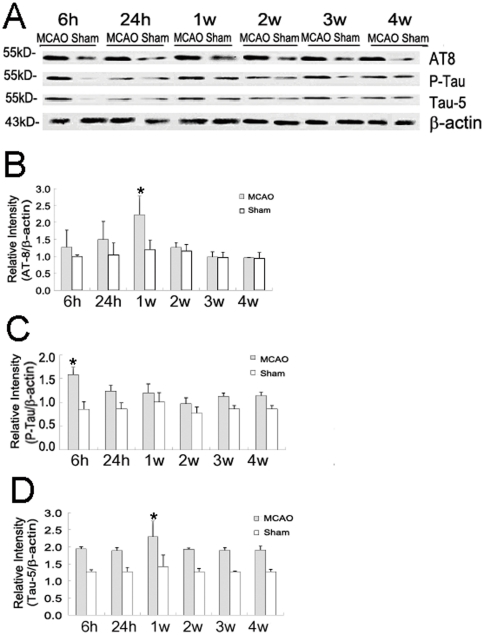
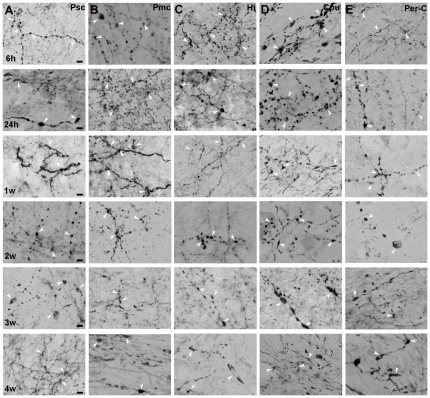
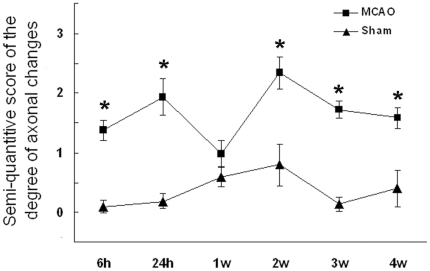
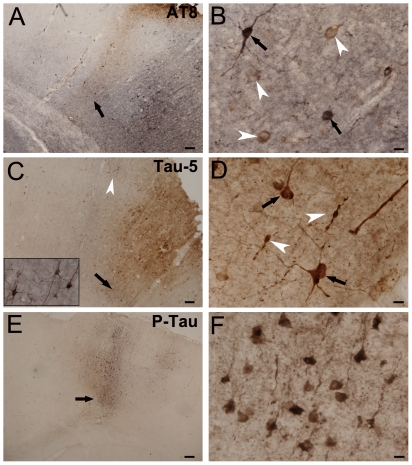
The dementia of Alzheimer's type and brain ischemia are known to increase at comparable rates with age. Recent advances suggest that cerebral ischemia may contribute to the pathogenesis of Alzheimer's disease (AD), however, the neuropathological relationship between these two disorders is largely unclear. It has been demonstrated that axonopathy, mainly manifesting as impairment of axonal transport and swelling of the axon and varicosity, is a prominent feature in AD and may play an important role in the neuropathological mechanisms in AD. In this study, we investigated the early and chronic changes of the axons of neurons in the different brain areas (cortex, hippocampus and striatum) using in vivo tracing technique and grading analysis method in a rat model of transient focal cerebral ischemia/reperfusion (middle cerebral artery occlusion, MCAO). In addition, the relationship between the changes of axons and the expression of β-amyloid 42 (Aβ42) and hyperphosphorylated Tau, which have been considered as the key neuropathological processes of AD, was analyzed by combining tracing technique with immunohistochemistry or western blotting. Subsequently, we found that transient cerebral ischemia/reperfusion produced obvious swelling of the axons and varicosities, from 6 hours after transient cerebral ischemia/reperfusion even up to 4 weeks. We could not observe Aβ plaques or overexpression of Aβ42 in the ischemic brain areas, however, the site-specific hyperphosphorylated Tau could be detected in the ischemic cortex. These results suggest that transient cerebral ischemia/reperfusion induce early and chronic axonal changes, which may be an important mechanism affecting the clinical outcome and possibly contributing to the development of AD after stroke.
阿尔茨海默病类型的痴呆症和脑缺血已知会随着年龄的增长以相当的速度增加。最近的进展表明,脑缺血可能有助于阿尔茨海默病(AD)的发病机制,然而,这两种疾病之间的神经病理学关系在很大程度上尚不清楚。已经证明,轴突病主要表现为轴突运输受损、轴突肿胀和轴突膨出,是 AD 的一个突出特征,可能在 AD 的神经病理学机制中发挥重要作用。在这项研究中,我们使用体内示踪技术和分级分析方法,在短暂性局灶性脑缺血再灌注(大脑中动脉闭塞,MCAO)大鼠模型中,研究了不同脑区(皮质、海马和纹状体)神经元轴突的早期和慢性变化。此外,通过将示踪技术与免疫组织化学或免疫印迹相结合,分析了轴突变化与β-淀粉样蛋白 42(Aβ42)和过度磷酸化 Tau 的表达之间的关系,这些变化被认为是 AD 的关键神经病理学过程。随后,我们发现短暂性脑缺血再灌注后,轴突和轴突膨体明显肿胀,从短暂性脑缺血再灌注后 6 小时甚至持续 4 周。我们在缺血脑区未观察到 Aβ斑块或 Aβ42 的过表达,但在缺血皮质中可检测到特异性的过度磷酸化 Tau。这些结果表明,短暂性脑缺血再灌注会引起早期和慢性的轴突变化,这可能是影响临床结果的一个重要机制,并可能导致中风后 AD 的发展。