
miR-185和miR-424在急性缺血性脑卒中患者中的表达及临床价值
Expression and Clinical Value of miR-185 and miR-424 in Patients with Acute Ischemic Stroke.
作者信息
Guo Chunxuan, Yao Yanping, Li Qi, Gao Yuanjie, Cao Hongyan
机构信息
Department of Neurology, People's Hospital of Danzhou, Danzhou, Hainan, People's Republic of China.
Department of Pharmacy, Suzhou Xiangcheng People's Hospital, Suzhou, Jiangsu, People's Republic of China.
出版信息
Int J Gen Med. 2022 Jan 4;15:71-78. doi: 10.2147/IJGM.S340586. eCollection 2022.
BACKGROUND
To investigate the expression of serum miR-185 and miR-424 in patients with acute ischemic stroke (AIS) and their predictive value. A total of 142 patients with AIS and 50 healthy controls were enrolled.
METHODS
According to the modified Rankin scale (mRS) score, AIS patients were divided into the good prognosis group and the poor prognosis group. Based on the National Institutes of Health Stroke Scale (NIHSS) score, AIS patients were divided into the mild group, the moderate group, and the severe group. RT-qPCR was used to determine the expression. ROC curve and Pearson correlation analysis were adopted to predict poor prognosis and analyze the correlation between the expression and NIHSS, mRS score.
RESULTS
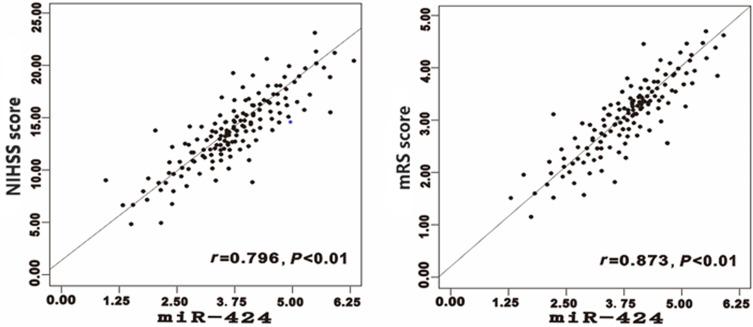
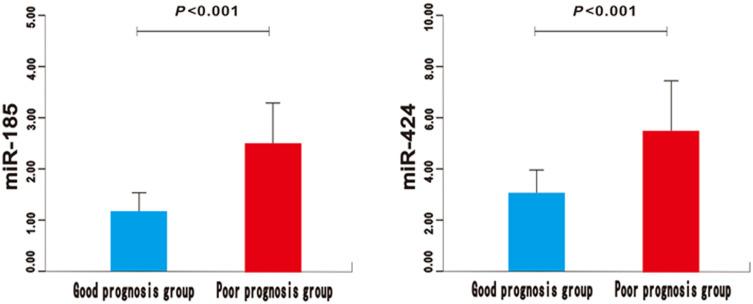
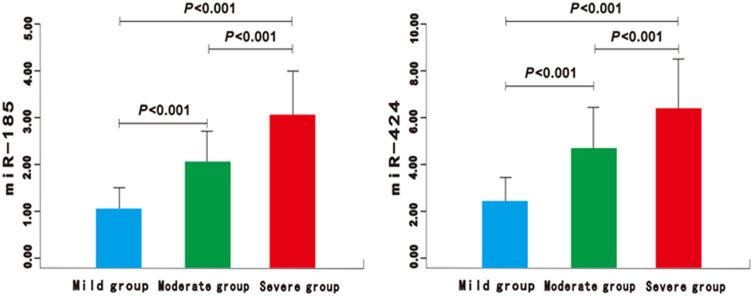
Compared with the control group, the expression of miR-185 and miR-424 in the AIS group was significantly higher (<0.01). Similarly, significantly higher expressions could be found in the poor prognosis group and the severe group (<0.01). The ROC curve revealed that the optimal cut-off values were 2.14 and 4.08, respectively. The area under the ROC curve (0.928, 95% CI: 0.870-0.993) was the largest, with sensitivity and specificity of 92.0% and 85.7%. Pearson correlation analysis showed that their expression was positively correlated with NIHSS score and mRS score in AIS patients (=0.735, 0.802, 0.796, 0.873, <0.01).
CONCLUSION
There are two factors related to the up-regulated expression of serum miR-185 and miR-424, one is the severity degree of neurological impairment of patients with AIS and the other is their prognosis. These two combined indicators can contribute to predicting the prognosis of AIS patients.
背景
探讨急性缺血性脑卒中(AIS)患者血清miR-185和miR-424的表达情况及其预测价值。共纳入142例AIS患者和50例健康对照者。
方法
根据改良Rankin量表(mRS)评分,将AIS患者分为预后良好组和预后不良组。根据美国国立卫生研究院卒中量表(NIHSS)评分,将AIS患者分为轻度组、中度组和重度组。采用RT-qPCR法测定表达情况。采用ROC曲线和Pearson相关性分析预测预后不良情况,并分析表达与NIHSS、mRS评分之间的相关性。
结果
与对照组相比,AIS组miR-185和miR-424的表达显著升高(<0.01)。同样,预后不良组和重度组的表达也显著升高(<0.01)。ROC曲线显示,最佳截断值分别为2.14和4.08。ROC曲线下面积(0.928,95%CI:0.870-0.993)最大,灵敏度和特异度分别为92.0%和85.7%。Pearson相关性分析显示,它们的表达与AIS患者的NIHSS评分和mRS评分呈正相关(=0.735、0.802、0.796、0.873,<0.01)。
结论
血清miR-185和miR-424表达上调与两个因素有关,一是AIS患者神经功能缺损的严重程度,二是其预后。这两个联合指标有助于预测AIS患者的预后。



 Zotero 插件