Division of Neonatology and Developmental Biology, Department of Pediatrics, Neonatal Research Center, David Geffen School of Medicine at University of California, Los Angeles, Los Angeles, California, USA.
Diabetes. 2012 Jun;61(6):1391-8. doi: 10.2337/db11-1347. Epub 2012 Mar 28.
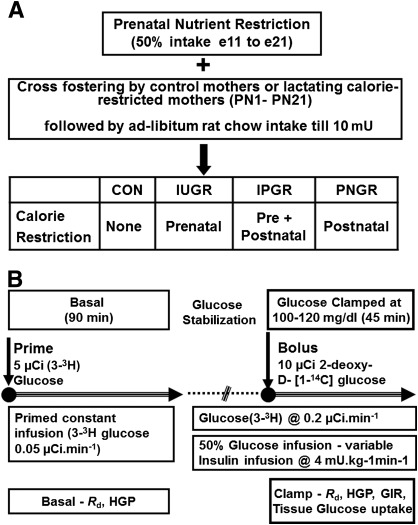
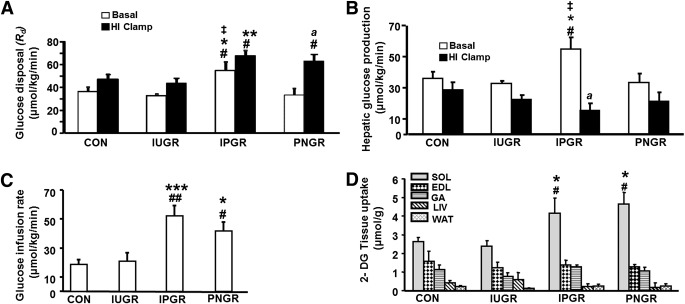
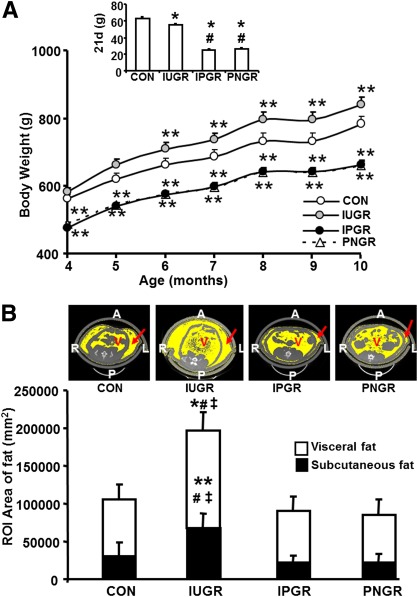
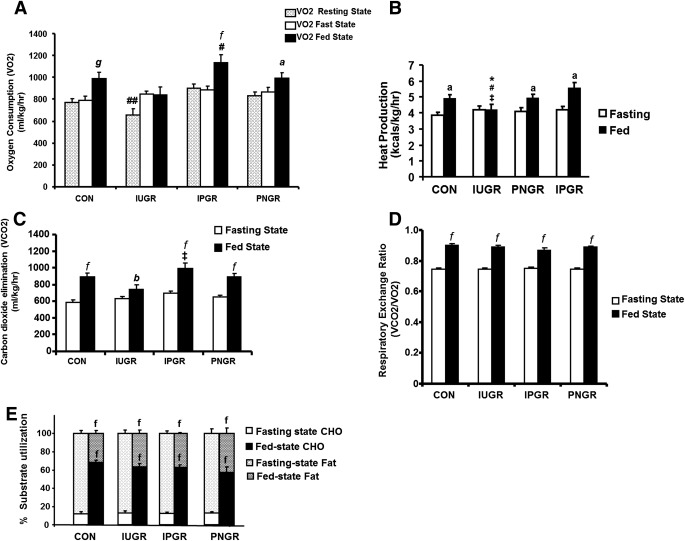
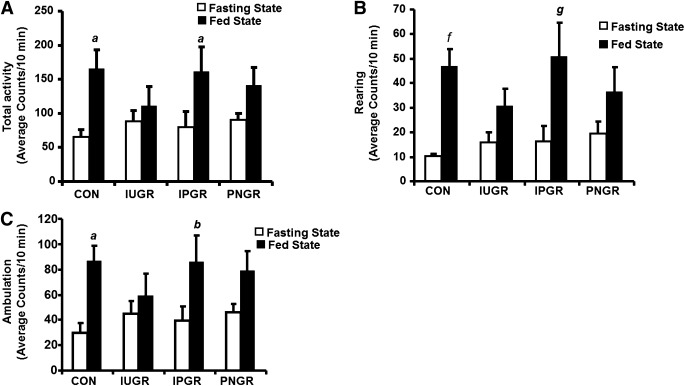
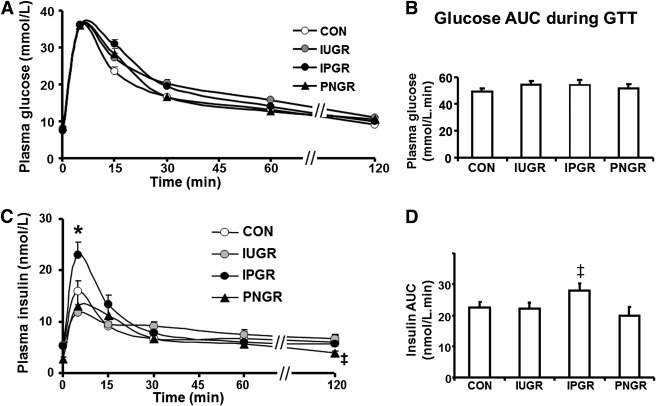
Postnatal ad libitum caloric intake superimposed on intrauterine growth restriction (IUGR) is associated with adult-onset obesity, insulin resistance, and type 2 diabetes mellitus (T2DM). We hypothesized that this paradigm of prenatal nutrient deprivation-induced programming can be reversed with the introduction of early postnatal calorie restriction. Ten-month-old male rats exposed to either prenatal nutrient restriction with ad libitum postnatal intake (IUGR), pre- and postnatal nutrient restriction (IPGR), or postnatal nutrient restriction limited to the suckling phase (50% from postnatal [PN]1 to PN21) (PNGR) were compared with age-matched controls (CON). Visceral adiposity, metabolic profile, and insulin sensitivity by hyperinsulinemic-euglycemic clamps were examined. The 10-month-old male IUGR group had a 1.5- to 2.0-fold increase in subcutaneous and visceral fat (P < 0.0002) while remaining euglycemic, insulin sensitive, inactive, and exhibiting metabolic inflexibility (Vo(2)) versus CON. The IPGR group remained lean, euglycemic, insulin sensitive, and active while maintaining metabolic flexibility. The PNGR group was insulin sensitive, similar to IPGR, but less active while maintaining metabolic flexibility. We conclude that IUGR resulted in obesity without insulin resistance and energy metabolic perturbations prior to development of glucose intolerance and T2DM. Postnatal nutrient restriction superimposed on IUGR was protective, restoring metabolic normalcy to a lean and active phenotype.
宫内生长受限(IUGR)后给予随意热量摄入会导致成年后肥胖、胰岛素抵抗和 2 型糖尿病(T2DM)。我们假设这种产前营养剥夺诱导编程的范式可以通过引入早期产后热量限制来逆转。将接受以下处理的 10 月龄雄性大鼠与年龄匹配的对照组(CON)进行比较:产前营养限制伴随意产后摄入(IUGR)、产前和产后营养限制(IPGR)或仅在哺乳阶段限制产后营养(50%从产后 [PN]1 至 PN21)(PNGR)。检查内脏脂肪堆积、代谢特征和胰岛素敏感性的高胰岛素-正常血糖钳夹试验。10 月龄的 IUGR 组的皮下和内脏脂肪增加了 1.5 到 2.0 倍(P < 0.0002),同时保持血糖正常、胰岛素敏感性、不活跃,并且表现出代谢灵活性(Vo(2))与 CON 相比。IPGR 组仍然保持消瘦、血糖正常、胰岛素敏感和活跃,同时保持代谢灵活性。PNGR 组与 IPGR 相似,胰岛素敏感,但活动量较低,同时保持代谢灵活性。我们得出结论,IUGR 导致肥胖,但在发展为葡萄糖耐量异常和 T2DM 之前没有胰岛素抵抗和能量代谢紊乱。IUGR 后给予的产后营养限制具有保护作用,可使代谢恢复正常,使大鼠保持消瘦和活跃的表型。