Bio-Crops Development Division, National Academy of Agricultural Sciences, Suwon 441-857, Republic of Korea.
Proteome Sci. 2012 Mar 31;10:25. doi: 10.1186/1477-5956-10-25.
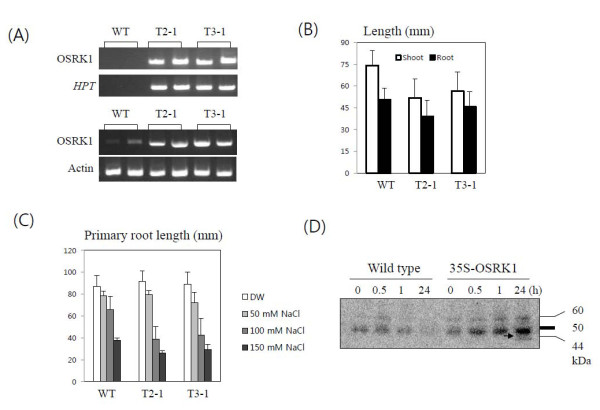
The rice roots are highly salt-sensitive organ and primary root growth is rapidly suppressed by salt stress. Sucrose nonfermenting 1-related protein kinase2 (SnRK2) family is one of the key regulator of hyper-osmotic stress signalling in various plant cells. To understand early salt response of rice roots and identify SnRK2 signaling components, proteome changes of transgenic rice roots over-expressing OSRK1, a rice SnRK2 kinase were investigated.
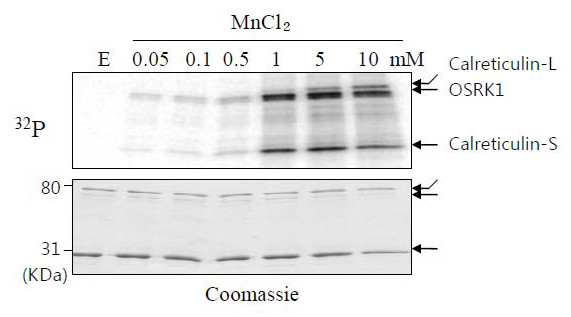
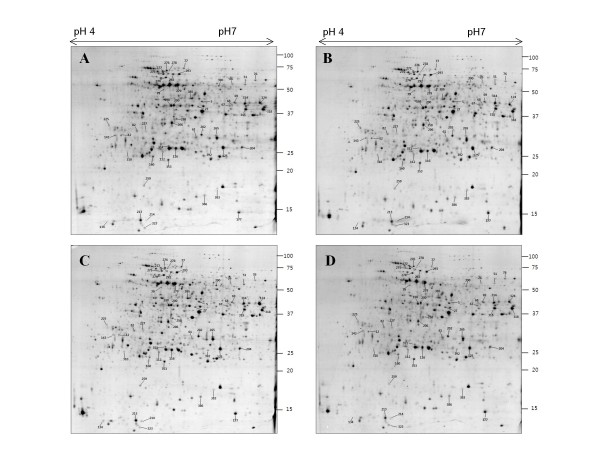
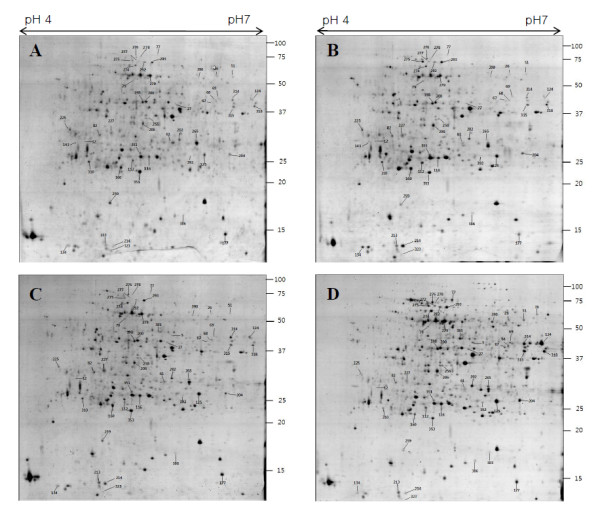
Proteomes were analyzed by two-dimensional electrophoresis and protein spots were identified by LC-MS/MS from wild type and OSRK1 transgenic rice roots exposed to 150 mM NaCl for either 3 h or 7 h. Fifty two early salt -responsive protein spots were identified from wild type rice roots. The major up-regulated proteins were enzymes related to energy regulation, amino acid metabolism, methylglyoxal detoxification, redox regulation and protein turnover. It is noted that enzymes known to be involved in GA-induced root growth such as fructose bisphosphate aldolase and methylmalonate semialdehyde dehydrogenase were clearly down-regulated. In contrast to wild type rice roots, only a few proteins were changed by salt stress in OSRK1 transgenic rice roots. A comparative quantitative analysis of the proteome level indicated that forty three early salt-responsive proteins were magnified in transgenic rice roots at unstressed condition. These proteins contain single or multiple potential SnRK2 recognition motives. In vitro kinase assay revealed that one of the identified proteome, calreticulin is a good substrate of OSRK1.
Our present data implicate that rice roots rapidly changed broad spectrum of energy metabolism upon challenging salt stress, and suppression of GA signaling by salt stress may be responsible for the rapid arrest of root growth and development. The broad spectrum of functional categories of proteins affected by over-expression of OSRK1 indicates that OSRK1 is an upstream regulator of stress signaling in rice roots. Enzymes involved in glycolysis, branched amino acid catabolism, dnaK-type molecular chaperone, calcium binding protein, Sal T and glyoxalase are potential targets of OSRK1 in rice roots under salt stress that need to be further investigated.
水稻根是高度盐敏感的器官,主根的生长会被盐胁迫迅速抑制。蔗糖非发酵 1 相关蛋白激酶 2(SnRK2)家族是各种植物细胞中超渗胁迫信号转导的关键调节因子之一。为了了解水稻根的早期盐响应,并鉴定 SnRK2 信号成分,我们研究了过表达水稻 SnRK2 激酶 OSRK1 的转基因水稻根的蛋白质组变化。
通过二维电泳分析蛋白质组,并用 LC-MS/MS 从暴露于 150mM NaCl 3 小时或 7 小时的野生型和 OSRK1 转基因水稻根中鉴定蛋白点。从野生型水稻根中鉴定出 52 个早期盐响应蛋白点。主要上调的蛋白质是与能量调节、氨基酸代谢、甲基乙二醛解毒、氧化还原调节和蛋白质周转有关的酶。值得注意的是,已知参与 GA 诱导根生长的酶,如果糖二磷酸醛缩酶和甲基丙二醛半醛脱氢酶,明显下调。与野生型水稻根相比,盐胁迫仅在 OSRK1 转基因水稻根中引起少数蛋白质的变化。对蛋白质组水平的比较定量分析表明,在无应激条件下,43 种早期盐响应蛋白在转基因水稻根中放大。这些蛋白质含有单个或多个潜在的 SnRK2 识别基序。体外激酶测定表明,鉴定出的蛋白质组之一钙网蛋白是 OSRK1 的良好底物。
我们目前的数据表明,水稻根在受到盐胁迫时迅速改变了广泛的能量代谢,而 GA 信号对盐胁迫的抑制可能是导致根生长和发育迅速停止的原因。OSRK1 过表达影响的蛋白质的广泛功能类别表明,OSRK1 是水稻根中应激信号的上游调节剂。参与糖酵解、支链氨基酸分解代谢、dnaK 型分子伴侣、钙结合蛋白、Sal T 和甲基乙二醛酶的酶是盐胁迫下水稻根中 OSRK1 的潜在靶点,需要进一步研究。