Blakey John D, Guy Debbie, Simpson Carl, Fearn Andrew, Cannaby Sharon, Wilson Petra, Shaw Dominick
Respiratory Biomedical Research Unit, University of Nottingham, Nottingham, UK.
BMJ Open. 2012 Mar 29;2(2):e000701. doi: 10.1136/bmjopen-2011-000701. Print 2012.
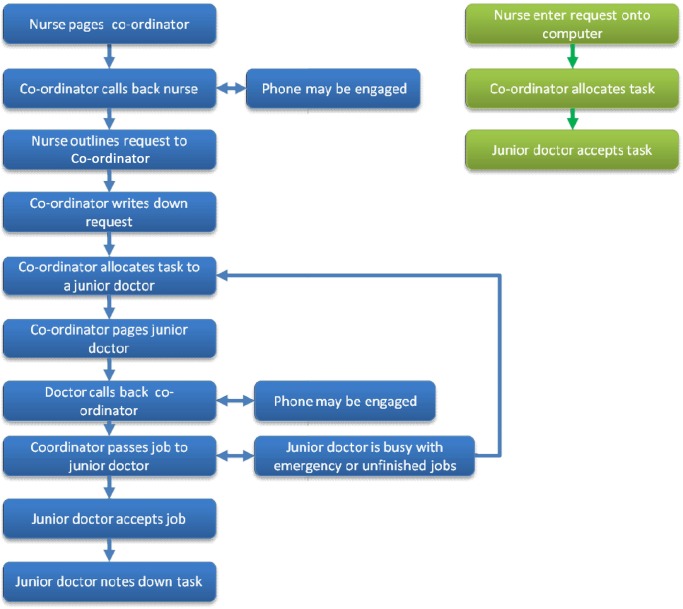
The authors investigated if a wireless system of call handling and task management for out of hours care could replace a standard pager-based system and improve markers of efficiency, patient safety and staff satisfaction.
Prospective assessment using both quantitative and qualitative methods, including interviews with staff, a standard satisfaction questionnaire, independent observation, data extraction from work logs and incident reporting systems and analysis of hospital committee reports.
A large teaching hospital in the UK.
Hospital at night co-ordinators, clinical support workers and junior doctors handling approximately 10 000 tasks requested out of hours per month.
Length of hospital stay, incidents reported, co-ordinator call logging activity, user satisfaction questionnaire, staff interviews.
Users were more satisfied with the new system (satisfaction score 62/90 vs 82/90, p=0.0080). With the new system over 70 h/week of co-ordinator time was released, and there were fewer untoward incidents related to handover and medical response (OR=0.30, p=0.02). Broad clinical measures (cardiac arrest calls for peri-arrest situations and length of hospital stay) improved significantly in the areas covered by the new system.
The introduction of call handling software and mobile technology over a medical-grade wireless network improved staff satisfaction with the Hospital at Night system. Improvements in efficiency and information flow have been accompanied by a reduction in untoward incidents, length of stay and peri-arrest calls.
作者研究了一种用于非工作时间护理的呼叫处理和任务管理无线系统是否可以取代基于传呼机的标准系统,并改善效率、患者安全和员工满意度指标。
采用定量和定性方法进行前瞻性评估,包括与工作人员访谈、标准满意度调查问卷、独立观察、从工作记录和事件报告系统中提取数据以及分析医院委员会报告。
英国一家大型教学医院。
夜间医院协调员、临床支持人员和初级医生,他们每月处理约10000项非工作时间请求的任务。
住院时间、报告的事件、协调员呼叫记录活动、用户满意度调查问卷、工作人员访谈。
用户对新系统更满意(满意度评分62/90对82/90,p=0.0080)。使用新系统后,每周释放了超过70小时的协调员时间,与交接和医疗响应相关的不良事件减少(OR=0.30,p=0.02)。在新系统覆盖的区域,广泛的临床指标(心脏骤停呼叫的围心脏骤停情况和住院时间)有显著改善。
通过医疗级无线网络引入呼叫处理软件和移动技术提高了员工对夜间医院系统的满意度。效率和信息流的改善伴随着不良事件、住院时间和围心脏骤停呼叫的减少。