Center for Clinical Molecular Medicine, Ministry of Education Key Laboratory of Child Development and Disorders, Chongqing International Science and Technology Cooperation Center for Child Development and Disorders, Children's Hospital, Chongqing Medical University, Chongqing 400014, China.
J Biomed Sci. 2012 Apr 3;19(1):38. doi: 10.1186/1423-0127-19-38.
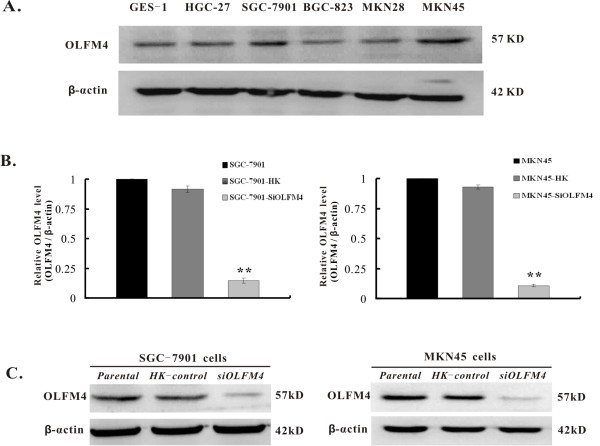
Human olfactomedin 4 (OLFM4) gene is a secreted glycoprotein more commonly known as the anti-apoptotic molecule GW112. OLFM4 is found to be frequently up-regulated in many types of human tumors including gastric cancer and it was believed to play significant role in the progression of gastric cancer. Although the function of OLFM4 has been indicated in many studies, recent evidence strongly suggests a cell or tissue type-dependent role of OLFM4 in cell growth and apoptosis. The aim of this study is to examine the role of gastric cancer-specific expression of OLFM4 in cell growth and apoptosis resistance.
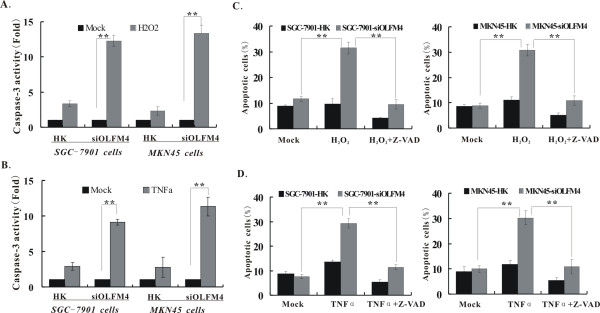
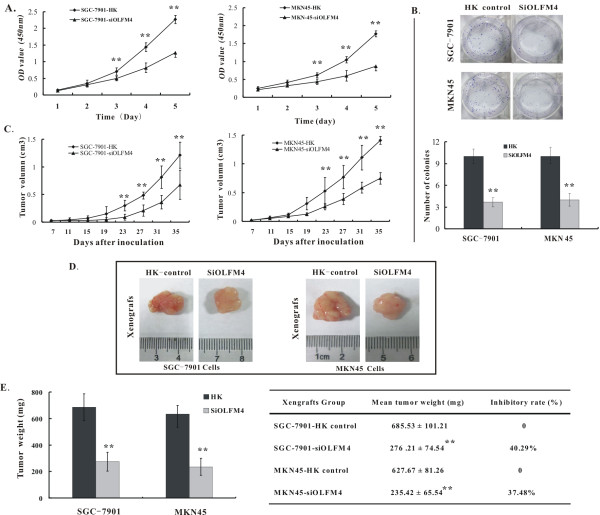
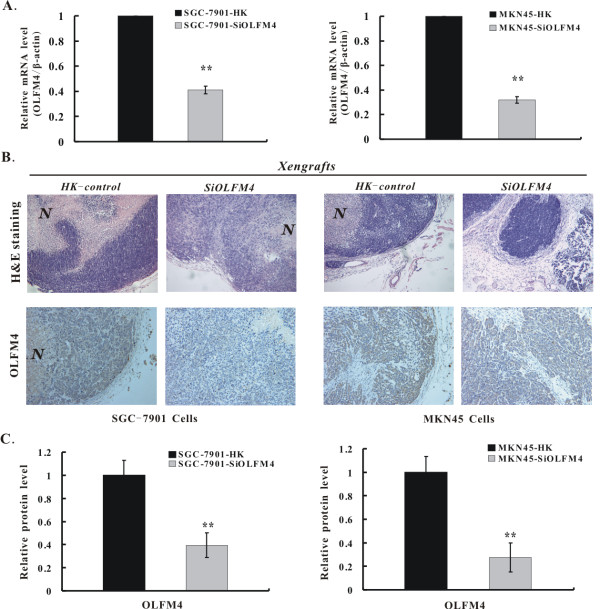
OLFM4 expression was eliminated by RNA interference in SGC-7901 and MKN45 cells. Cell proliferation, anchorage-independent growth, cell cycle and apoptosis were characterized in vitro. Tumorigenicity was analyzed in vivo. The apoptosis and caspase-3 activation in response to hydrogen peroxide (H2O2) or tumor necrosis factor-alpha (TNF α) were assessed in the presence or absence of caspase inhibitor Z-VAD-fmk.
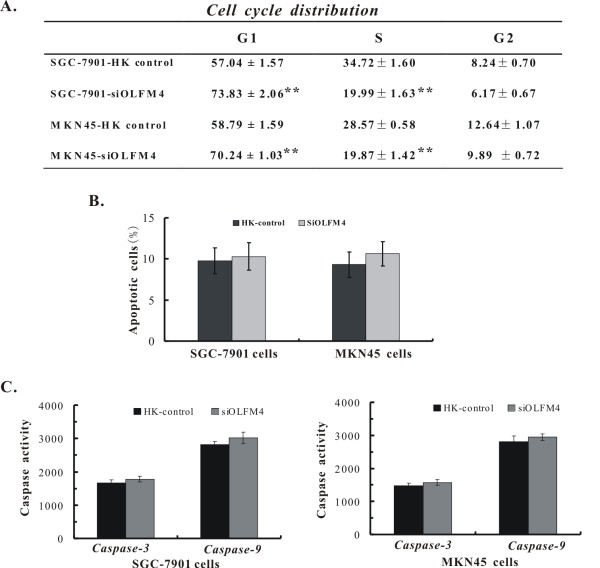
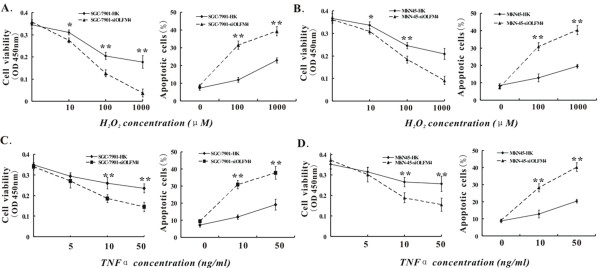
The elimination of OLFM4 protein by RNA interference in SGC-7901 and MKN45 cells significantly inhibits tumorigenicity both in vitro and in vivo by induction of cell G1 arrest (all P < 0.01). OLFM4 knockdown did not trigger obvious cell apoptosis but increased H2O2 or TNF α-induced apoptosis and caspase-3 activity (all P < 0.01). Treatment of Z-VAD-fmk attenuated caspase-3 activity and significantly reversed the H(2)O(2) or TNF α-induced apoptosis in OLFM4 knockdown cells (all P < 0.01).
Our study suggests that depletion of OLFM4 significantly inhibits tumorigenicity of the gastric cancer SGC-7901 and MKN45 cells. Blocking OLFM4 expression can sensitize gastric cancer cells to H2O2 or TNF α treatment by increasing caspase-3 dependent apoptosis. A combination strategy based on OLFM4 inhibition and anticancer drugs treatment may provide therapeutic potential in gastric cancer intervention.
人类嗅觉素 4(OLFM4)基因是一种分泌型糖蛋白,通常被称为抗凋亡分子 GW112。OLFM4 在包括胃癌在内的许多人类肿瘤中经常上调,并且被认为在胃癌的进展中发挥重要作用。尽管 OLFM4 的功能已在许多研究中得到证实,但最近的证据强烈表明 OLFM4 在细胞生长和凋亡中的作用依赖于细胞或组织类型。本研究旨在研究胃癌特异性 OLFM4 表达在细胞生长和抗凋亡中的作用。
通过 RNA 干扰消除 SGC-7901 和 MKN45 细胞中的 OLFM4 表达。在体外研究细胞增殖、锚定非依赖性生长、细胞周期和凋亡。体内分析肿瘤发生。在存在或不存在半胱氨酸天冬氨酸蛋白酶抑制剂 Z-VAD-fmk 的情况下,评估对过氧化氢(H2O2)或肿瘤坏死因子-α(TNFα)的凋亡和半胱氨酸天冬氨酸蛋白酶-3 激活。
SGC-7901 和 MKN45 细胞中 OLFM4 蛋白的 RNA 干扰消除显著抑制了体外和体内的肿瘤发生,通过诱导细胞 G1 期阻滞(均 P<0.01)。OLFM4 敲低不会引发明显的细胞凋亡,但增加了 H2O2 或 TNFα 诱导的凋亡和半胱氨酸天冬氨酸蛋白酶-3 活性(均 P<0.01)。Z-VAD-fmk 处理减弱了半胱氨酸天冬氨酸蛋白酶-3 活性,并显著逆转了 OLFM4 敲低细胞中 H2O2 或 TNFα 诱导的凋亡(均 P<0.01)。
我们的研究表明,OLFM4 的耗竭显著抑制了胃癌 SGC-7901 和 MKN45 细胞的肿瘤发生。阻断 OLFM4 表达可通过增加半胱氨酸天冬氨酸蛋白酶-3 依赖性凋亡使胃癌细胞对 H2O2 或 TNFα 治疗敏感。基于 OLFM4 抑制和抗癌药物治疗的联合策略可能为胃癌干预提供治疗潜力。