Cordingley M G, LaFemina R L, Callahan P L, Condra J H, Sardana V V, Graham D J, Nguyen T M, LeGrow K, Gotlib L, Schlabach A J
Department of Virus and Cell Biology, Merck Sharp and Dohme Research Laboratories, West Point, PA 19486.
Proc Natl Acad Sci U S A. 1990 Nov;87(22):8985-9. doi: 10.1073/pnas.87.22.8985.
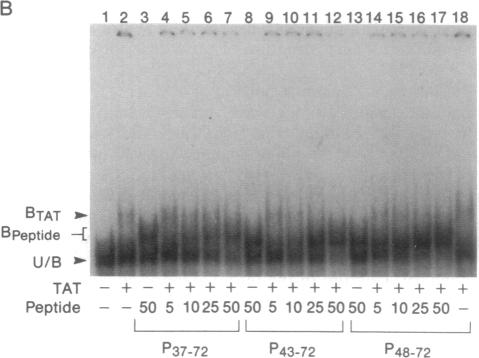
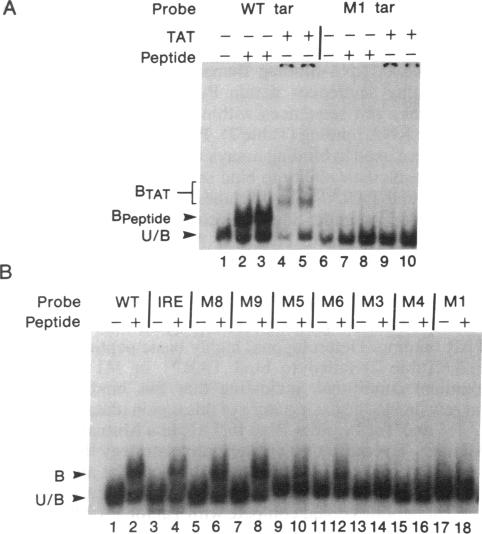
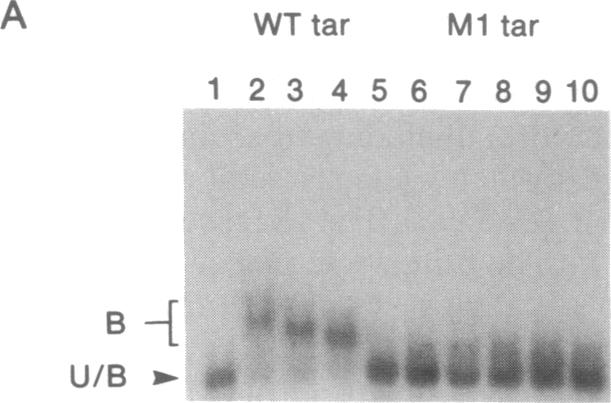
Bacterially expressed Tat protein of human immunodeficiency virus type 1 binds selectively to short RNA transcripts containing the viral transactivation-responsive element (TAR). Sequences sufficient for Tat interaction map to the distal portion of the TAR stem-loop. We show that critical sequences for Tat binding are located in the single-stranded "bulge," but no requirement for specific "loop" sequences could be demonstrated. TAR RNA competed for complex formation, and TAR mutants exhibited up to 10-fold reduced affinity for Tat. Synthetic peptides containing the basic region of Tat bound selectively to TAR RNA and exhibited the same sequence requirements and similar relative affinities for mutant TAR RNA as the intact protein. These results suggest that Tat contains a small RNA-binding domain capable of recognizing TAR and implicate functional relevance for direct Tat-TAR interaction in transactivation.
人类免疫缺陷病毒1型的细菌表达Tat蛋白选择性地结合含有病毒反式激活应答元件(TAR)的短RNA转录本。足以实现Tat相互作用的序列定位于TAR茎环的远端部分。我们发现,Tat结合的关键序列位于单链“凸起”处,但未证明对特定“环”序列有要求。TAR RNA竞争复合物形成,TAR突变体对Tat的亲和力降低了10倍。含有Tat碱性区域的合成肽选择性地结合TAR RNA,并且对突变TAR RNA表现出与完整蛋白相同的序列要求和相似的相对亲和力。这些结果表明,Tat含有一个能够识别TAR的小RNA结合结构域,并暗示Tat-TAR直接相互作用在反式激活中的功能相关性。