Broom's Barn Research Centre , Higham, Bury St Edmunds, Suffolk IP28 6NP , UK.
AoB Plants. 2010;2010:plq012. doi: 10.1093/aobpla/plq012. Epub 2010 Aug 9.
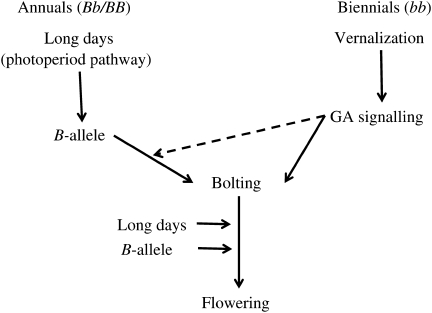
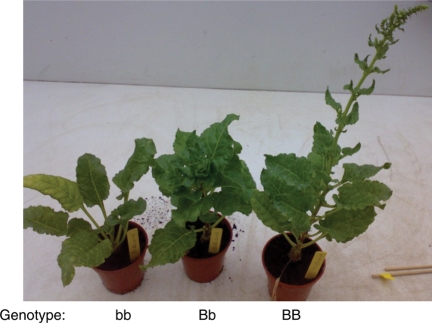
Bolting, the first visible sign of reproductive transition in beets (Beta vulgaris), is controlled by the dominant bolting gene B (B allele), which allows for flowering under long days (LDs, >14 h light) without prior vernalization. The B-locus carries recessive alleles (bb) in sugar beet (Beta vulgaris L. spp. vulgaris), so that vernalization and LDs are required for bolting and flowering. Gibberellin growth hormones (GAs) control stem elongation and reproductive development, but their role during these processes in sugar beet is not defined. We aimed to investigate the involvement of GAs in bolting and flowering in sugar beet, and also its relationship with the vernalization requirement as defined by the B-gene.
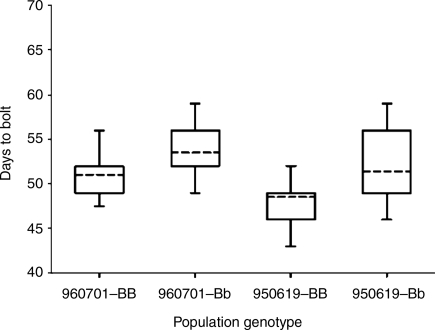
Plants segregating for the B allele were treated with exogenous GA(4) under inductive (16 h light) and non-inductive (8 h light) photoperiods, with and without prior vernalization treatment. A co-dominant polymerase chain reaction (PCR) marker was used to genotype the B-gene locus. Bolting and flowering dates were scored, and bolt heights were measured as appropriate. Analysis of variance was used to determine the effects and interactions of GAs, the B allele and vernalization on bolting and flowering. The effects of the B allele on bolting were also verified in the field.
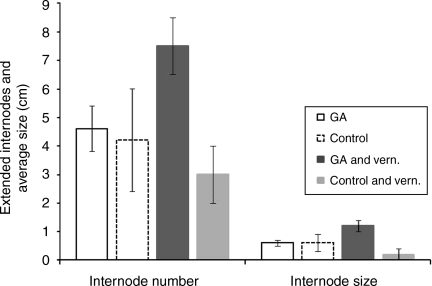
Application of GAs or the B allele could initiate bolting independently. When the B allele was absent, the applied GAs promoted stem growth, but did so only in vernalized plants, irrespective of photoperiod. Under LDs, bolt height before flowering in plants carrying the B allele (BB; Bb) was not significantly influenced by GAs. The timing and frequency of flowering were influenced by the B allele without interactive effects from GAs.
In sugar beet, GA acts independently of the B allele and photoperiod to induce bolting. Vernalization enables GA action independently of the B allele; hence, the dominant B allele may not directly participate in vernalization-induced bolting.
在甜菜(Beta vulgaris)中,抽薹是生殖转变的第一个可见标志,由显性抽薹基因 B(B 等位基因)控制,该基因允许在长日照(LDs,>14 小时光照)下开花,而无需先前的春化。B 基因座在糖甜菜(Beta vulgaris L. spp. vulgaris)中携带隐性等位基因(bb),因此抽薹和开花需要春化和 LDs。赤霉素生长激素(GAs)控制茎伸长和生殖发育,但它们在糖甜菜中这些过程中的作用尚未确定。我们旨在研究 GAs 在糖甜菜抽薹和开花中的作用,以及它与 B 基因定义的春化要求的关系。
在诱导(16 小时光照)和非诱导(8 小时光照)光周期下,用外源性 GA(4)处理分离出 B 等位基因的植物,有和没有预先春化处理。使用共显性聚合酶链反应(PCR)标记对 B 基因座进行基因分型。记录抽薹和开花日期,并适当测量抽薹高度。方差分析用于确定 GAs、B 等位基因和春化对抽薹和开花的影响及其相互作用。还在田间验证了 B 等位基因对抽薹的影响。
GA 的应用或 B 等位基因的存在可以独立引发抽薹。当不存在 B 等位基因时,施加的 GAs 促进茎生长,但仅在春化的植物中如此,而与光周期无关。在 LDs 下,携带 B 等位基因(BB;Bb)的植物在开花前的抽薹高度不受 GAs 的显著影响。开花的时间和频率受 B 等位基因的影响,而不受 GAs 的交互作用影响。
在糖甜菜中,GA 独立于 B 等位基因和光周期作用诱导抽薹。春化使 GA 作用独立于 B 等位基因;因此,显性 B 等位基因可能不会直接参与春化诱导的抽薹。