Department of Biology , University of Louisiana-Lafayette , Lafayette, LA 70504 , USA.
AoB Plants. 2011;2011:plr028. doi: 10.1093/aobpla/plr028. Epub 2011 Nov 17.
As remnants of the earliest land plants, the bryophytes (liverworts, mosses and hornworts) are important in understanding microtubule organization in plant cells. Land plants have an anastral mitotic spindle that forms in the absence of centrosomes, and a cytokinetic apparatus comprised of a predictive preprophase band (PPB) before mitosis and a phragmoplast after mitosis. These microtubule arrays have no counterpart in animal cells and the nature of the plant microtubule organizing centre (MTOC) remained an enigma for many years until antibodies to γ-tubulin, an essential component of the MTOC in all eukaryotes, became available for tracing the origin of microtubule arrays.
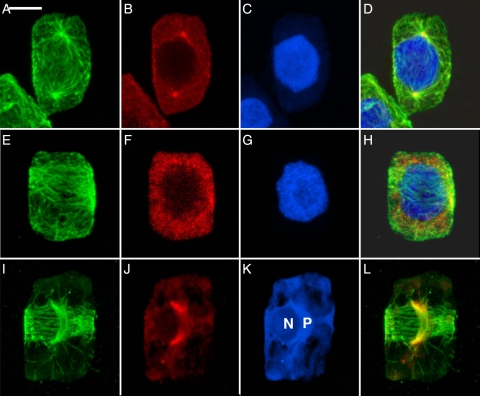
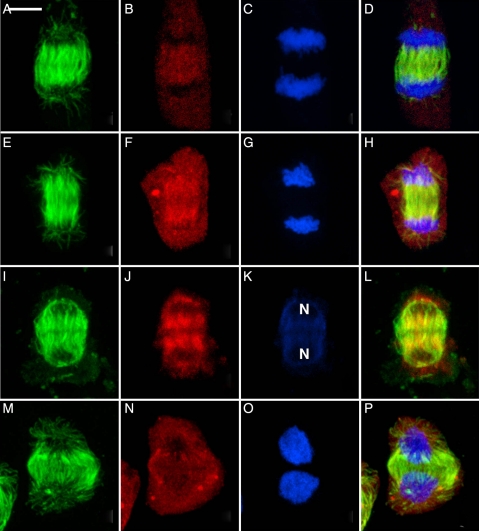
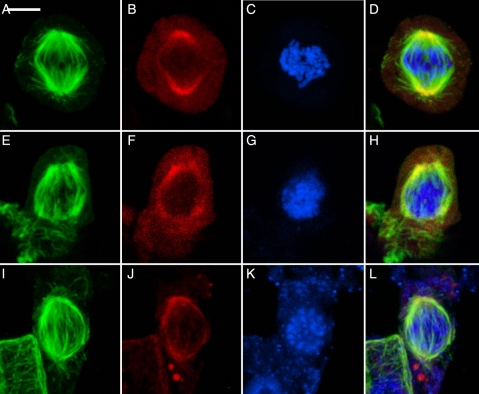
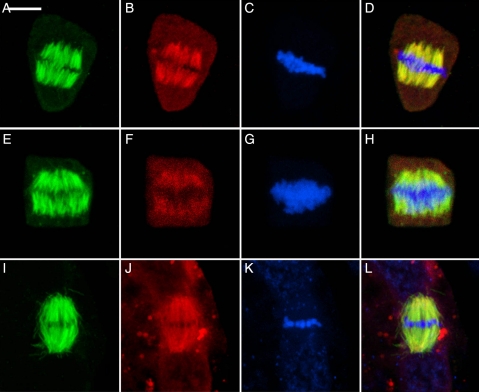
We used immunofluorescence techniques to colocalize γ-tubulin, microtubules and chromosomes in mitotic cells of a representative liverwort, moss and hornwort to study the organization of microtubules during mitotic cell division.
THE FUTURE DIVISION SITE IS MARKED BY A PPB IN ALL TAXA BUT THE MTOCS INITIALLY GENERATING THE HALF SPINDLES DIFFER: polar organizers in the liverwort, plastid MTOCs in the hornwort, and nuclear envelope-associated MTOCs in the moss. By mid-prophase, the forming spindles become more similar as γ-tubulin begins to spread around the polar regions of the nuclear envelope.
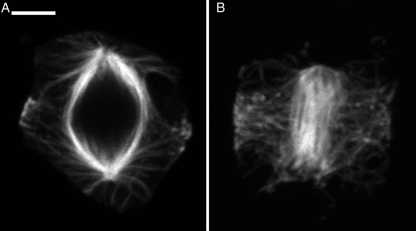
Regardless of origin, mature metaphase spindles are identical and indistinguishable from the typical anastral spindle of higher plants with broad polar regions consisting of numerous subsets of converging microtubules. A curious phenomenon of plant spindles, true of bryophytes as well as higher plants, is the movement of γ-tubulin into the metaphase spindle itself. The bipolar arrays of phragmoplast microtubules are organized by diffuse γ-tubulin located at proximal surfaces of reforming nuclear envelopes. Phragmoplast development appears similar in the three taxa and to vascular plants as well.
作为最早的陆生植物的残余物,苔藓植物(地钱、藓类和角苔)对于理解植物细胞中的微管组织非常重要。陆生植物有一个无中心体的无星纺锤体,在有丝分裂前有一个预测的前期带(PPB),在有丝分裂后有一个成膜体。这些微管阵列在动物细胞中没有对应物,植物微管组织中心(MTOC)的性质多年来一直是个谜,直到针对γ-微管蛋白的抗体可用,γ-微管蛋白是所有真核生物 MTOC 的一个必需组成部分,用于追踪微管阵列的起源。
我们使用免疫荧光技术,在代表地钱、藓类和角苔的有丝分裂细胞中使 γ-微管蛋白、微管和染色体共定位,以研究有丝分裂细胞分裂过程中微管的组织。
在所有分类群中,未来的分裂部位都有一个前期带标记,但最初产生半纺锤体的 MTOC 不同:地钱的极性组织者、角苔的质体 MTOC 和藓类的核膜相关 MTOC。在中期前期,形成的纺锤体变得更加相似,因为 γ-微管蛋白开始在核膜的极区周围扩散。
无论起源如何,成熟的中期纺锤体都是相同的,与具有宽极区的高等植物的典型无星纺锤体无法区分,宽极区由许多收敛微管的子集组成。植物纺锤体的一个奇特现象,在苔藓植物和高等植物中都存在,是 γ-微管蛋白进入中期纺锤体本身的运动。成膜体微管的双极阵列是由位于重建核膜近端表面的弥散 γ-微管蛋白组织的。三个分类群和成血管植物的成膜体发育似乎相似。