Department of Gastroenterology, Infectiology and Rheumatology, Charité-University Medicine Berlin, Berlin, Germany,
J Cachexia Sarcopenia Muscle. 2012 Jun;3(2):111-6. doi: 10.1007/s13539-012-0060-z. Epub 2012 Mar 30.
Reduced muscle strength is a cardinal feature in cachexia. We investigated whether weight loss is associated differently with muscle strength in men and women in a large cohort of hospitalized patients.
One thousand five hundred hospitalized patients (whereof 718 men, mean age 57.6 ± 16.0 years, mean body mass index (BMI) 24.6 ± 4.8 kg/m²) were included in the study. Non-edematous involuntary weight loss was determined with Subjective Global Assessment; isometric maximal muscle strength was evaluated by hand grip strength. Mid-upper arm circumference and triceps skinfold were used to calculate arm muscle area. Interrelationship between sex and weight loss was evaluated by regression analysis performed with the general linear model (GLM) allowing adjustment for continuous and categorical variables and corrected for age, arm muscle area (AMA), BMI, and diagnosis category (benign/malignant disease) as potentially confounding covariates.
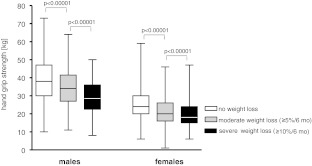
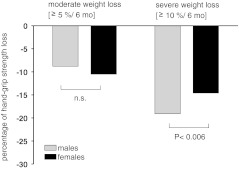
Both men and women exhibited a significant stepwise decrease of hand grip strength with increasing weight loss. Age, sex, moderate and severe weight loss, BMI, and AMA were significant predictors of hand grip strength. The GLM moreover revealed a significant sex × weight loss effect, since grip strength was similarly decreased in moderate weight loss in men and women when compared to control patients without weight loss (8.5% in men and 10.5% in women, not significant (n.s.)), but the further reduction of grip strength in severe weight loss was significantly different between men and women (10.6% vs. 4.1%, P = 0.033).
Our findings indicate sex-specific differences in muscle strength response to weight loss.
肌肉力量下降是恶病质的主要特征。我们研究了在一个大型住院患者队列中,体重减轻是否与男性和女性的肌肉力量相关不同。
本研究纳入了 1500 名住院患者(其中男性 718 名,平均年龄 57.6±16.0 岁,平均 BMI 24.6±4.8kg/m²)。非水肿性非自愿性体重减轻通过主观全面评估确定;等长最大肌肉力量通过握力评估。中上臂周长和三头肌皮褶用于计算手臂肌肉面积。通过一般线性模型(GLM)进行的回归分析评估性别与体重减轻之间的相互关系,该模型允许调整连续和分类变量,并校正年龄、手臂肌肉面积(AMA)、BMI 和诊断类别(良性/恶性疾病)作为潜在的混杂协变量。
男性和女性的握力均随着体重减轻呈显著逐步下降。年龄、性别、中度和重度体重减轻、BMI 和 AMA 是握力的显著预测因子。GLM 还显示了性别×体重减轻的显著效应,因为与没有体重减轻的对照患者相比,男性和女性的中度体重减轻时握力同样下降(男性 8.5%,女性 10.5%,无统计学意义(n.s.)),但严重体重减轻时握力的进一步下降在男性和女性之间存在显著差异(10.6%比 4.1%,P=0.033)。
我们的发现表明,肌肉力量对体重减轻的反应存在性别特异性差异。