Silva Junior João Manoel da, Rezende Ederlon, Amendola Cristina Prada, Tomita Rafael, Torres Daniele, Ferrari Maria Tereza, Toledo Diogo Oliveira, Oliveira Amanda Maria Ribas Rosa, Marques Juliana Andreia
Hospital do Servidor Público Estadual, São Paulo, Brazil.
Sao Paulo Med J. 2012;130(2):77-83. doi: 10.1590/s1516-31802012000200002.
Anemia and blood transfusions are common in intensive care. This study aimed to evaluate epidemiology and outcomes among critically ill patients under a restrictive transfusion strategy.
Prospective observational cohort study in an intensive care unit (ICU) at a tertiary hospital.
All adults admitted to the ICU over a one-year period who remained there for more than 72 hours were included, except those with acute coronary syndrome, ischemic stroke, acute hemorrhage, prior transfusion, pregnant women and Jehovah's Witnesses. The restrictive strategy consisted of transfusion indicated when hemoglobin levels were less than or equal to 7.0 g/dl.
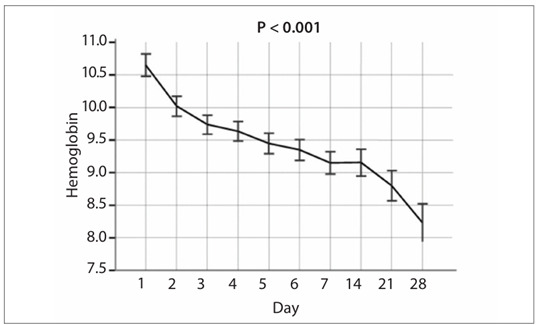
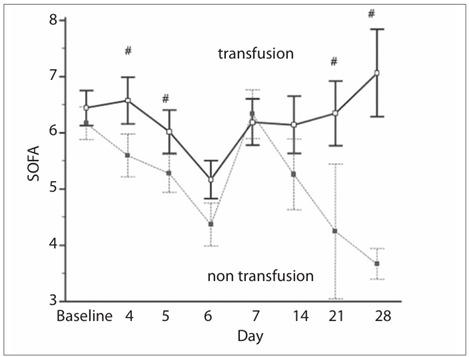
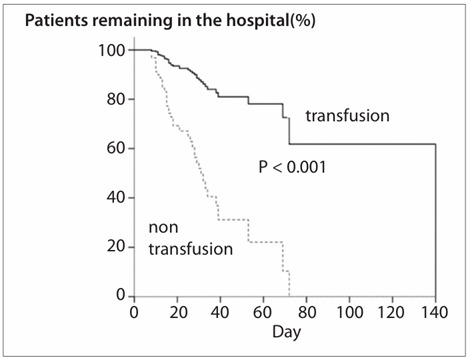
The study enrolled 167 patients; the acute physiology and chronic health evaluation II (APACHE II) score was 28.9 ± 6.5. The baseline hemoglobin level was 10.6 ± 2.2 g/dl and on day 28, it was 8.2 ± 1.3 g/dl (P < 0.001). Transfusions were administered to 35% of the patients. In the transfusion group, 61.1% did not survive, versus 48.6% in the non-transfusion group (P = 0.03). Transfusion was an independent risk factor for mortality (P = 0.011; odds ratio, OR = 2.67; 95% confidence interval, CI = 1.25 to 5.69). ICU stay and hospital stay were longer in the transfusion group: 20.0 (3.0-83.0) versus 8.0 (3.0-63.0) days (P < 0,001); and 24.0 (3.0-140.0) versus 14.0 (3.0-80.0) days (P = 0.002), respectively.
In critically ill patients, there was a reduction in hemoglobin with increasing length of ICU stay. Moreover, transfusion was associated with worse prognoses.
贫血和输血在重症监护中很常见。本研究旨在评估采用限制性输血策略的重症患者的流行病学情况及预后。
在一家三级医院的重症监护病房(ICU)进行的前瞻性观察队列研究。
纳入在一年期间入住ICU且停留时间超过72小时的所有成年患者,但急性冠状动脉综合征、缺血性中风、急性出血、既往输血、孕妇和耶和华见证会成员除外。限制性策略为当血红蛋白水平小于或等于7.0 g/dl时进行输血。
该研究纳入了167例患者;急性生理与慢性健康状况评分系统II(APACHE II)评分为28.9±6.5。基线血红蛋白水平为10.6±2.2 g/dl,在第28天时为8.2±1.3 g/dl(P<0.001)。35%的患者接受了输血。在输血组中,61.1%的患者未存活,而非输血组为48.6%(P = 0.03)。输血是死亡的独立危险因素(P = 0.011;比值比,OR = 2.67;95%置信区间,CI = 1.25至5.69)。输血组的ICU住院时间和住院时间更长:分别为20.0(3.0 - 83.0)天和8.0(3.0 - 63.0)天(P<0.001);以及24.0(3.0 - 140.0)天和14.0(3.0 - 80.0)天(P = 0.002)。
在重症患者中,随着ICU住院时间的延长,血红蛋白水平降低。此外,输血与更差的预后相关。