Center for Animal Genomics, Veterinary Faculty, University of Ljubljana, Ljubljana, Slovenia.
Horm Behav. 2012 May;61(5):719-24. doi: 10.1016/j.yhbeh.2012.03.008. Epub 2012 Mar 30.
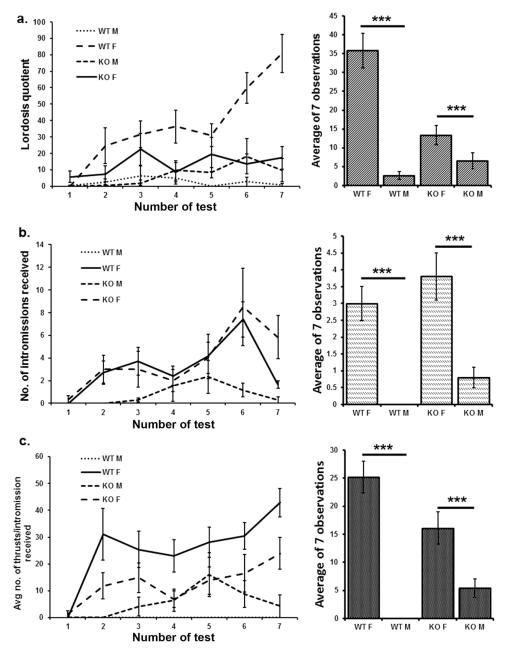
Female receptivity including the immobile hormone-dependent lordosis posture is essential for successful reproduction in rodents. It is well documented that lordosis is organized during the perinatal period when the actions of androgens decrease the males' ability to display this behavior in adulthood. Conversely the absence of androgens, and the presence of low levels of prepubertal estrogens, preserve circuitry that regulates this behavior in females. The current study set out to determine whether sex chromosomal genes are involved in the differentiation of this behavior. An agonadal mouse model was used to test this hypothesis. The SF-1 gene (Nr5a1) is required for development of gonads and adrenal glands, and knockout mice are consequently not exposed to endogenous gonadal steroids. Thus contributions of sex chromosome genes can be disassociated from the actions of estrogens. Use of this model reveals a direct genetic contribution from sex chromosomes in the display of lordosis and other female-typical sexual behavior patterns. It is likely that the concentrations of gonadal steroids present during normal male development modify the actions of sex chromosome genes on the potential to display female sexual behavior.
雌性接受能力,包括不动的激素依赖性发情姿势,是啮齿动物成功繁殖所必需的。有充分的文献记载表明,发情是在围产期组织的,此时雄激素的作用降低了雄性在成年后表现这种行为的能力。相反,雄激素的缺乏和青春期前雌激素水平的降低,会保留调节雌性这种行为的电路。本研究旨在确定性染色体基因是否参与这种行为的分化。使用去势小鼠模型来检验这一假设。SF-1 基因(Nr5a1)是性腺和肾上腺发育所必需的,因此敲除小鼠不会接触内源性性腺类固醇。因此,可以将性染色体基因的作用与雌激素的作用区分开来。使用这种模型揭示了性染色体在发情和其他女性典型性行为模式表现中的直接遗传贡献。很可能是在正常男性发育过程中存在的性腺类固醇浓度修饰了性染色体基因对表现女性性行为潜力的作用。