CNRS UMR2027, Centre Universitaire, Orsay, France.
FEBS J. 2012 Jun;279(12):2108-19. doi: 10.1111/j.1742-4658.2012.08597.x. Epub 2012 May 9.
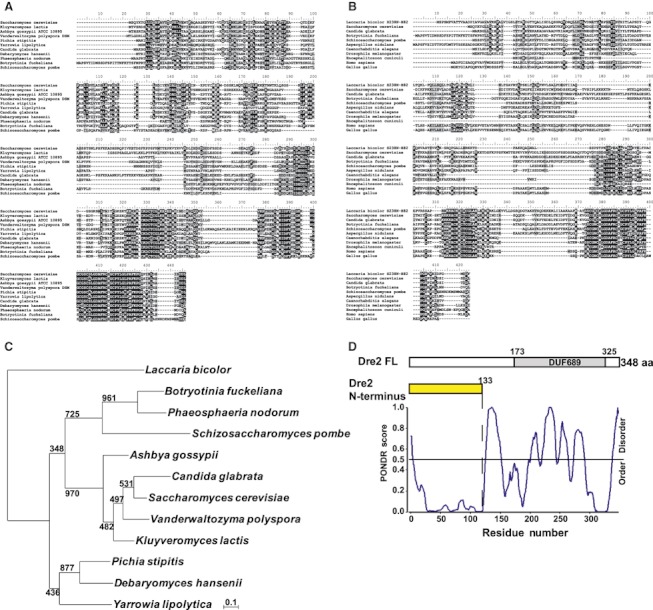
Yeast Dre2 is an essential Fe-S cluster-containing protein that has been implicated in cytosolic Fe-S protein biogenesis and in cell death regulation in response to oxidative stress. Its absence in yeast can be complemented by the human homologous antiapoptotic protein cytokine-induced apoptosis inhibitor 1 (also known as anamorsin), suggesting at least one common function. Using complementary techniques, we have investigated the biochemical and biophysical properties of Dre2. We show that it contains an N-terminal domain whose structure in solution consists of a stable well-structured monomer with an overall typical S-adenosylmethionine methyltransferase fold lacking two α-helices and a β-strand. The highly conserved C-terminus of Dre2, containing two Fe-S clusters, influences the flexibility of the N-terminal domain. We discuss the hypotheses that the activity of the N-terminal domain could be modulated by the redox activity of Fe-S clusters containing the C-terminus domain in vivo.
酵母 Dre2 是一种必需的含 Fe-S 簇的蛋白质,它与细胞质 Fe-S 蛋白生物发生以及对氧化应激的细胞死亡调节有关。酵母中该蛋白的缺失可以通过人类同源抗凋亡蛋白细胞因子诱导的凋亡抑制剂 1(也称为 anamorsin)来补充,这表明至少有一个共同的功能。我们使用互补技术研究了 Dre2 的生化和生物物理特性。我们表明,它包含一个 N 端结构域,该结构域在溶液中的结构由一个稳定的、结构良好的单体组成,其整体具有典型的 S-腺苷甲硫氨酸甲基转移酶折叠,缺少两个α-螺旋和一个β-折叠。Dre2 的高度保守的 C 端含有两个 Fe-S 簇,影响 N 端结构域的灵活性。我们讨论了以下假说:N 端结构域的活性可能通过体内含有 C 端结构域的 Fe-S 簇的氧化还原活性来调节。