Musculoskeletal Research Unit, School of Clinical Sciences, University of Bristol, Bristol, UK.
J Bone Miner Res. 2012 Sep;27(9):1887-95. doi: 10.1002/jbmr.1631.
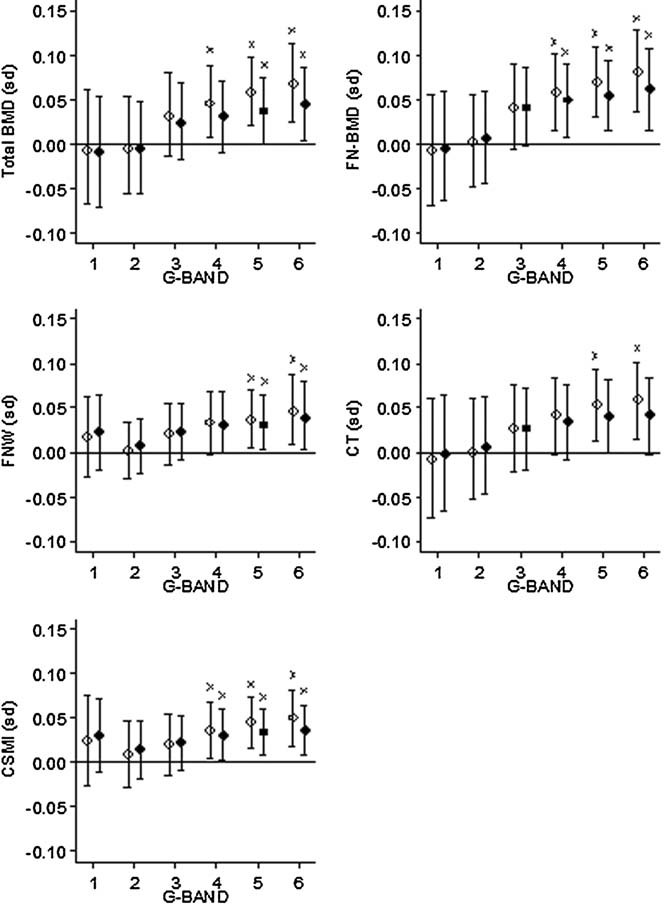
Whether a certain level of impact needs to be exceeded for physical activity (PA) to benefit bone accrual is currently unclear. To examine this question, we performed a cross-sectional analysis between PA and hip BMD in 724 adolescents (292 boys, mean 17.7 years) from the Avon Longitudinal Study of Parents and Children (ALSPAC), partitioning outputs from a Newtest accelerometer into six different impact bands. Counts within 2.1 to 3.1g, 3.1 to 4.2g, 4.2 to 5.1g, and >5.1g bands were positively related to femoral neck (FN) BMD, in boys and girls combined, in our minimally adjusted model including age, height, and sex (0.5-1.1g: beta = -0.007, p = 0.8; 1.1-2.1g: beta = 0.003, p = 0.9; 2.1-3.1g: beta = 0.042, p = 0.08; 3.1-4.2g: beta = 0.058, p = 0.009; 4.2-5.1g: beta = 0.070, p = 0.001; >5.1g: beta = 0.080, p < 0.001) (beta = SD change per doubling in activity). Similar positive relationships were observed between high-impact bands and BMD at other hip sites (ward's triangle, total hip), hip structure indices derived by hip structural analysis of dual-energy X-ray absorptiometry (DXA) scans (FN width, cross-sectional area, cortical thickness), and predicted strength (cross-sectional moment of inertia). In analyses where adjacent bands were combined and then adjusted for other impacts, high impacts (>4.2g) were positively related to FN BMD, whereas, if anything, moderate (2.1-4.2g) and low impacts (0.5-2.1g) were inversely related (low: beta = -0.052, p = 0.2; medium: beta = -0.058, p = 0.2; high: beta = 0.137, p < 0.001). Though slightly attenuated, the positive association between PA and FN BMD, confined to high impacts, was still observed after adjustment for fat mass, lean mass, and socioeconomic position (high: beta = 0.096, p = 0.016). These results suggest that PA associated with impacts >4.2g, such as jumping and running (which further studies suggested requires speeds >10 km/h) is positively related to hip BMD and structure in adolescents, whereas moderate impact activity (eg, jogging) is of little benefit. Hence, PA may only strengthen lower limb bones in adolescents, and possibly adults, if this comprises high-impact activity.
目前尚不清楚体力活动(PA)需要达到何种程度才能有益于骨量增加。为了检验这一问题,我们对 724 名青少年(男 292 名,平均年龄 17.7 岁)的 PA 与髋部骨密度(BMD)进行了横断面分析,这些青少年来自阿冯纵向父母和儿童研究(ALSPAC),将 Newtest 加速度计的输出分为六个不同的冲击带。在我们最小调整模型中,包括年龄、身高和性别,2.1 至 3.1g、3.1 至 4.2g、4.2 至 5.1g 和>5.1g 带中的计数与股骨颈(FN)BMD 呈正相关,男孩和女孩均如此(0.5-1.1g:β=-0.007,p=0.8;1.1-2.1g:β=0.003,p=0.9;2.1-3.1g:β=0.042,p=0.08;3.1-4.2g:β=0.058,p=0.009;4.2-5.1g:β=0.070,p=0.001;>5.1g:β=0.080,p<0.001)(β=每活动增加一倍的 SD 变化)。在髋部其他部位(ward 三角区、全髋)、双能 X 射线吸收法(DXA)扫描的髋部结构分析得出的髋部结构指数(FN 宽度、横截面积、皮质厚度)和预测强度(横截面对矩惯性矩)中,也观察到高冲击带与 BMD 之间存在类似的正相关关系。在将相邻带合并并对其他冲击进行调整的分析中,高冲击(>4.2g)与 FN BMD 呈正相关,而适度(2.1-4.2g)和低冲击(0.5-2.1g)则呈负相关(低:β=-0.052,p=0.2;中:β=-0.058,p=0.2;高:β=0.137,p<0.001)。尽管略有减弱,但在调整体脂量、瘦体量和社会经济地位后,PA 与 FN BMD 之间的正相关关系仍然局限于高冲击(高:β=0.096,p=0.016)。这些结果表明,与冲击>4.2g 相关的 PA,如跳跃和跑步(进一步研究表明,这需要速度>10km/h),与青少年髋部 BMD 和结构呈正相关,而适度冲击活动(如慢跑)则几乎没有益处。因此,如果 PA 包括高冲击活动,那么它可能只会增强青少年和成年人下肢骨骼的强度。