Department of Urology, Henry Ford Health Systems, Detroit, Michigan, United States of America.
PLoS One. 2012;7(4):e34875. doi: 10.1371/journal.pone.0034875. Epub 2012 Apr 6.
The identification of a blood-based diagnostic marker is a goal in many areas of medicine, including the early diagnosis of prostate cancer. We describe the use of averaged differential display as an efficient mechanism for biomarker discovery in whole blood RNA. The process of averaging reduces the problem of clinical heterogeneity while simultaneously minimizing sample handling.
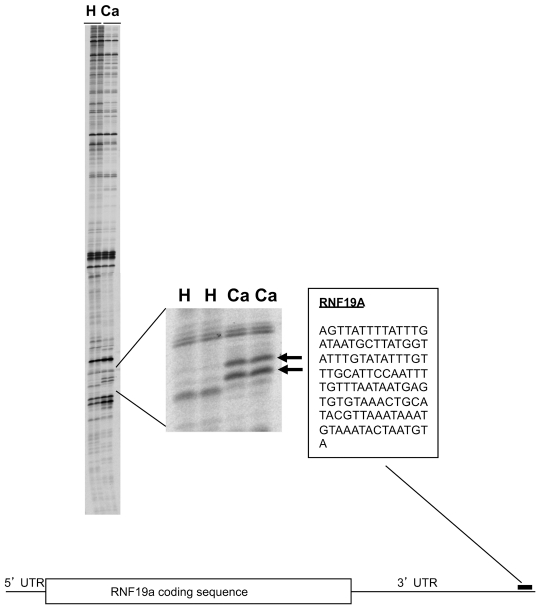
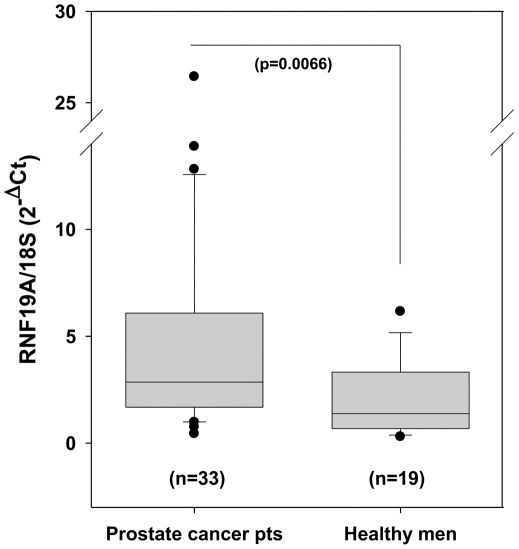
METHODOLOGY/PRINCIPAL FINDINGS: RNA was isolated from the blood of prostate cancer patients and healthy controls. Samples were pooled and subjected to the averaged differential display process. Transcripts present at different levels between patients and controls were purified and sequenced for identification. Transcript levels in the blood of prostate cancer patients and controls were verified by quantitative RT-PCR. Means were compared using a t-test and a receiver-operating curve was generated. The Ring finger protein 19A (RNF19A) transcript was identified as having higher levels in prostate cancer patients compared to healthy men through the averaged differential display process. Quantitative RT-PCR analysis confirmed a more than 2-fold higher level of RNF19A mRNA levels in the blood of patients with prostate cancer than in healthy controls (p = 0.0066). The accuracy of distinguishing cancer patients from healthy men using RNF19A mRNA levels in blood as determined by the area under the receiving operator curve was 0.727.
CONCLUSIONS/SIGNIFICANCE: Averaged differential display offers a simplified approach for the comprehensive screening of body fluids, such as blood, to identify biomarkers in patients with prostate cancer. Furthermore, this proof-of-concept study warrants further analysis of RNF19A as a clinically relevant biomarker for prostate cancer detection.
在医学的许多领域,包括前列腺癌的早期诊断,确定基于血液的诊断标志物是一个目标。我们描述了使用平均差异显示作为在全血 RNA 中发现生物标志物的有效机制。平均化过程减少了临床异质性的问题,同时最大限度地减少了样本处理。
方法/主要发现:从前列腺癌患者和健康对照者的血液中分离 RNA。将样本汇集并进行平均差异显示处理。从患者和对照者之间水平不同的转录本中纯化并测序以鉴定。通过定量 RT-PCR 验证前列腺癌患者和对照者血液中的转录本水平。使用 t 检验比较平均值,并生成接收者操作曲线。通过平均差异显示过程,鉴定出环状指蛋白 19A(RNF19A)转录本在前列腺癌患者中的水平高于健康男性。定量 RT-PCR 分析证实,与健康对照者相比,前列腺癌患者血液中 RNF19A mRNA 水平高出 2 倍以上(p=0.0066)。使用血液中 RNF19A mRNA 水平区分癌症患者和健康男性的准确性通过接收者操作曲线下的面积确定为 0.727。
结论/意义:平均差异显示为全面筛选血液等体液中的生物标志物提供了一种简化的方法,以鉴定前列腺癌患者的生物标志物。此外,这项概念验证研究证明了 RNF19A 作为前列腺癌检测的临床相关生物标志物的进一步分析是合理的。