School of Health and Population Sciences, College of Medical and Dental Sciences, University of Birmingham, Birmingham, UK.
Lancet. 2012 Apr 14;379(9824):1419-27. doi: 10.1016/S0140-6736(11)61650-4. Epub 2012 Apr 10.
Vitamin D has a role in regulating immune function, and its deficiency is a suggested risk factor for childhood pneumonia. Our aim was to assess whether oral supplementation of vitamin D(3) (cholecalciferol) will reduce the incidence and severity of pneumonia in a high-risk infant population.
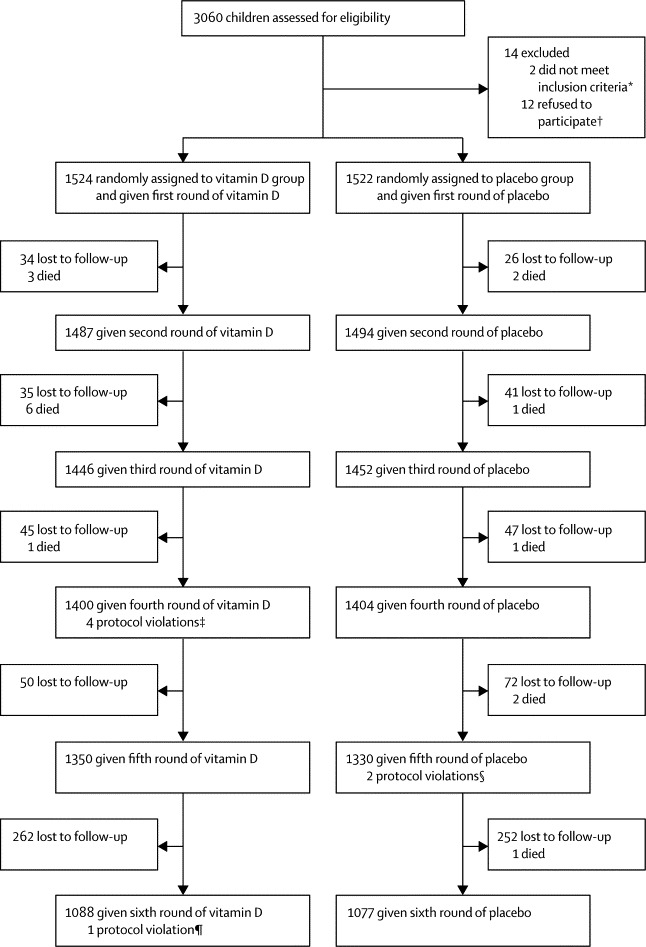
We did a randomised placebo-controlled trial to compare oral 100,000 IU (2·5 mg) vitamin D(3) with placebo given to children aged 1-11 months in Kabul, Afghanistan. Randomisation was by use of a computer-generated list. Vitamin D or placebo was given by fieldworkers once every 3 months for 18 months. Children presenting at the study hospital with signs of pneumonia had their diagnosis confirmed radiographically. Our primary outcome was the first or only episode of radiologically confirmed pneumonia. Our analysis was by intention to treat. This study is registered with ClinicalTrials.gov, number NCT00548379.
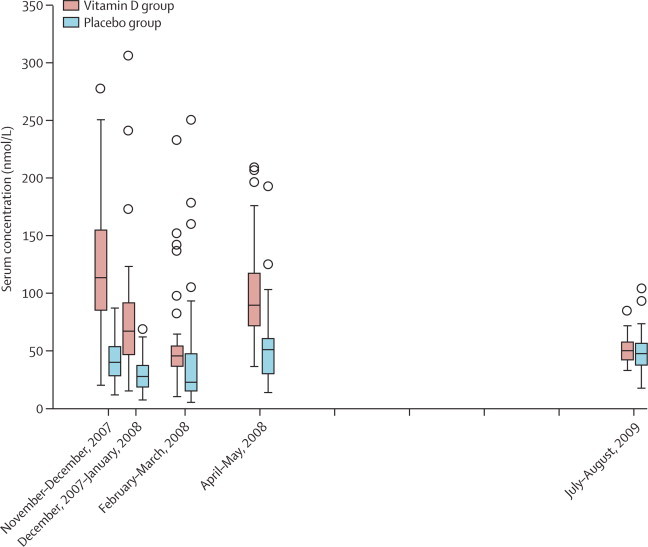
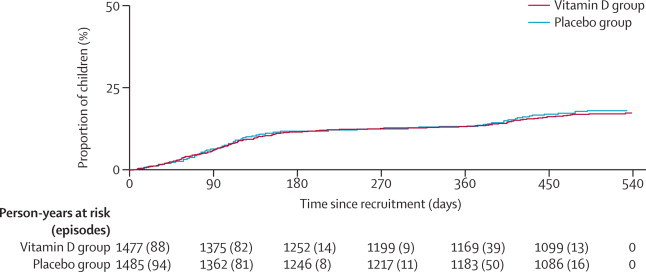
1524 children were assigned to receive vitamin D(3) and 1522 placebo. There was no significant difference between the incidence of first or only pneumonia between the vitamin D (0·145 per child per year, 95% CI 0·129-0·164) and the placebo group (0.137, 0·121-0·155); the incidence rate ratio was 1·06 (95% CI 0·89-1·27). From 652 children during five separate periods of testing serum calcifediol, only one child in each of two testing periods had results greater than 375 nmol/L in the intervention group--a toxic level.
Quarterly bolus doses of oral vitamin D(3) supplementation to infants are not an effective intervention to reduce the incidence of pneumonia in infants in this setting.
Wellcome Trust and British Council.
维生素 D 在调节免疫功能方面发挥着作用,其缺乏被认为是儿童肺炎的一个风险因素。我们旨在评估口服维生素 D(3)(胆钙化醇)补充剂是否会降低高危婴儿人群中肺炎的发病率和严重程度。
我们进行了一项随机安慰剂对照试验,比较了阿富汗喀布尔 1-11 个月大的儿童口服 100000IU(2.5mg)维生素 D(3)与安慰剂。随机分组采用计算机生成的列表。维生素 D 或安慰剂由现场工作人员每 3 个月给药一次,共 18 个月。在研究医院出现肺炎体征的儿童通过放射学确认其诊断。我们的主要结局是首次或唯一一次经放射学确认的肺炎发作。我们的分析是基于意向治疗。这项研究在 ClinicalTrials.gov 注册,编号为 NCT00548379。
1524 名儿童被分配接受维生素 D(3)治疗,1522 名儿童接受安慰剂治疗。维生素 D 组(0.145 例/儿童/年,95%CI0.129-0.164)与安慰剂组(0.137,0.121-0.155)之间首次或唯一肺炎的发生率无显著差异;发病率比为 1.06(95%CI0.89-1.27)。在 5 个单独的血清钙三醇检测周期中,从 652 名儿童中仅检测到 2 个检测周期中各有 1 名儿童的结果大于 375nmol/L-一个毒性水平。
在这种情况下,给婴儿口服维生素 D(3)补充剂进行季度大剂量冲击治疗不是一种有效降低婴儿肺炎发病率的干预措施。
惠康信托基金会和英国文化协会。