Institute of Molecular Virology (IMV), Centre of Molecular Biology of Inflammation (ZMBE), Muenster University Hospital, Von-Esmarch-Str. 56, D-48149 Muenster, Germany.
Cell Death Dis. 2012 Apr 12;3(4):e297. doi: 10.1038/cddis.2012.37.
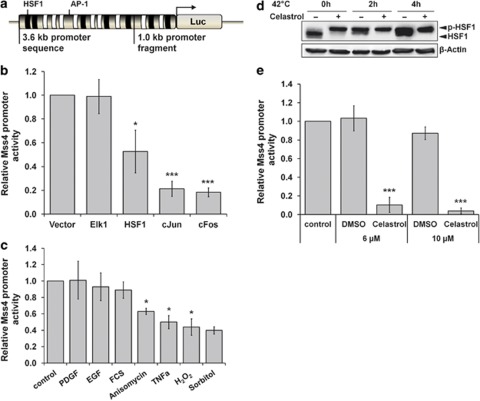
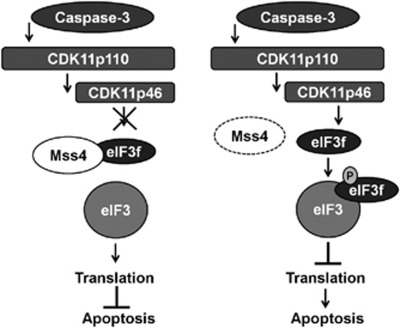
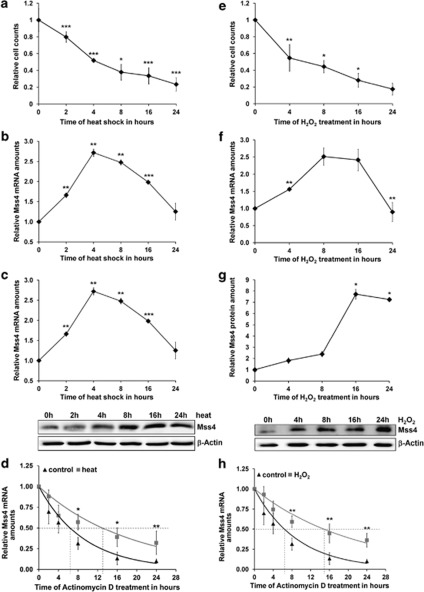
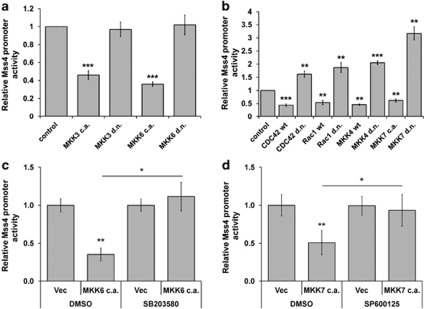
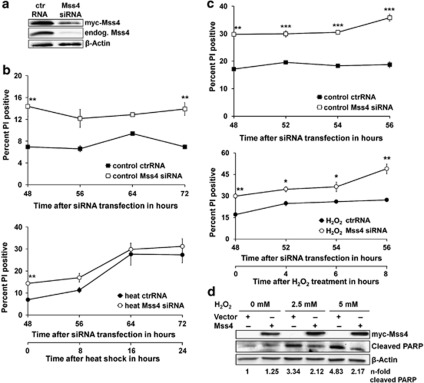
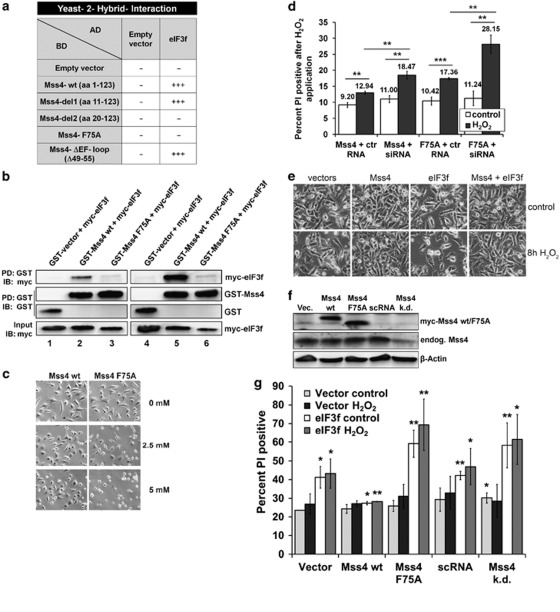
Mss4 (mammalian suppressor of Sec4) is an evolutionarily highly conserved protein and shows high sequence and structural similarity to nucleotide exchange factors. Although Mss4 tightly binds a series of exocytic Rab GTPases, it exercises only a low catalytic activity. Therefore Mss4 was proposed to work rather as a chaperone, protecting nucleotide free Rabs from degradation than as a nucleotide exchange factor. Here we provide further evidence for chaperone-like properties of Mss4. We show that expression levels of cellular Mss4 mRNA and protein are rapidly changed in response to a broad range of extracellular stress stimuli. The alterations are regulated mostly via the (c-jun NH(2)-terminal kinase) JNK stress MAPK signaling pathway and the mode of regulation resembles that of heat shock proteins. Similar to heat shock proteins, upregulation of Mss4 after stress stimulation functions protectively against the programmed cell death. Molecular analysis of the Mss4-mediated inhibition of apoptosis showed that interaction of Mss4 with eIF3f (eukaryotic translation initiation factor 3 subunit f), a member of the translation initiation complex and a protein with distinct pro-apoptotic properties, is the critical event in the anti-apoptotic action of Mss4.
Mss4(哺乳动物 Sec4 的抑制剂)是一种进化上高度保守的蛋白质,与核苷酸交换因子具有高度的序列和结构相似性。尽管 Mss4 紧密结合一系列外排 Rab GTPases,但它只表现出低的催化活性。因此,Mss4 被认为更像是一种伴侣蛋白,而不是核苷酸交换因子,它可以保护无核苷酸的 Rab 免受降解。在这里,我们提供了 Mss4 具有伴侣样特性的进一步证据。我们表明,细胞内 Mss4 mRNA 和蛋白质的表达水平会迅速响应广泛的细胞外应激刺激而发生变化。这些变化主要通过(c-jun NH(2)-末端激酶)JNK 应激 MAPK 信号通路进行调节,其调节方式类似于热休克蛋白。与热休克蛋白相似,应激刺激后 Mss4 的上调对程序性细胞死亡具有保护作用。对 Mss4 介导的细胞凋亡抑制的分子分析表明,Mss4 与翻译起始复合物的成员 eIF3f(真核翻译起始因子 3 亚基 f)之间的相互作用,以及具有明显促凋亡特性的蛋白质,是 Mss4 抗凋亡作用的关键事件。