Virginia Tech, Blacksburg, VA 24060, USA.
Child Dev. 2012 Jul-Aug;83(4):1213-28. doi: 10.1111/j.1467-8624.2012.01763.x. Epub 2012 Apr 12.
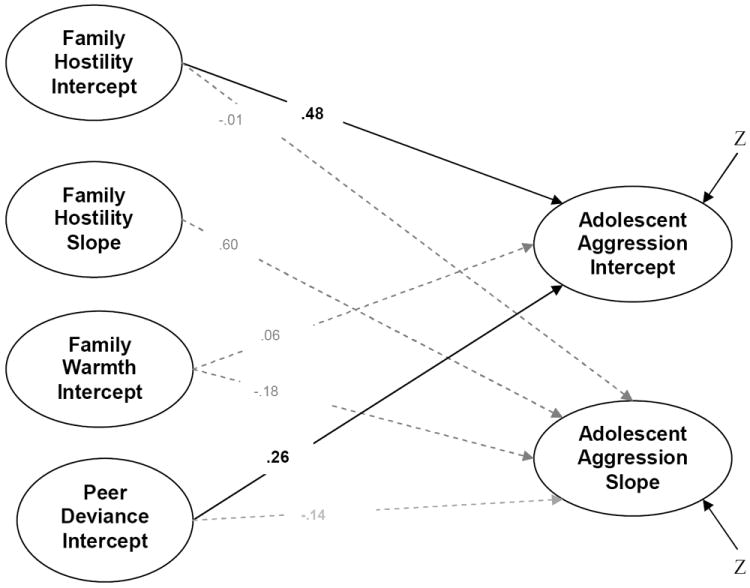
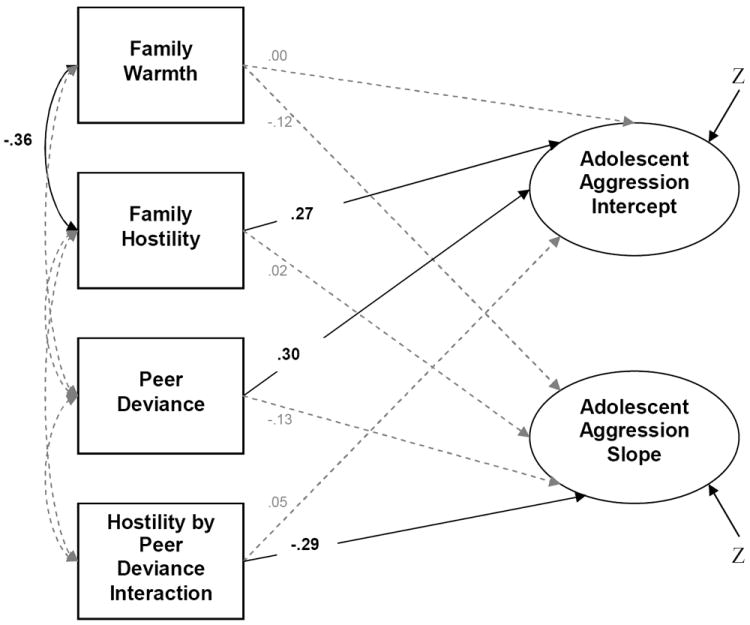
Beginning in sixth grade at an average age of 11.9 years, 416 adolescents and their parents participated in 4 waves of data collection involving family observations and multiple-reporter assessments. Ecological theory and the process-person-context-time (PPCT) model guided the hypotheses and analyses. Lagged, growth curve models revealed that family hostility and peer deviance affiliation predicted adolescent aggression in the subsequent year. Family warmth played only a minor role in protecting against adolescent aggression. In hostile or low-warmth families, peer deviance affiliation linked to a declining aggression trajectory consistent with the arena of comfort hypothesis. The longitudinal findings suggest a nonadditive, synergistic interplay between family and peer contexts across time in adding nuance to understanding the adolescent aggression.
从六年级开始,平均年龄为 11.9 岁,416 名青少年及其父母参与了 4 波数据收集,包括家庭观察和多报告者评估。生态理论和过程-人-环境-时间(PPCT)模型指导了假设和分析。滞后的增长曲线模型显示,家庭敌对和同伴偏差关系预测了青少年在随后一年的攻击行为。家庭温暖在保护青少年免受攻击方面只起很小的作用。在敌对或温暖程度低的家庭中,同伴偏差关系与符合舒适区假说的攻击性下降轨迹有关。纵向研究结果表明,家庭和同伴环境在时间上的非加性、协同相互作用,为理解青少年攻击行为增添了微妙之处。