Department of Public Health Sciences, Division of Global Health (IHCAR), Karolinska Institutet, Nobels väg 9, SE-17177 Stockholm, Sweden.
Implement Sci. 2012 Apr 13;7:31. doi: 10.1186/1748-5908-7-31.
Initiatives to raise the quality of care provided to mothers need to be given priority in Sub Saharan Africa (SSA). The promotion of clinical practice guidelines (CPGs) is a common strategy, but their implementation is often challenging, limiting their potential impact. Through a cross-country perspective, this study explored CPGs for maternal health in Burkina Faso, Ghana, and Tanzania. The objectives were to compare factors related to CPG use including their content compared with World Health Organization (WHO) guidelines, their format, and their development processes. Perceptions of their availability and use in practice were also explored. The overall purpose was to further the understanding of how to increase CPGs' potential to improve quality of care for mothers in SSA.
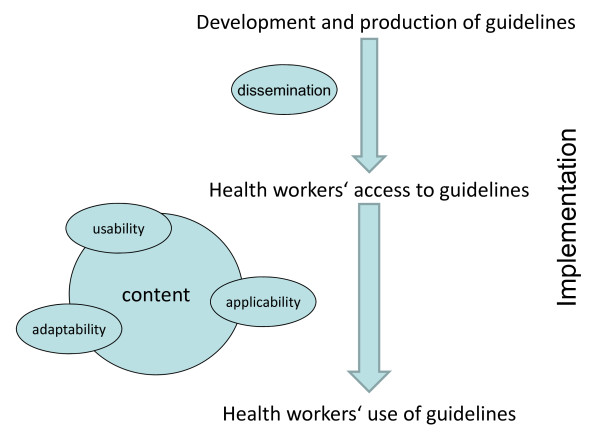
The study was a multiple case study design consisting of cross-country comparisons using document review and key informant interviews. A conceptual framework to aid analysis and discussion of results was developed, including selected domains related to guidelines' implementability and use by health workers in practice in terms of usability, applicability, and adaptability.
The study revealed few significant differences in content between the national guidelines for maternal health and WHO recommendations. There were, however, marked variations in the format of CPGs between the three countries. Apart from the Ghanaian and one of the Tanzanian CPGs, the levels of both usability and applicability were assessed as low or medium. In all three countries, the use of CPGs by health workers in practice was perceived to be limited.
Our cross-country study suggests that it is not poor quality of content or lack of evidence base that constitute the major barrier for CPGs to positively impact on quality improvement in maternal care in SSA. It rather emphasises the need to prioritise the format of guidelines to increase their usability and applicability and to consider these attributes together with implementation strategies as integral to their development processes.
提高向撒哈拉以南非洲(SSA)提供的产妇护理质量的举措需要优先考虑。推广临床实践指南(CPG)是一种常见的策略,但它们的实施往往具有挑战性,限制了其潜在影响。通过跨国视角,本研究探讨了布基纳法索、加纳和坦桑尼亚的孕产妇保健 CPG。目的是比较与 CPG 使用相关的因素,包括与世界卫生组织(WHO)指南相比的内容、格式和开发过程。还探讨了对其实践中可用性和使用的看法。总体目的是进一步了解如何提高 CPG 提高 SSA 产妇护理质量的潜力。
本研究是一项多案例研究设计,包括使用文件审查和关键知情人访谈进行跨国比较。制定了一个概念框架,以帮助分析和讨论结果,包括与指南在实践中对卫生工作者的可实施性和使用相关的选定领域,包括可用性、适用性和适应性。
该研究表明,国家孕产妇保健指南与 WHO 建议之间在内容上几乎没有显著差异。然而,三国 CPG 的格式存在明显差异。除了加纳和坦桑尼亚的一份 CPG 外,可用性和适用性的水平均被评估为低或中。在所有三个国家,卫生工作者在实践中使用 CPG 的情况被认为是有限的。
我们的跨国研究表明,不是内容质量差或缺乏证据基础构成了 CPG 对 SSA 产妇护理质量改进产生积极影响的主要障碍。相反,它强调需要优先考虑指南的格式,以提高其可用性和适用性,并将这些属性与实施策略一起视为其开发过程的组成部分。