Department of Medicine, Minneapolis Medical Research Foundation, Minneapolis, MN, United States.
Pharmacol Biochem Behav. 2012 Jul;102(1):157-62. doi: 10.1016/j.pbb.2012.03.026. Epub 2012 Apr 4.
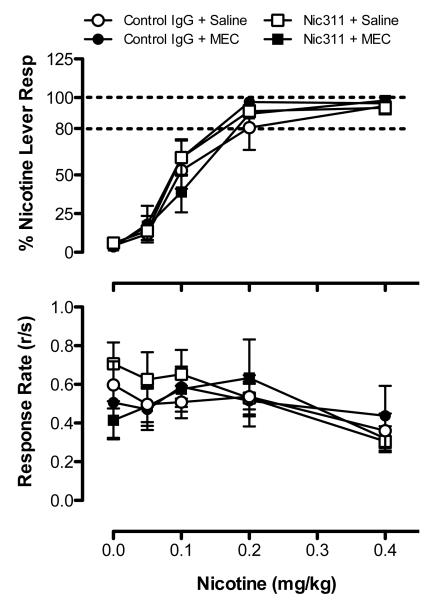
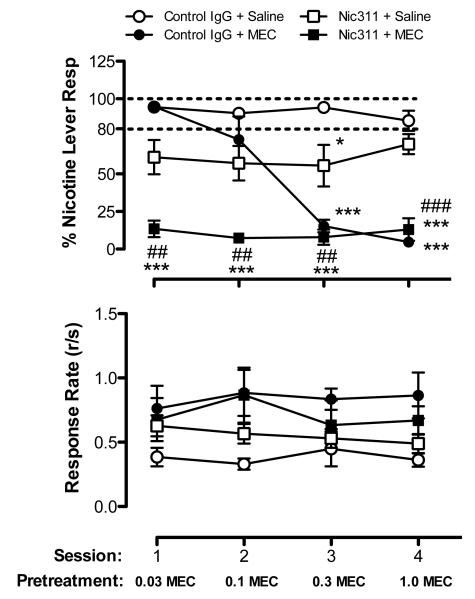
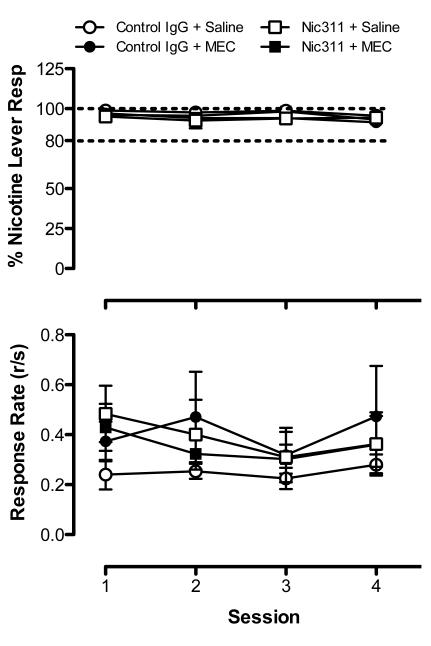
Tobacco addiction requires activation by nicotine of a variety of central nicotinic acetylcholine receptors (nAChRs). In animals, both nAChR antagonists and immunization against nicotine can reduce nAChR activation by nicotine and block a variety of addiction-relevant behaviors. However, clinical use of nAChR antagonists for smoking cessation is limited by dose-related side effects, and immunization does not reliably produce sufficient antibody levels in smokers to enhance smoking cessation rates. Combining these approaches may be one way of addressing the limitations of each while enhancing overall efficacy. This study examined the individual and combined effects of passive immunization with the monoclonal nicotine-specific antibody Nic311 and the nicotinic receptor antagonist mecamylamine (MEC) on nicotine's discriminative stimulus effects. Rats were trained to discriminate 0.4 mg/kg of nicotine from saline using a two-lever operant discrimination procedure. Antagonism of nicotine discrimination by Nic311 (160 mg/kg i.v.) and ascending doses of MEC (0.03, 0.1, 0.3, and 1.0 mg/kg s.c.) was assessed across four consecutive daily 2-min extinction test sessions using a 2×2 design. Nic311 alone produced a 24-48% reduction in % nicotine-lever responding (%NLR) across all four test sessions. MEC produced a dose-dependent decrease in %NLR, with no effect at the two lowest doses and 80-93% attenuation at the two highest doses. Nic311 combined with MEC significantly suppressed %NLR at every MEC dose (85-92% reduction across all four test sessions). Very low doses of MEC that were ineffective alone completely blocked nicotine discrimination when combined with Nic311. These data demonstrate that nicotine-specific antibodies and MEC can work synergistically to suppress the subjective effects of nicotine and suggest that low doses of MEC may significantly enhance the efficacy of immunotherapy.
烟草成瘾需要尼古丁激活多种中枢型烟碱乙酰胆碱受体(nAChR)。在动物实验中,nAChR 拮抗剂和尼古丁免疫接种都可以减少尼古丁对 nAChR 的激活,并阻断多种与成瘾相关的行为。然而,nAChR 拮抗剂在戒烟方面的临床应用受到剂量相关副作用的限制,免疫接种并不能在吸烟者中可靠地产生足够的抗体水平来提高戒烟率。结合这些方法可能是一种解决每种方法局限性的方法,同时提高整体疗效。本研究考察了被动免疫接种尼古丁特异性单克隆抗体 Nic311 和烟碱受体拮抗剂美加明(MEC)对尼古丁辨别刺激效应的单独和联合作用。大鼠通过双杠杆操作辨别程序接受 0.4mg/kg 尼古丁和生理盐水训练,以辨别这两者。在四个连续的每日 2 分钟消退测试中,采用 2×2 设计,用 Nic311(160mg/kg 静脉注射)和递增剂量的 MEC(0.03、0.1、0.3 和 1.0mg/kg 皮下注射)来评估尼古丁辨别作用的拮抗作用。Nic311 单独使用时,在所有四个测试阶段,尼古丁辨别的响应率(%NLR)降低了 24-48%。MEC 呈剂量依赖性降低 %NLR,在两个最低剂量没有效果,在两个最高剂量时产生 80-93%的衰减。Nic311 与 MEC 联合使用时,在所有 MEC 剂量下均显著抑制 %NLR(在所有四个测试阶段减少了 85-92%)。单独使用时无效的非常低剂量 MEC 与 Nic311 联合使用时完全阻断了尼古丁辨别。这些数据表明,尼古丁特异性抗体和 MEC 可以协同作用,抑制尼古丁的主观效应,并表明低剂量 MEC 可能显著增强免疫疗法的疗效。