Environmental Studies Department, University of California, Santa Cruz, California, United States of America.
PLoS Biol. 2012;10(4):e1001303. doi: 10.1371/journal.pbio.1001303. Epub 2012 Apr 10.
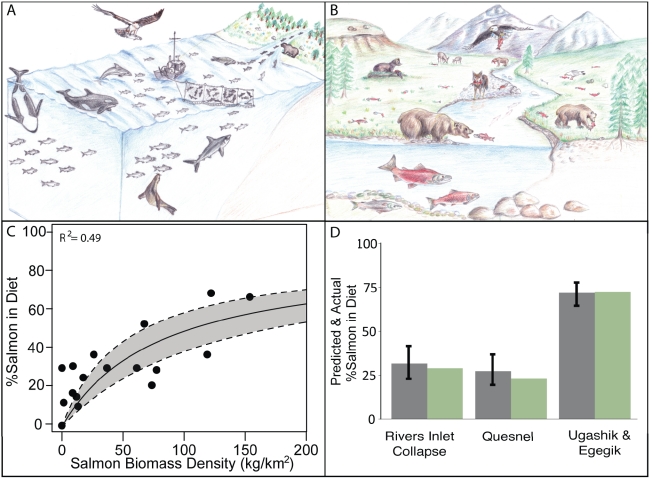
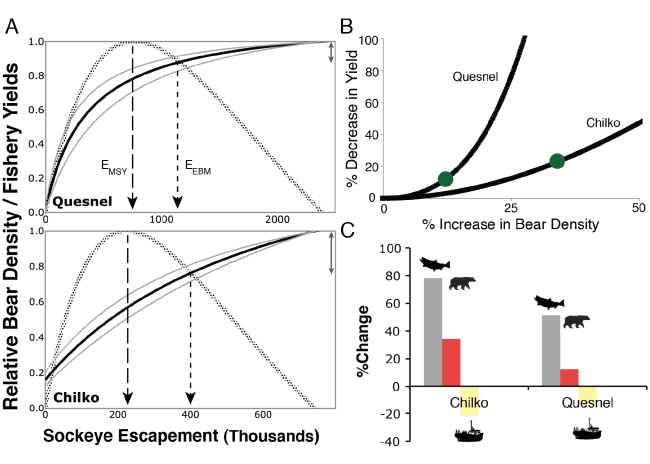
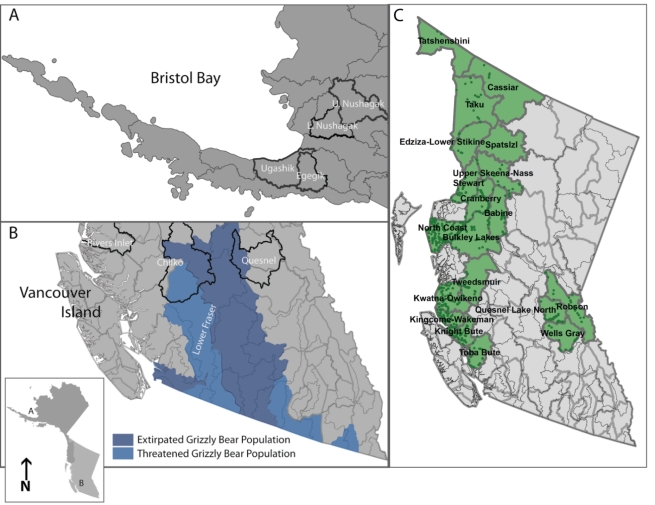
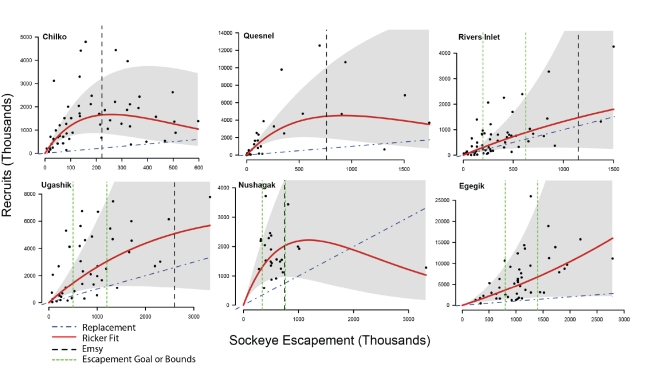
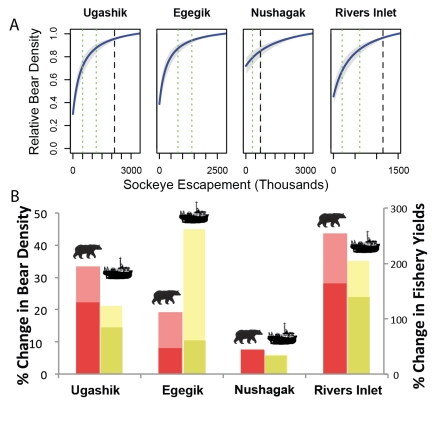
Implementation of ecosystem-based fisheries management (EBFM) requires a clear conceptual and quantitative framework for assessing how different harvest options can modify benefits to ecosystem and human beneficiaries. We address this social-ecological need for Pacific salmon fisheries, which are economically valuable but intercept much of the annual pulse of nutrient subsidies that salmon provide to terrestrial and aquatic food webs. We used grizzly bears, vectors of salmon nutrients and animals with densities strongly coupled to salmon abundance, as surrogates for "salmon ecosystem" function. Combining salmon biomass and stock-recruitment data with stable isotope analysis, we assess potential tradeoffs between fishery yields and bear population densities for six sockeye salmon stocks in Bristol Bay, Alaska, and British Columbia (BC), Canada. For the coastal stocks, we find that both bear densities and fishery yields would increase substantially if ecosystem allocations of salmon increase from currently applied lower to upper goals and beyond. This aligning of benefits comes at a potential cost, however, with the possibility of forgoing harvests in low productivity years. In contrast, we detect acute tradeoffs between bear densities and fishery yields in interior stocks within the Fraser River, BC, where biomass from other salmon species is low. There, increasing salmon allocations to ecosystems would benefit threatened bear populations at the cost of reduced long-term yields. To resolve this conflict, we propose an EBFM goal that values fisheries and bears (and by extension, the ecosystem) equally. At such targets, ecosystem benefits are unexpectedly large compared with losses in fishery yields. To explore other management options, we generate tradeoff curves that provide stock-specific accounting of the expected loss to fishers and gain to bears as more salmon escape the fishery. Our approach, modified to suit multiple scenarios, provides a generalizable method to resolve conflicts over shared resources in other systems.
实施基于生态系统的渔业管理(EBFM)需要一个明确的概念和量化框架,以评估不同的捕捞选择如何改变对生态系统和人类受益者的利益。我们针对太平洋鲑鱼渔业解决了这种社会生态需求,这些渔业具有经济价值,但拦截了鲑鱼向陆地和水生食物网提供的大部分年度养分脉冲。我们使用灰熊作为“鲑鱼生态系统”功能的替代物,灰熊是鲑鱼养分的载体,其密度与鲑鱼丰度紧密相关。我们将鲑鱼生物量和种群补充数据与稳定同位素分析相结合,评估了阿拉斯加布里斯托尔湾和加拿大不列颠哥伦比亚省(BC)的六个红大麻哈鱼种群的渔业产量和熊种群密度之间的潜在权衡。对于沿海种群,我们发现,如果鲑鱼的生态系统分配从目前应用的较低目标增加到较高目标并超过该目标,熊的密度和渔业产量都会大幅增加。然而,这种利益的协调是有代价的,因为在生产力较低的年份可能会放弃捕捞。相比之下,我们在不列颠哥伦比亚省弗雷泽河的内陆种群中检测到了熊密度和渔业产量之间的急剧权衡,那里其他鲑鱼物种的生物量较低。在这些地方,增加鲑鱼向生态系统的分配将以减少长期产量为代价,使受威胁的熊种群受益。为了解决这一冲突,我们提出了一个 EBFM 目标,即平等重视渔业和熊(以及更广泛的生态系统)。在这些目标下,与渔业产量的损失相比,生态系统的效益出人意料地大。为了探索其他管理选择,我们生成了权衡曲线,为鱼类逃离渔业的预期损失和熊的收益提供了针对特定种群的核算,随着更多的鲑鱼逃离渔业,这种损失和收益会增加。我们的方法经过修改,适用于多种情况,为解决其他系统中共享资源的冲突提供了一种可推广的方法。