Cognitive Psychology, Vrije Universiteit Amsterdam, Amsterdam, The Netherlands.
PLoS One. 2012;7(4):e34598. doi: 10.1371/journal.pone.0034598. Epub 2012 Apr 10.
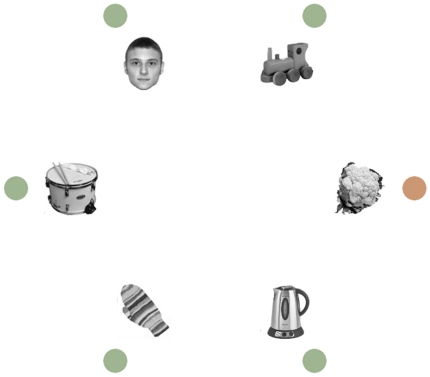
Even though it is generally agreed that face stimuli constitute a special class of stimuli, which are treated preferentially by our visual system, it remains unclear whether faces can capture attention in a stimulus-driven manner. Moreover, there is a long-standing debate regarding the mechanism underlying the preferential bias of selecting faces. Some claim that faces constitute a set of special low-level features to which our visual system is tuned; others claim that the visual system is capable of extracting the meaning of faces very rapidly, driving attentional selection. Those debates continue because many studies contain methodological peculiarities and manipulations that prevent a definitive conclusion. Here, we present a new visual search task in which observers had to make a saccade to a uniquely colored circle while completely irrelevant objects were also present in the visual field. The results indicate that faces capture and guide the eyes more than other animated objects and that our visual system is not only tuned to the low-level features that make up a face but also to its meaning.
尽管人们普遍认为面部刺激构成了一个特殊的刺激类别,我们的视觉系统会优先处理这些刺激,但目前尚不清楚面部刺激是否可以以刺激驱动的方式吸引注意力。此外,对于优先选择面部刺激的机制,长期以来一直存在争议。一些人声称,面部刺激构成了一组特殊的低水平特征,我们的视觉系统对这些特征进行了调整;另一些人则声称,视觉系统能够非常迅速地提取面部的含义,从而驱动注意力的选择。这些争论仍在继续,因为许多研究存在方法上的特殊性和操作上的差异,无法得出明确的结论。在这里,我们提出了一个新的视觉搜索任务,观察者必须在视野中存在完全不相关的物体的情况下,将视线转移到一个独特颜色的圆圈上。结果表明,面部刺激比其他动画物体更能吸引和引导眼睛,并且我们的视觉系统不仅对构成面部的低水平特征进行了调整,还对其含义进行了调整。