Istituto di Biomedicina ed Immunologia Molecolare (IBIM) Alberto Monroy CNR, via Ugo La Malfa 153, 90146 Palermo, Italy.
Immun Ageing. 2012 Apr 16;9(1):3. doi: 10.1186/1742-4933-9-3.
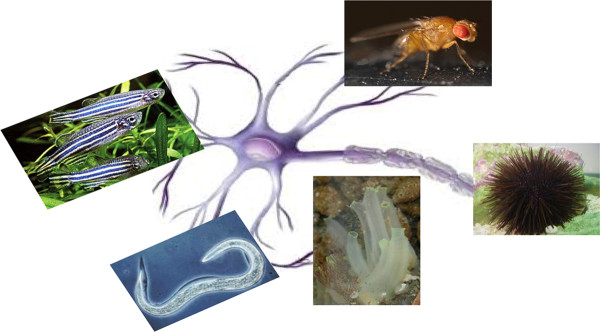
The success of biomedical researches has led to improvement in human health and increased life expectancy. An unexpected consequence has been an increase of age-related diseases and, in particular, neurodegenerative diseases. These disorders are generally late onset and exhibit complex pathologies including memory loss, cognitive defects, movement disorders and death. Here, it is described as the use of simple animal models such as worms, fishes, flies, Ascidians and sea urchins, have facilitated the understanding of several biochemical mechanisms underlying Alzheimer's disease (AD), one of the most diffuse neurodegenerative pathologies. The discovery of specific genes and proteins associated with AD, and the development of new technologies for the production of transgenic animals, has helped researchers to overcome the lack of natural models. Moreover, simple model systems of AD have been utilized to obtain key information for evaluating potential therapeutic interventions and for testing efficacy of putative neuroprotective compounds.
生物医学研究的成功导致了人类健康的改善和预期寿命的延长。一个意想不到的后果是与年龄相关的疾病的增加,特别是神经退行性疾病。这些疾病通常是发病较晚,并表现出复杂的病理,包括记忆丧失、认知缺陷、运动障碍和死亡。在这里,我们描述了使用简单的动物模型,如蠕虫、鱼类、苍蝇、海鞘和海胆,有助于理解阿尔茨海默病(AD)的几种生化机制,AD 是最常见的神经退行性疾病之一。与 AD 相关的特定基因和蛋白质的发现,以及用于生产转基因动物的新技术的发展,帮助研究人员克服了缺乏自然模型的问题。此外,AD 的简单模型系统被用于获得关键信息,以评估潜在的治疗干预措施的效果,并测试潜在的神经保护化合物的功效。