Physics Department, Drexel University, Philadelphia, Pennsylvania, United States of America.
PLoS One. 2012;7(4):e34345. doi: 10.1371/journal.pone.0034345. Epub 2012 Apr 11.
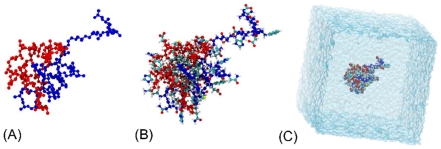
Amyloid β-protein (Aβ) is central to the pathology of Alzheimer's disease. A 5% difference in the primary structure of the two predominant alloforms, Aβ(1-40) and Aβ(1-42), results in distinct assembly pathways and toxicity properties. Discrete molecular dynamics (DMD) studies of Aβ(1-40) and Aβ(1-42) assembly resulted in alloform-specific oligomer size distributions consistent with experimental findings. Here, a large ensemble of DMD-derived Aβ(1-40) and Aβ(1-42) monomers and dimers was subjected to fully atomistic molecular dynamics (MD) simulations using the OPLS-AA force field combined with two water models, SPCE and TIP3P. The resulting all-atom conformations were slightly larger, less compact, had similar turn and lower β-strand propensities than those predicted by DMD. Fully atomistic Aβ(1-40) and Aβ(1-42) monomers populated qualitatively similar free energy landscapes. In contrast, the free energy landscape of Aβ(1-42) dimers indicated a larger conformational variability in comparison to that of Aβ(1-40) dimers. Aβ(1-42) dimers were characterized by an increased flexibility in the N-terminal region D1-R5 and a larger solvent exposure of charged amino acids relative to Aβ(1-40) dimers. Of the three positively charged amino acids, R5 was the most and K16 the least involved in salt bridge formation. This result was independent of the water model, alloform, and assembly state. Overall, salt bridge propensities increased upon dimer formation. An exception was the salt bridge propensity of K28, which decreased upon formation of Aβ(1-42) dimers and was significantly lower than in Aβ(1-40) dimers. The potential relevance of the three positively charged amino acids in mediating the Aβ oligomer toxicity is discussed in the light of available experimental data.
淀粉样β蛋白(Aβ)是阿尔茨海默病病理学的核心。两种主要同种型 Aβ(1-40)和 Aβ(1-42)的一级结构有 5%的差异,导致其组装途径和毒性特性不同。Aβ(1-40)和 Aβ(1-42)组装的离散分子动力学(DMD)研究导致同种型特异性寡聚物大小分布与实验结果一致。在这里,大量的 DMD 衍生的 Aβ(1-40)和 Aβ(1-42)单体和二聚体被用于完全原子分子动力学(MD)模拟,使用 OPLS-AA 力场结合两种水模型,SPCE 和 TIP3P。得到的全原子构象比 DMD 预测的构象略大、不那么紧凑、转角相似且β-链倾向较低。完全原子的 Aβ(1-40)和 Aβ(1-42)单体具有定性相似的自由能景观。相比之下,Aβ(1-42)二聚体的自由能景观表明其构象变异性比 Aβ(1-40)二聚体更大。与 Aβ(1-40)二聚体相比,Aβ(1-42)二聚体的 N 端区域 D1-R5 更加灵活,带电荷氨基酸的溶剂暴露也更大。在三个带正电荷的氨基酸中,R5 参与盐桥形成的程度最高,K16 参与盐桥形成的程度最低。这一结果与水模型、同种型和组装状态无关。总体而言,盐桥倾向随二聚体的形成而增加。一个例外是 K28 的盐桥倾向,它在 Aβ(1-42)二聚体形成时降低,并且明显低于 Aβ(1-40)二聚体。在考虑现有实验数据的情况下,讨论了这三个带正电荷的氨基酸在介导 Aβ 寡聚物毒性方面的潜在相关性。