Demetz Gabriele, Ott Ilka
Deutsches Herzzentrum Technische Universität München, Lazarettstraße 36, 80636 München, Germany.
Int J Inflam. 2012;2012:860301. doi: 10.1155/2012/860301. Epub 2012 Feb 19.
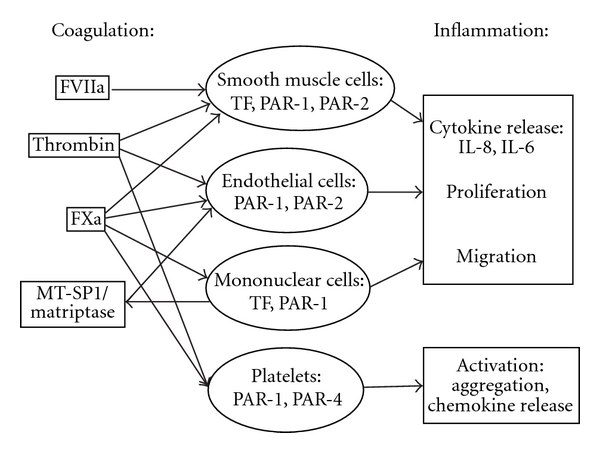
The intimate connection between coagulation and inflammation in the pathogenesis of vascular disease has moved more and more into focus of clinical research. This paper focuses on the essential components of this interplay in the settings of cardiovascular disease and acute coronary syndrome. Tissue factor, the main initiator of the extrinsic coagulation pathway, plays a central role via causing a proinflammatory response through activation of coagulation factors and thereby initiating coagulation and downstream cellular signalling pathways. Regarding activated clotting factors II, X, and VII, protease-activated receptors provide the molecular link between coagulation and inflammation. Hereby, PAR-1 displays deleterious as well as beneficial properties. Unravelling these interrelations may help developing new strategies to ameliorate the detrimental reciprocal aggravation of inflammation and coagulation.
凝血与炎症在血管疾病发病机制中的密切联系已越来越成为临床研究的焦点。本文聚焦于心血管疾病和急性冠状动脉综合征背景下这种相互作用的关键组成部分。组织因子是外源性凝血途径的主要启动因子,通过激活凝血因子引发促炎反应,从而启动凝血及下游细胞信号通路,发挥核心作用。对于活化的凝血因子II、X和VII,蛋白酶激活受体提供了凝血与炎症之间的分子联系。在此过程中,PAR-1显示出有害和有益的特性。阐明这些相互关系可能有助于开发新策略,以改善炎症和凝血相互有害的加重情况。