Department of Chemistry, University of Illinois at Urbana-Champaign, Urbana, Illinois, USA.
Nat Chem Biol. 2012 Apr 22;8(6):569-75. doi: 10.1038/nchembio.944.
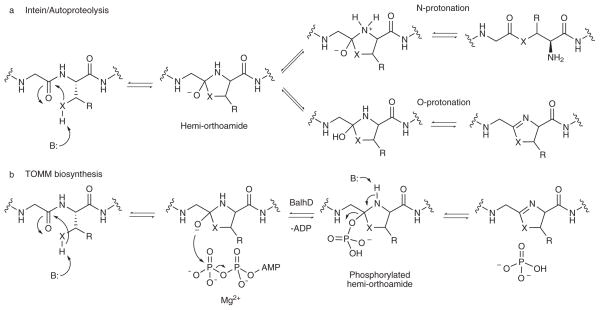
Thiazole/oxazole-modified microcins (TOMMs) encompass a recently defined class of ribosomally synthesized natural products with a diverse set of biological activities. Although TOMM biosynthesis has been investigated for over a decade, the mechanism of heterocycle formation by the synthetase enzymes remains poorly understood. Using substrate analogs and isotopic labeling, we demonstrate that ATP is used to directly phosphorylate the peptide amide backbone during TOMM heterocycle formation. Moreover, we present what is to our knowledge the first experimental evidence that the D-protein component of the heterocycle-forming synthetase (YcaO/domain of unknown function 181 family member), formerly annotated as a docking protein involved in complex formation and regulation, is able to perform the ATP-dependent cyclodehydration reaction in the absence of the other TOMM biosynthetic proteins. Together, these data reveal the role of ATP in the biosynthesis of azole and azoline heterocycles in ribosomal natural products and prompt a reclassification of the enzymes involved in their installation.
噻唑/噁唑修饰的微菌素 (TOMMs) 是一类新定义的核糖体合成天然产物,具有多种生物活性。尽管 TOMM 的生物合成已经研究了十多年,但合成酶酶催化杂环形成的机制仍知之甚少。本研究使用底物类似物和同位素标记,证明在 TOMM 杂环形成过程中,ATP 被直接用于磷酸化肽酰胺骨架。此外,我们提出了据我们所知的第一个实验证据,表明杂环形成合成酶的 D 蛋白成分(YcaO/未知功能域 181 家族成员),以前被注释为参与复合物形成和调节的对接蛋白,能够在没有其他 TOMM 生物合成蛋白的情况下,进行依赖于 ATP 的环脱水反应。这些数据共同揭示了 ATP 在核糖体天然产物中唑和唑啉杂环生物合成中的作用,并促使对参与其安装的酶进行重新分类。