Department of Evolutionary and Environmental Biology, Institute of Evolution, University of Haifa, Haifa, Israel.
PLoS One. 2012;7(4):e34689. doi: 10.1371/journal.pone.0034689. Epub 2012 Apr 16.
Fluctuating asymmetry is a contentious indicator of stress in populations of animals and plants. Nevertheless, it is a measure of developmental noise, typically obtained by measuring asymmetry across an individual organism's left-right axis of symmetry. These individual, signed asymmetries are symmetrically distributed around a mean of zero. Fluctuating asymmetry, however, has rarely been studied in microorganisms, and never in fungi.
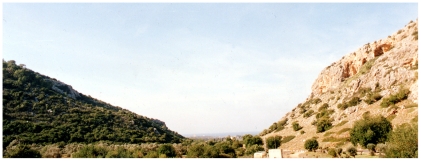
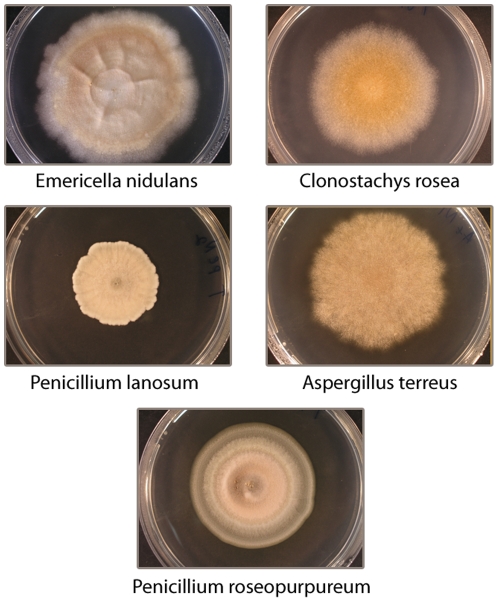
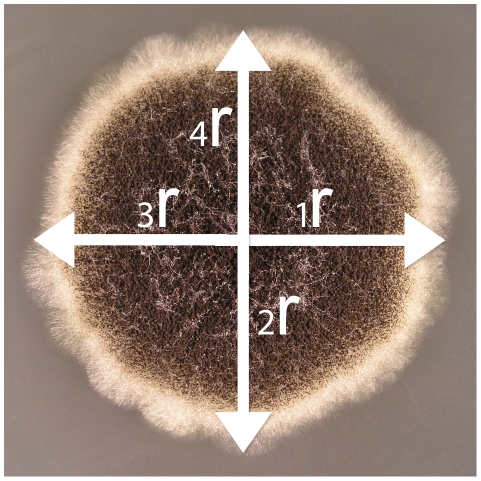
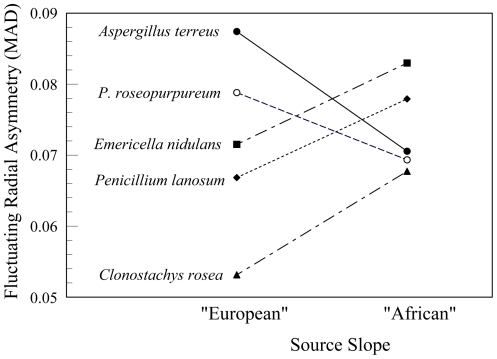
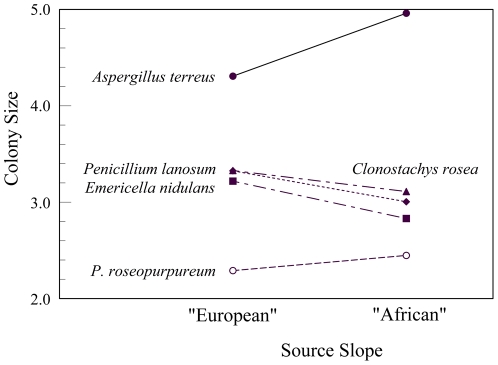
We examined colony growth and random phenotypic variation of five soil microfungal species isolated from the opposing slopes of "Evolution Canyon," Mount Carmel, Israel. This canyon provides an opportunity to study diverse taxa inhabiting a single microsite, under different kinds and intensities of abiotic and biotic stress. The south-facing "African" slope of "Evolution Canyon" is xeric, warm, and tropical. It is only 200 m, on average, from the north-facing "European" slope, which is mesic, cool, and temperate. Five fungal species inhabiting both the south-facing "African" slope, and the north-facing "European" slope of the canyon were grown under controlled laboratory conditions, where we measured the fluctuating radial asymmetry and sizes of their colonies.
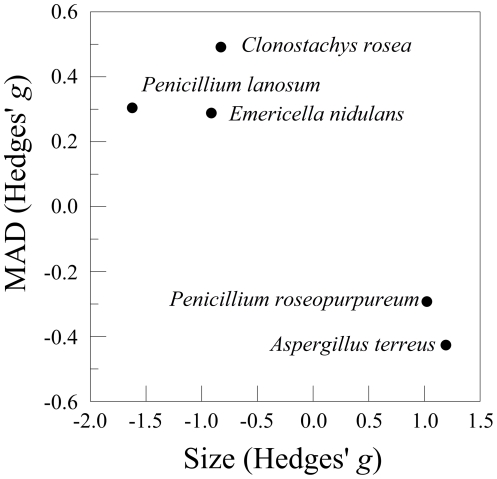
Different species displayed different amounts of radial asymmetry (and colony size). Moreover, there were highly significant slope by species interactions for size, and marginally significant ones for fluctuating asymmetry. There were no universal differences (i.e., across all species) in radial asymmetry and colony size between strains from "African" and "European" slopes, but colonies of Clonostachys rosea from the "African" slope were more asymmetric than those from the "European" slope.
Our study suggests that fluctuating radial asymmetry has potential as an indicator of random phenotypic variation and stress in soil microfungi. Interaction of slope and species for both growth rate and asymmetry of microfungi in a common environment is evidence of genetic differences between the "African" and "European" slopes of "Evolution Canyon."
波动不对称是动物和植物种群压力的一个有争议的指标。然而,它是一种发育噪声的衡量标准,通常通过测量个体生物左右对称轴上的不对称性来获得。这些个体的、有符号的不对称性在零均值周围对称分布。然而,波动不对称在微生物中很少被研究,在真菌中从未被研究过。
我们研究了从以色列 Carmel 山“进化峡谷”相反斜坡分离出的五种土壤微生物真菌的菌落生长和随机表型变异。这个峡谷为研究在不同种类和强度的非生物和生物胁迫下,单一微生境中栖息的多种分类群提供了机会。“进化峡谷”的南坡“非洲”坡干旱、温暖、热带。它离北坡“欧洲”坡平均只有 200 米,后者湿润、凉爽、温带。在受控的实验室条件下,生长了栖息在峡谷南坡“非洲”坡和北坡“欧洲”坡的五种真菌物种,我们测量了它们菌落的波动径向不对称和大小。
不同的物种表现出不同程度的径向不对称(和菌落大小)。此外,大小的坡度与物种相互作用具有高度显著意义,而波动不对称的相互作用则具有边缘显著意义。来自“非洲”和“欧洲”坡的菌株之间没有普遍的差异(即,所有物种),在径向不对称和菌落大小方面,但来自“非洲”坡的 Clonostachys rosea 菌落比来自“欧洲”坡的更不对称。
我们的研究表明,波动的径向不对称有可能成为土壤微生物随机表型变异和应激的指标。在共同环境中,微真菌的生长速率和不对称性的坡度和物种相互作用是“进化峡谷”“非洲”和“欧洲”坡之间遗传差异的证据。