Verhaltensbiologie / Institut für Biologie, Freie Universität, Berlin, Germany.
PLoS One. 2012;7(4):e35119. doi: 10.1371/journal.pone.0035119. Epub 2012 Apr 18.
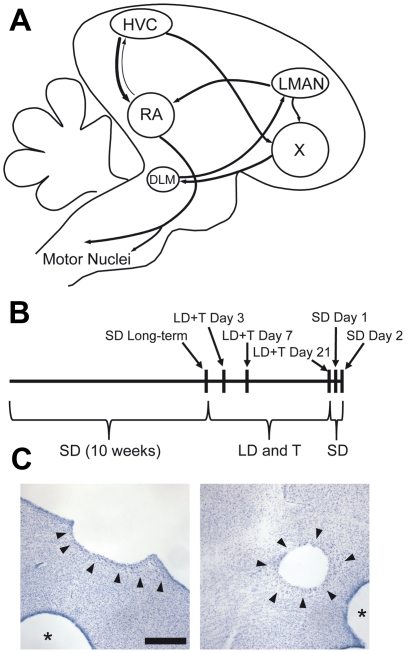
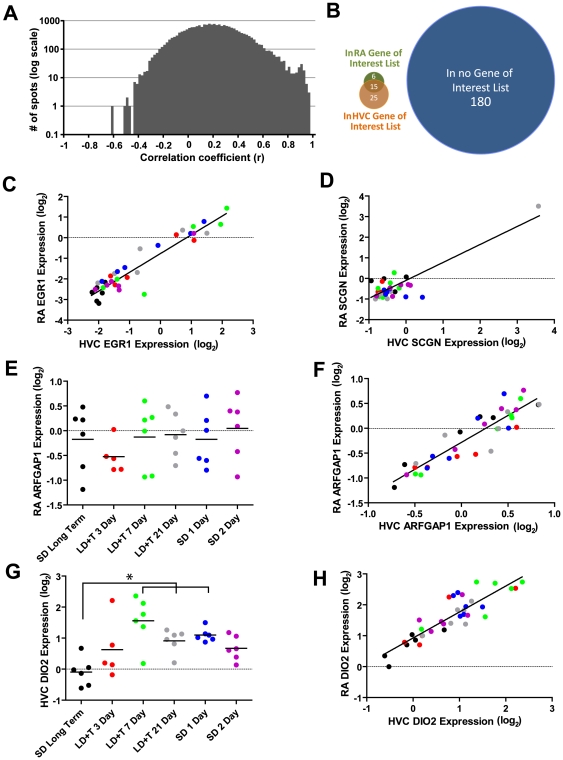
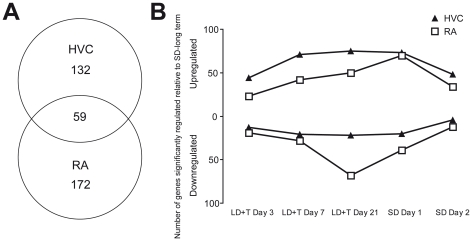
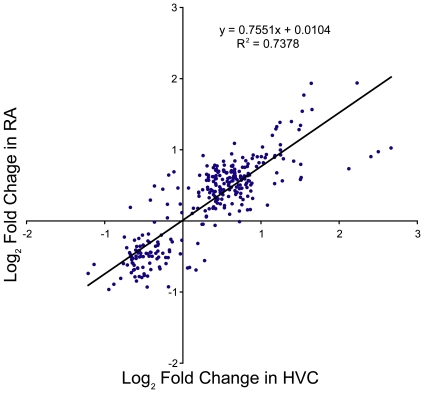
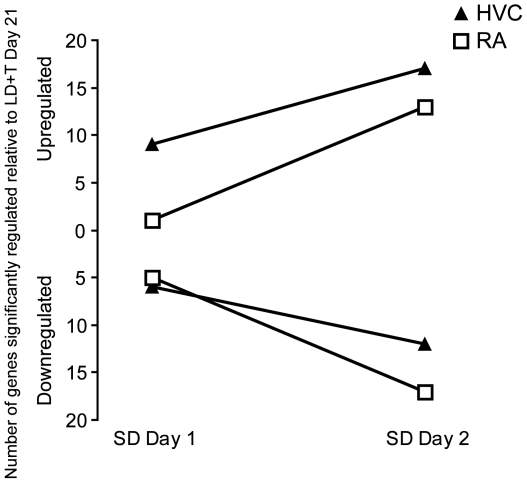
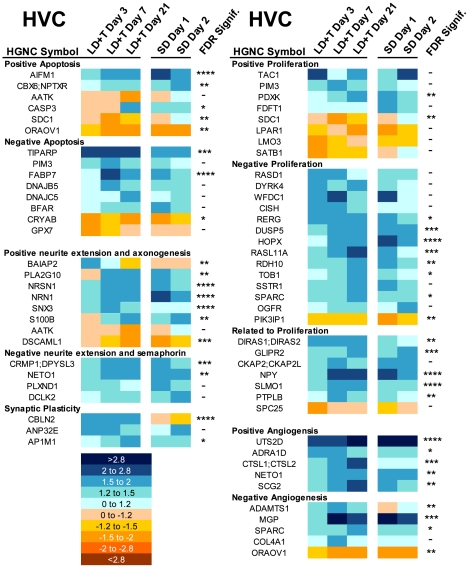
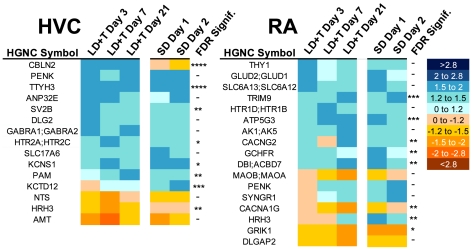
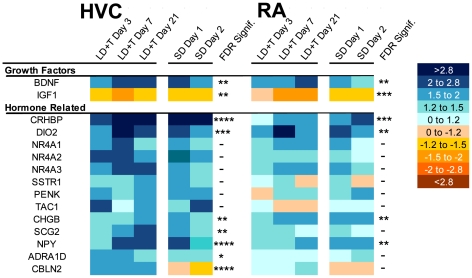
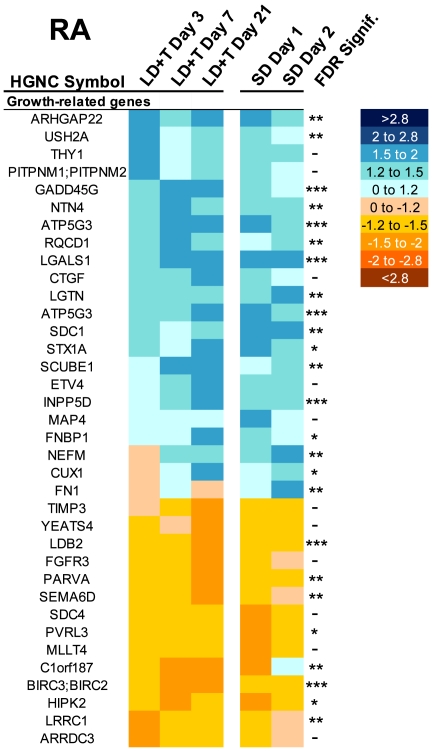
Photoperiod and hormonal cues drive dramatic seasonal changes in structure and function of the avian song control system. Little is known, however, about the patterns of gene expression associated with seasonal changes. Here we address this issue by altering the hormonal and photoperiodic conditions in seasonally-breeding Gambel's white-crowned sparrows and extracting RNA from the telencephalic song control nuclei HVC and RA across multiple time points that capture different stages of growth and regression. We chose HVC and RA because while both nuclei change in volume across seasons, the cellular mechanisms underlying these changes differ. We thus hypothesized that different genes would be expressed between HVC and RA. We tested this by using the extracted RNA to perform a cDNA microarray hybridization developed by the SoNG initiative. We then validated these results using qRT-PCR. We found that 363 genes varied by more than 1.5 fold (>log(2) 0.585) in expression in HVC and/or RA. Supporting our hypothesis, only 59 of these 363 genes were found to vary in both nuclei, while 132 gene expression changes were HVC specific and 172 were RA specific. We then assigned many of these genes to functional categories relevant to the different mechanisms underlying seasonal change in HVC and RA, including neurogenesis, apoptosis, cell growth, dendrite arborization and axonal growth, angiogenesis, endocrinology, growth factors, and electrophysiology. This revealed categorical differences in the kinds of genes regulated in HVC and RA. These results show that different molecular programs underlie seasonal changes in HVC and RA, and that gene expression is time specific across different reproductive conditions. Our results provide insights into the complex molecular pathways that underlie adult neural plasticity.
光周期和激素线索驱动鸟类歌唱控制系统结构和功能的剧烈季节性变化。然而,人们对与季节性变化相关的基因表达模式知之甚少。在这里,我们通过改变季节性繁殖的 Gambel 的白冠麻雀的激素和光周期条件,并在多个时间点从 telencephalic 歌唱控制核 HVC 和 RA 提取 RNA,这些时间点捕获了生长和退化的不同阶段,从而解决了这个问题。我们选择 HVC 和 RA 是因为虽然这两个核在整个季节中体积都会发生变化,但这些变化的细胞机制不同。因此,我们假设 HVC 和 RA 之间会表达不同的基因。我们通过使用提取的 RNA 来执行 SoNG 计划开发的 cDNA 微阵列杂交来测试这一点。然后,我们使用 qRT-PCR 验证了这些结果。我们发现,在 HVC 和/或 RA 中,有 363 个基因的表达变化超过 1.5 倍(>log(2) 0.585)。支持我们的假设,在这 363 个基因中,只有 59 个基因在两个核中都发生了变化,而 132 个基因表达变化是 HVC 特异性的,172 个是 RA 特异性的。然后,我们将这些基因中的许多分配到与 HVC 和 RA 季节性变化背后的不同机制相关的功能类别中,包括神经发生、细胞凋亡、细胞生长、树突分支和轴突生长、血管生成、内分泌学、生长因子和电生理学。这揭示了 HVC 和 RA 中调节的基因种类的分类差异。这些结果表明,HVC 和 RA 中的季节性变化有不同的分子程序,并且在不同的生殖条件下,基因表达具有时间特异性。我们的研究结果为阐明成年神经可塑性的复杂分子途径提供了线索。