Williams Warren M, Ellison Nicholas W, Ansari Helal A, Verry Isabelle M, Hussain S Wajid
AgResearch Grasslands Research Centre, Private Bag 11008, Palmerston North, 4442, New Zealand.
BMC Plant Biol. 2012 Apr 24;12:55. doi: 10.1186/1471-2229-12-55.
White clover (Trifolium repens) is a ubiquitous weed of the temperate world that through use of improved cultivars has also become the most important legume of grazed pastures world-wide. It has long been suspected to be allotetraploid, but the diploid ancestral species have remained elusive. Putative diploid ancestors were indicated by DNA sequence phylogeny to be T. pallescens and T. occidentale. Here, we use further DNA evidence as well as a combination of molecular cytogenetics (FISH and GISH) and experimental hybridization to test the hypothesis that white clover originated as a hybrid between T. pallescens and T. occidentale.
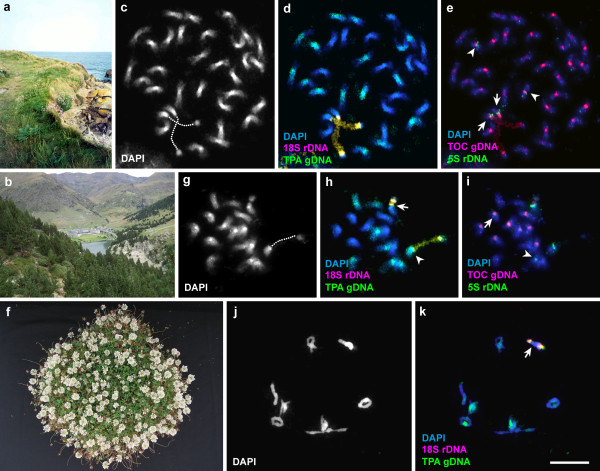
T. pallescens plants were identified with chloroplast trnL intron DNA sequences identical to those of white clover. Similarly, T. occidentale plants with nuclear ITS sequences identical to white clover were also identified. Reciprocal GISH experiments, alternately using labeled genomic DNA probes from each of the putative ancestral species on the same white clover cells, showed that half of the chromosomes hybridized with each probe. F1 hybrids were generated by embryo rescue and these showed strong interspecific chromosome pairing and produced a significant frequency of unreduced gametes, indicating the likely mode of polyploidization. The F1 hybrids are inter-fertile with white clover and function as synthetic white clovers, a valuable new resource for the re-incorporation of ancestral genomes into modern white clover for future plant breeding.
Evidence from DNA sequence analyses, molecular cytogenetics, interspecific hybridization and breeding experiments supports the hypothesis that a diploid alpine species (T. pallescens) hybridized with a diploid coastal species (T. occidentale) to generate tetraploid T. repens. The coming together of these two narrowly adapted species (one alpine and the other maritime), along with allotetraploidy, has led to a transgressive hybrid with a broad adaptive range.
白三叶草(Trifolium repens)是温带地区常见的杂草,通过改良品种,它也已成为全球放牧草场最重要的豆科植物。长期以来人们一直怀疑它是异源四倍体,但其二倍体祖先物种一直难以确定。DNA序列系统发育分析表明,假定的二倍体祖先为苍白三叶草(T. pallescens)和西方三叶草(T. occidentale)。在此,我们利用更多的DNA证据以及分子细胞遗传学(荧光原位杂交和基因组原位杂交)与实验杂交相结合的方法,来检验白三叶草起源于苍白三叶草和西方三叶草杂交种这一假说。
鉴定出叶绿体trnL内含子DNA序列与白三叶草相同的苍白三叶草植株。同样,也鉴定出核ITS序列与白三叶草相同的西方三叶草植株。在同一白三叶草细胞上交替使用来自每个假定祖先物种的标记基因组DNA探针进行相互基因组原位杂交实验,结果显示一半的染色体与每个探针杂交。通过胚胎拯救获得了F1杂种,这些杂种表现出强烈的种间染色体配对,并产生了显著频率的未减数配子,这表明了多倍体化的可能模式。F1杂种与白三叶草可育,起到了合成白三叶草的作用,这是一种宝贵的新资源,可将祖先基因组重新引入现代白三叶草用于未来的植物育种。
DNA序列分析、分子细胞遗传学、种间杂交和育种实验的证据支持了这样一种假说,即二倍体高山物种(苍白三叶草)与二倍体沿海物种(西方三叶草)杂交产生了四倍体白三叶草。这两个适应范围狭窄的物种(一个是高山物种,另一个是滨海物种)的结合,再加上异源四倍体,产生了一个具有广泛适应范围的超亲杂种。