Department of Clinical Chemistry, Microbiology, and Immunology, Ghent University, Ghent, (B-9000), Belgium.
Retrovirology. 2012 Apr 27;9:34. doi: 10.1186/1742-4690-9-34.
The Nef protein of HIV facilitates virus replication and disease progression in infected patients. This role as pathogenesis factor depends on several genetically separable Nef functions that are mediated by interactions of highly conserved protein-protein interaction motifs with different host cell proteins. By studying the functionality of a series of nef alleles from clinical isolates, we identified a dysfunctional HIV group O Nef in which a highly conserved valine-glycine-phenylalanine (VGF) region, which links a preceding acidic cluster with the following proline-rich motif into an amphipathic surface was deleted. In this study, we aimed to study the functional importance of this VGF region.
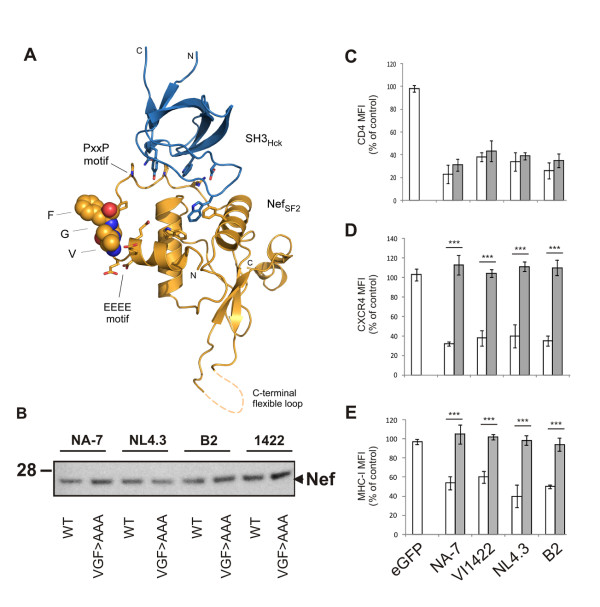
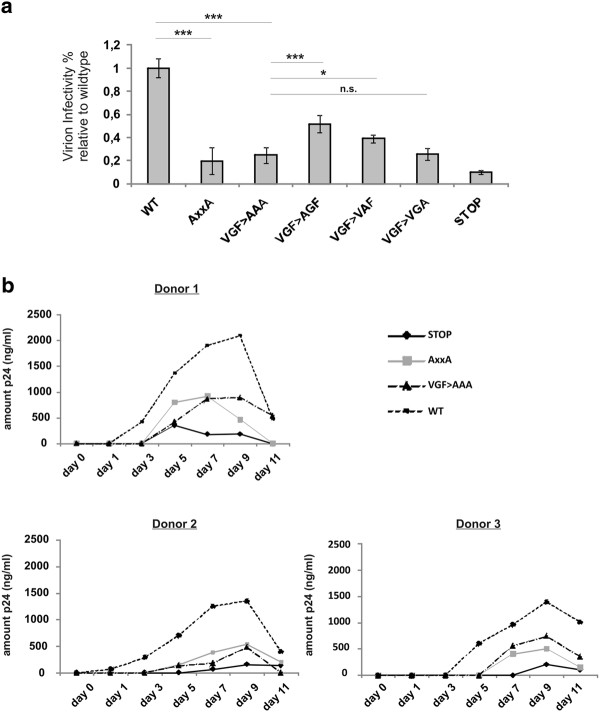
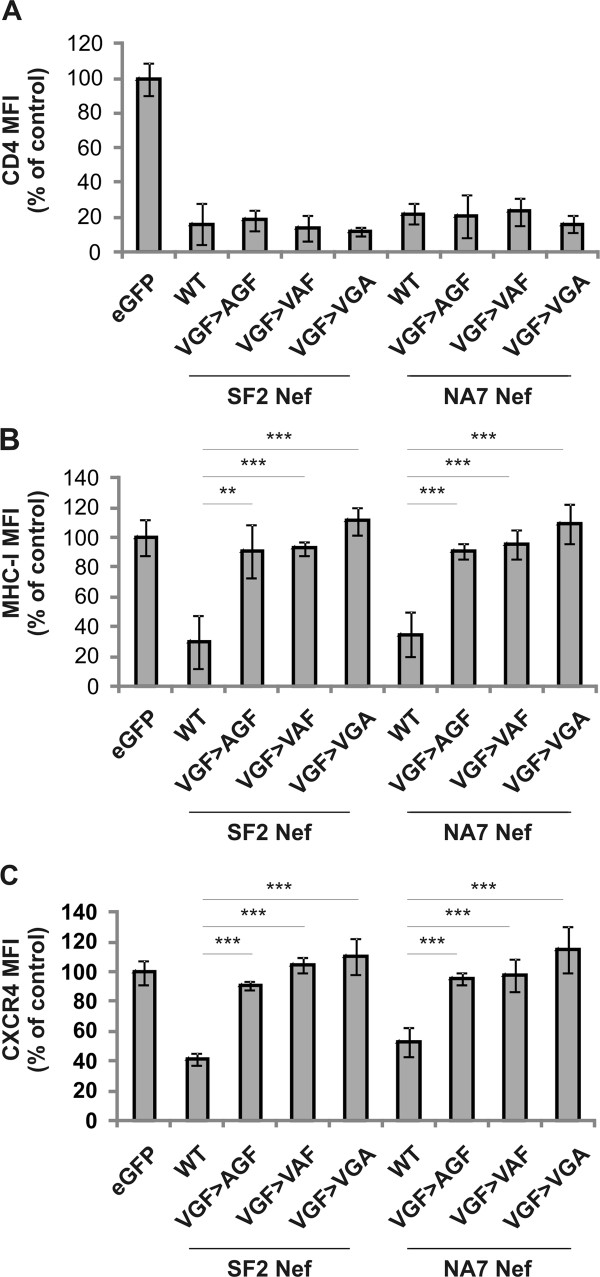
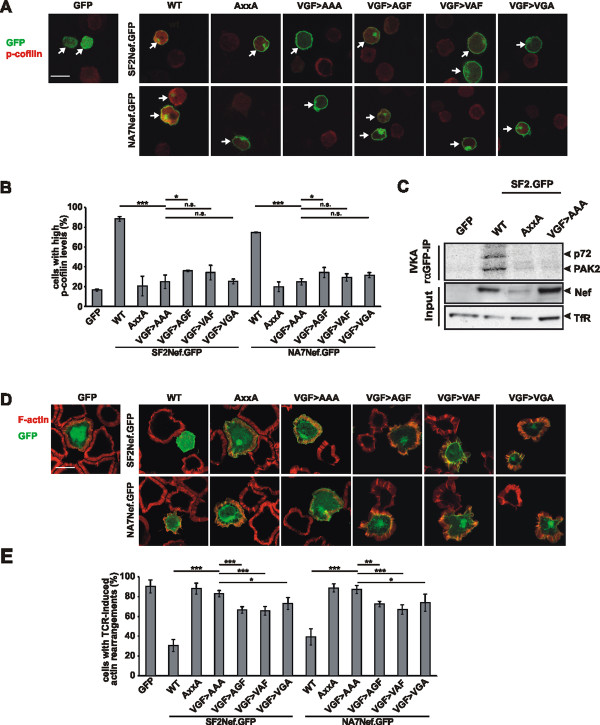
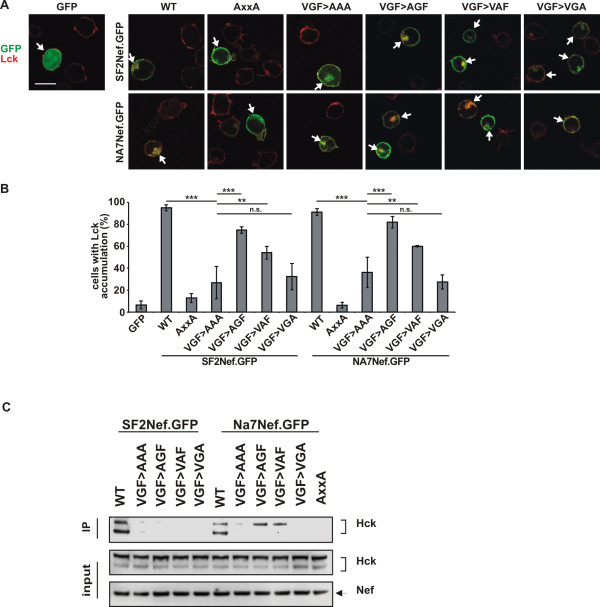
The dysfunctional HIV group O8 nef allele was restored to the consensus sequence, and mutants of canonical (NL4.3, NA-7, SF2) and non-canonical (B2 and C1422) HIV-1 group M nef alleles were generated in which the amino acids of the VGF region were changed into alanines (VGF→AAA) and tested for their capacity to interfere with surface receptor trafficking, signal transduction and enhancement of viral replication and infectivity. We found the VGF motif, and each individual amino acid of this motif, to be critical for downregulation of MHC-I and CXCR4. Moreover, Nef's association with the cellular p21-activated kinase 2 (PAK2), the resulting deregulation of cofilin and inhibition of host cell actin remodeling, and targeting of Lck kinase to the trans-golgi-network (TGN) were affected as well. Of particular interest, VGF integrity was essential for Nef-mediated enhancement of HIV virion infectivity and HIV replication in peripheral blood lymphocytes. For targeting of Lck kinase to the TGN and viral infectivity, especially the phenylalanine of the triplet was essential. At the molecular level, the VGF motif was required for the physical interaction of the adjacent proline-rich motif with Hck.
Based on these findings, we propose that this highly conserved three amino acid VGF motif together with the acidic cluster and the proline-rich motif form a previously unrecognized amphipathic surface on Nef. This surface appears to be essential for the majority of Nef functions and thus represents a prime target for the pharmacological inhibition of Nef.
HIV 的 nef 蛋白促进了感染患者体内的病毒复制和疾病进展。这种作为发病机制因素的作用取决于几个在遗传上可分离的 nef 功能,这些功能是通过高度保守的蛋白-蛋白相互作用基序与不同宿主细胞蛋白的相互作用来介导的。通过研究来自临床分离株的一系列 nef 等位基因,我们发现了一种功能失调的 HIV 组 O nef,其中一个高度保守的缬氨酸-甘氨酸-苯丙氨酸(VGF)区域缺失,该区域将前面的酸性簇与后面的富含脯氨酸的基序连接成一个两亲性表面。在这项研究中,我们旨在研究这个 VGF 区域的功能重要性。
功能失调的 HIV 组 O8 nef 等位基因被恢复到共识序列,并生成了具有经典(NL4.3、NA-7、SF2)和非经典(B2 和 C1422)HIV-1 组 M nef 等位基因的突变体,其中 VGF 区域的氨基酸被替换为丙氨酸(VGF→AAA),并测试它们干扰表面受体运输、信号转导以及增强病毒复制和感染性的能力。我们发现 VGF 基序和该基序中的每个单个氨基酸对于 MHC-I 和 CXCR4 的下调至关重要。此外,Nef 与细胞 p21 激活激酶 2(PAK2)的结合、由此导致的对细胞骨架蛋白肌动蛋白的去调节以及 Lck 激酶向反高尔基网络(TGN)的靶向作用也受到影响。特别值得注意的是,VGF 的完整性对于 Nef 介导的 HIV 病毒粒子感染力和外周血淋巴细胞中的 HIV 复制增强至关重要。对于 Lck 激酶向 TGN 的靶向作用和病毒感染力,特别是三联体中的苯丙氨酸至关重要。在分子水平上,VGF 基序对于相邻富含脯氨酸的基序与 Hck 的物理相互作用是必需的。
基于这些发现,我们提出这个高度保守的三氨基酸 VGF 基序与酸性簇和富含脯氨酸的基序一起形成了 nef 上一个以前未被识别的两亲性表面。这个表面似乎对于 nef 的大多数功能都是必需的,因此代表了 nef 药理学抑制的主要靶点。